World History Timeline

This timeline covers world history from c. 300,000 years ago to 2008 CE, beginning with the origin of Homo sapiens. Its 119 entries sit in seven lanes: Africa, the Near East and North Africa, Europe, South Asia, East Asia, the Americas and the World. Events that happened at the same time in different places line up side by side.

Period covered
c. 300,000 years ago – 2008 CE
Entries
119
Lanes
7
Key dates
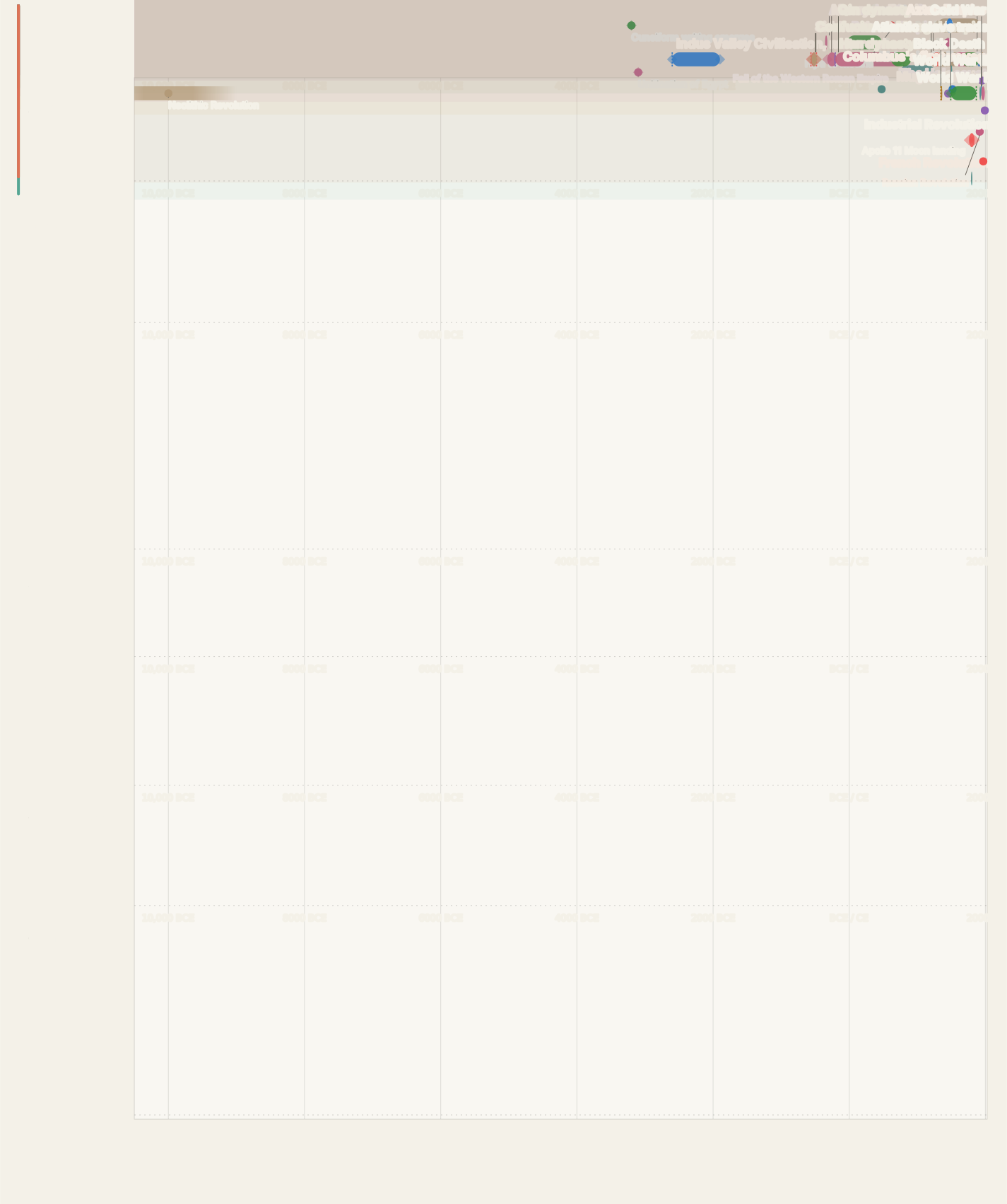
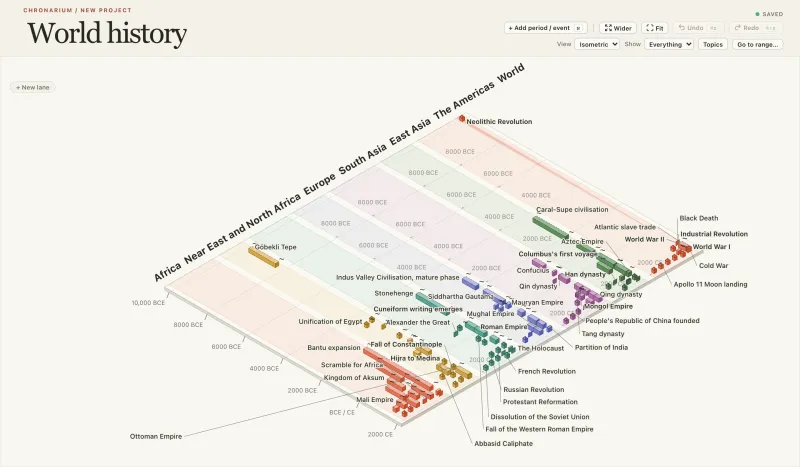
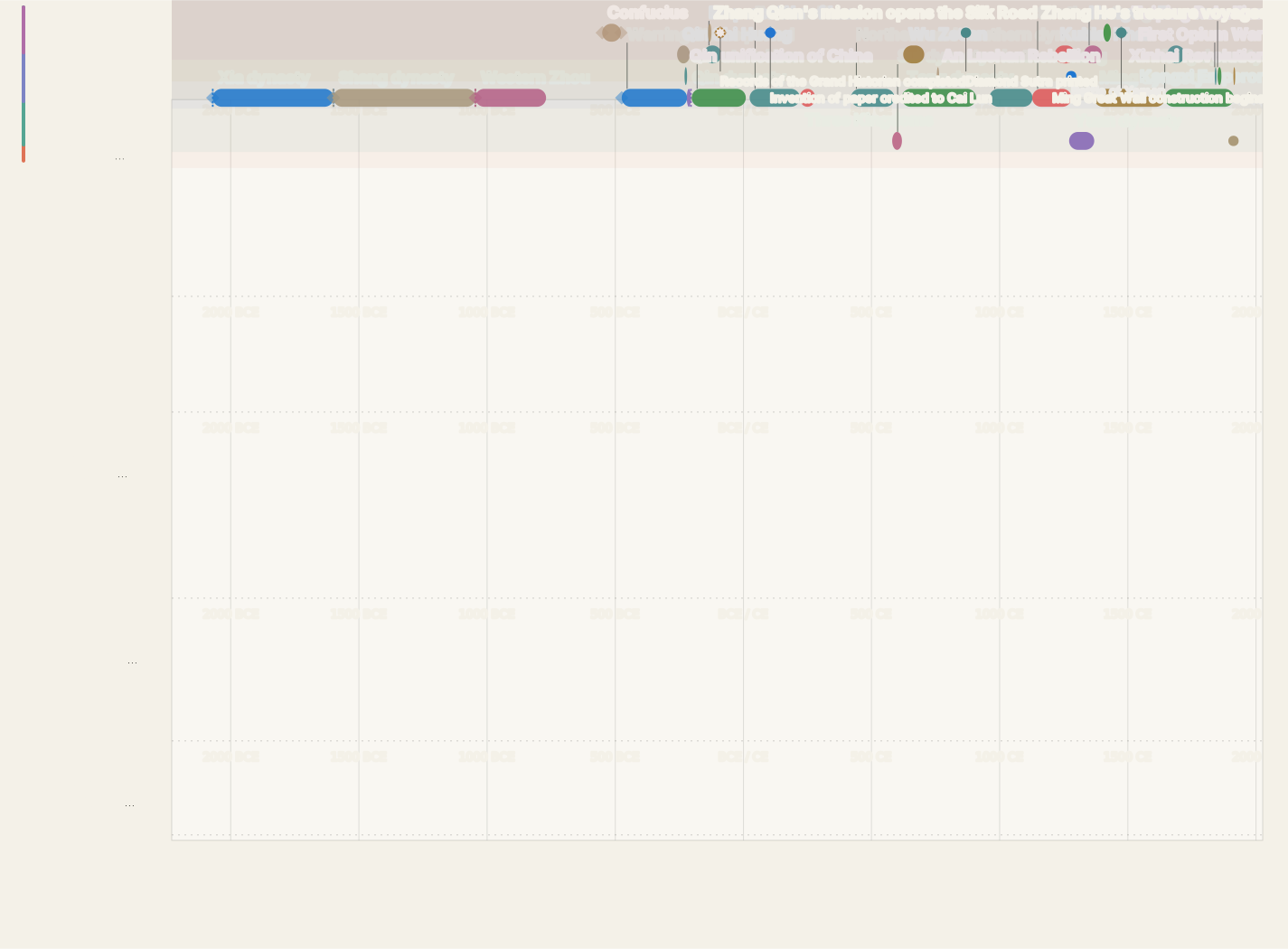
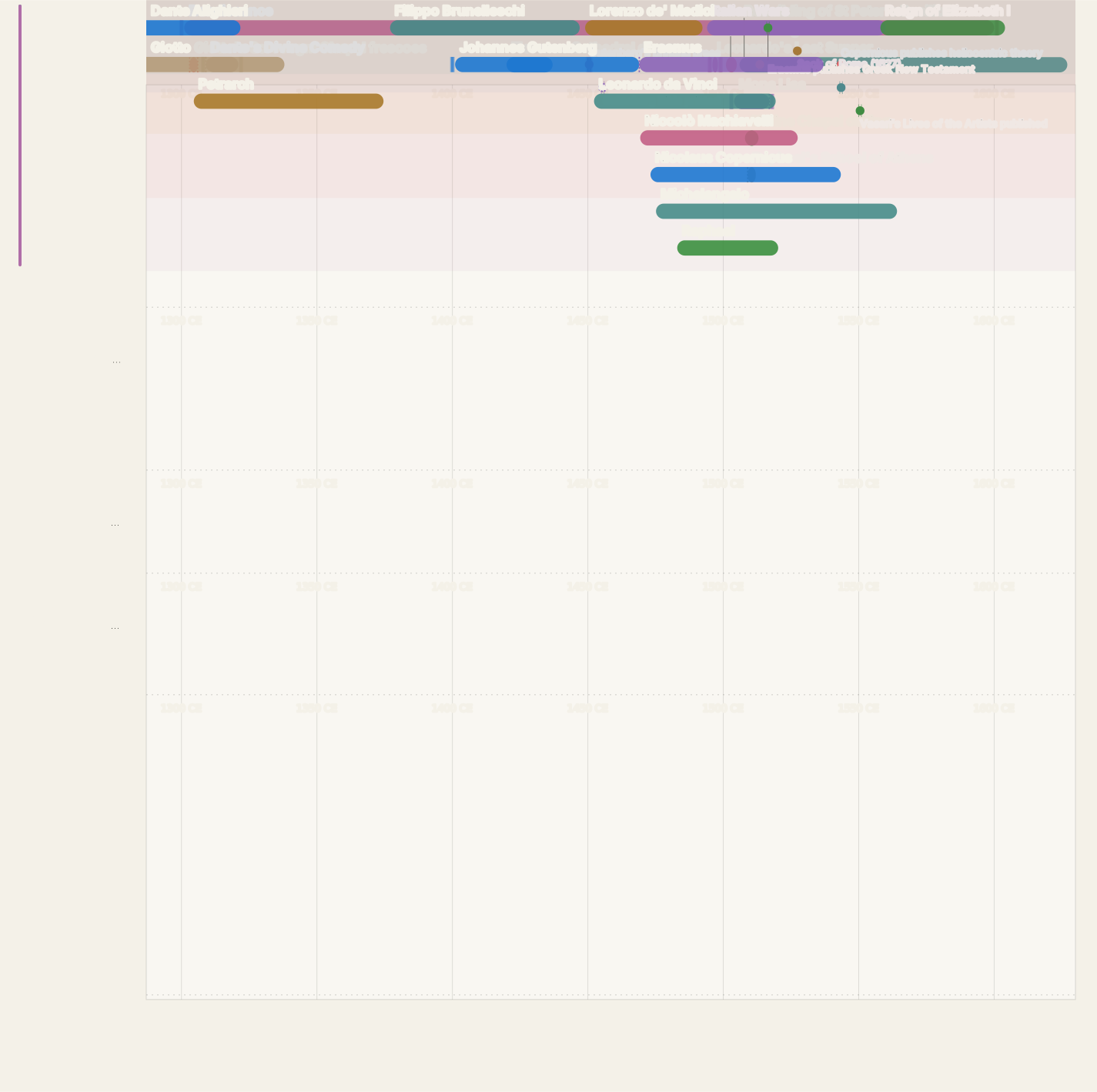
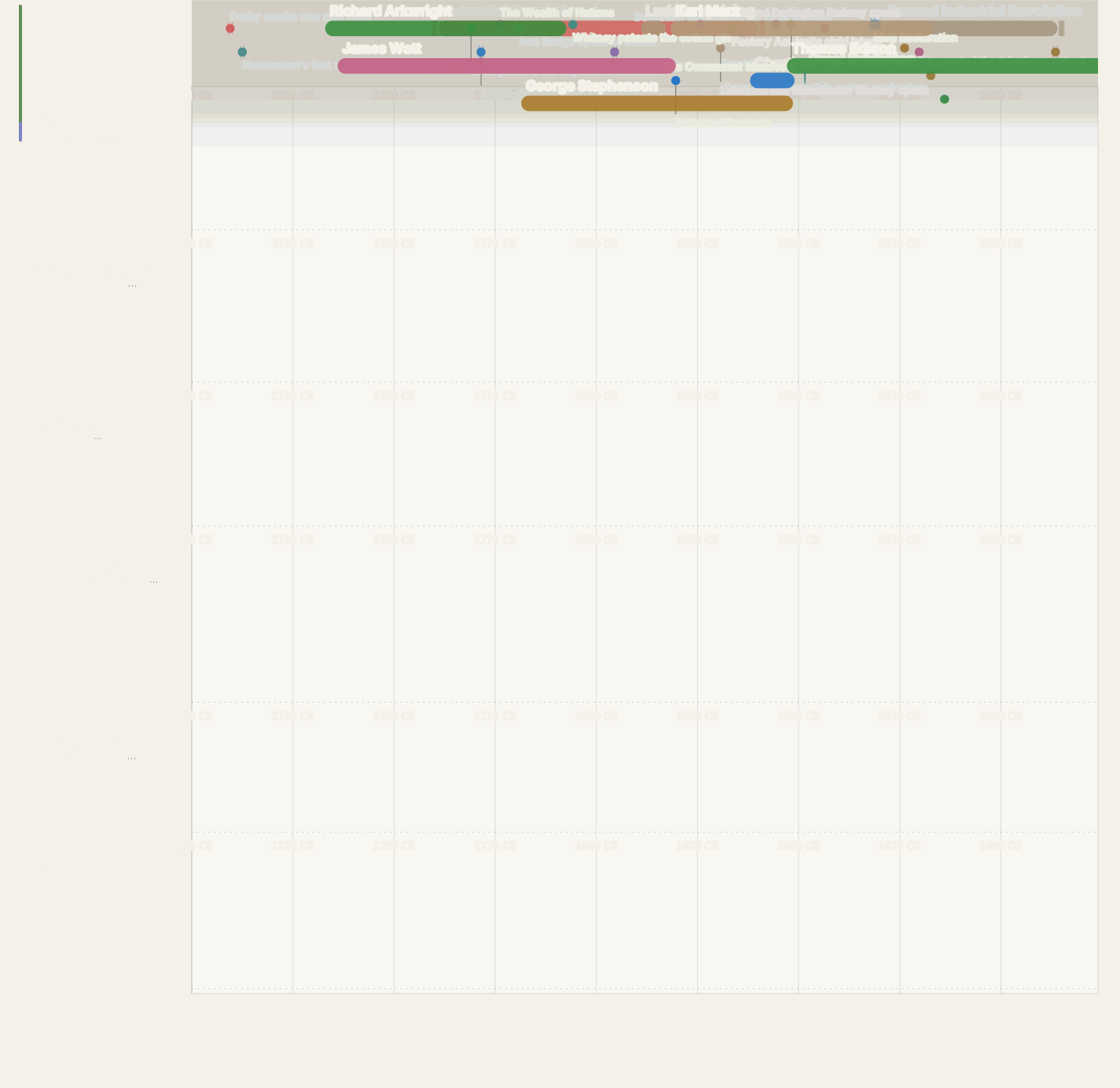
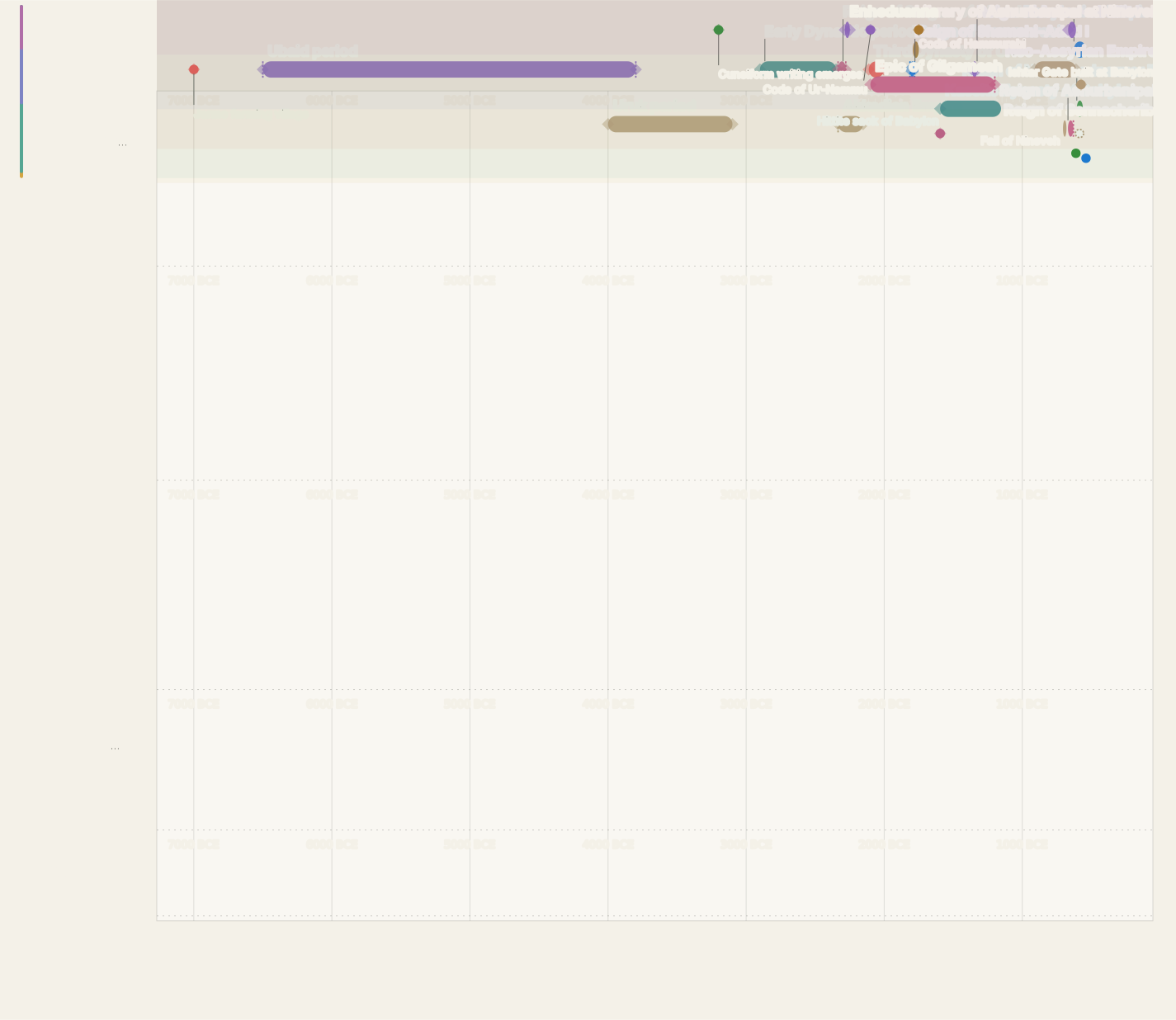
Chronarium’s picture of the World History timeline, major entries only, 10,500 BCE – 2025 CE. Lanes: Africa, Near East and North Africa, Europe, South Asia, East Asia, The Americas, World.

Loading the live app…

Show the whole picture
· made by Chronarium’s Export → Picture, Major only · open the SVG (237 KB)
In the picture: 40 of 119 entries (major only) · all 119 in the table belowPicture range: 10,500 BCE – 2025 CENot in the picture (in the table): Origin of Homo sapiens, Modern humans spread beyond Africa, Chauvet Cave paintings, Peopling of the Americas

In the table, "c." marks an approximate date, which the timeline draws with a fading band, and "?" marks a date that sources disagree on. The table below lists all 119 entries under 8 period headings.

Story

Story by period

Prehistory

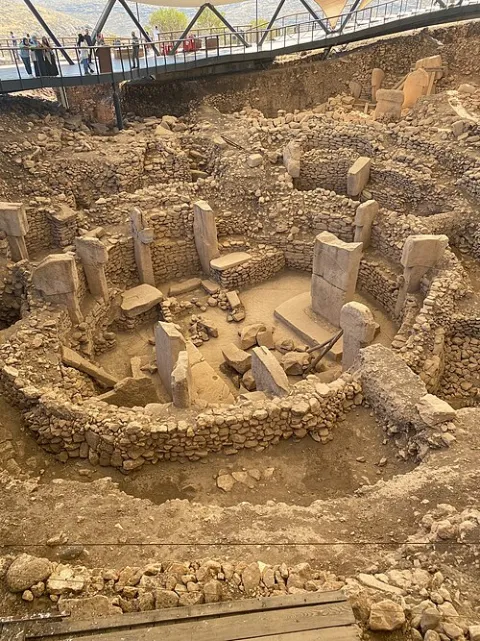
Göbekli Tepe enclosure with T-shaped pillars, photo
Göbekli Tepe enclosure with T-shaped pillars, photo, Göbekli Tepe, Şanlıurfa, TurkeyImage: TaylanOzgurUksal · CC BY-SA 4.0 · Wikimedia CommonsIn the table: Göbekli Tepe

It all began in Africa, where our species, Homo sapiens, evolved. Later, modern humans spread beyond Africa, reaching Asia, Australia and Europe. Prehistoric artists at Chauvet Cave, France, painted and engraved animals, with lions, rhinos and bears among the most common. At White Sands, New Mexico, fossil footprints show people lived in the Americas at an earlier date than many scientists had thought.

Hunter-gatherers who had not yet started farming built Göbekli Tepe, a temple site, and it challenged older assumptions about early societies. People first took up farming c. 10,000 BCE in the Middle East, starting the Neolithic Revolution. Farming led many people out of hunting and gathering and into permanent settlements. As farming communities produced more food, some people turned to specialized work, such as crafts. More food supported more people, and farming villages grew over time into towns and then cities.

The first cities and states

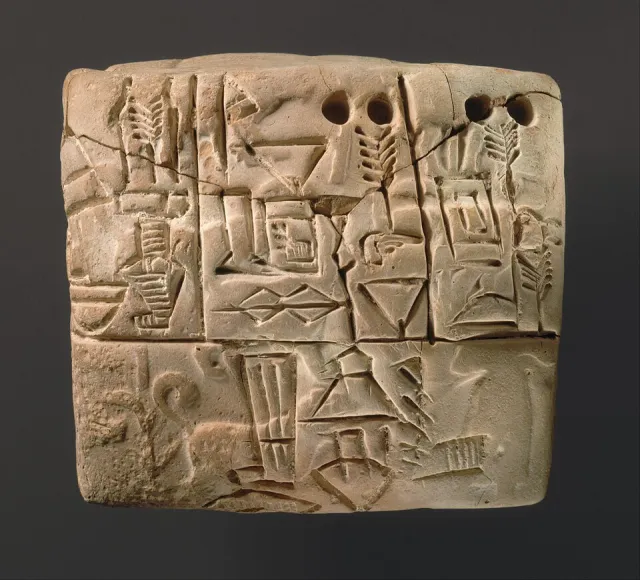
Proto-cuneiform clay tablet, barley account
Proto-cuneiform clay tablet, barley account, Metropolitan Museum of Art, New YorkImage: Metropolitan Museum of Art · CC0 · Wikimedia CommonsIn the table: Cuneiform writing emerges

In the Sumerian city of Uruk, people began recording goods on clay tablets, the start of cuneiform. According to tradition, King Menes made Upper and Lower Egypt one kingdom, founding the First Dynasty. At Giza, the Great Pyramid rose under Khufu, a 4th Dynasty king. In Indus Valley cities like Mohenjo-daro, drains served houses and streets. Caral, in Peru, was a centre of the Americas' oldest known civilisation.

Hammurabi, king of Babylon, issued 282 legal rulings covering family life, trade and similar matters. Under the Shang dynasty, Chinese writing developed, carved onto animal bones and turtle shells. Then came the Late Bronze Age collapse, which brought down great powers, the Hittite Empire among them. Blame once fell on the Sea Peoples; scholars now see several causes. Once the collapse ran its course, iron became the main metal of the Middle East and the Mediterranean, replacing bronze.

The ancient empires

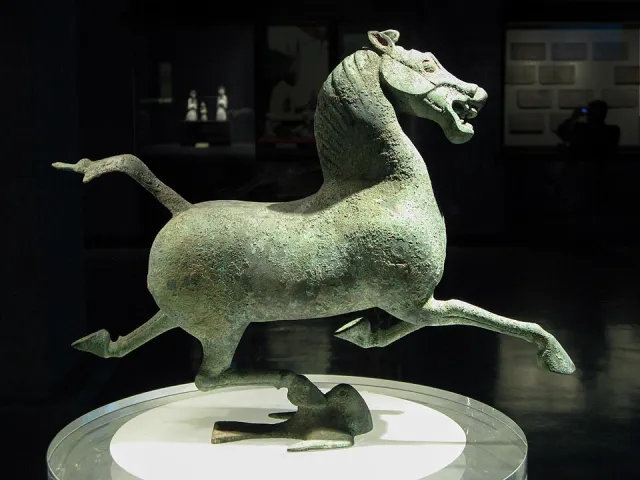
Galloping horse on a swallow, Eastern Han bronze
Galloping horse on a swallow, Eastern Han bronze, Gansu Provincial Museum, LanzhouImage: G41rn8 · CC BY-SA 4.0 · Wikimedia CommonsIn the table: Han dynasty

Under the Olmec, Mesoamerica gained its first great civilisation, thought to have shaped patterns its later peoples followed. Buddhism was founded in India by Siddhartha Gautama, the Buddha. Alexander the Great of Macedon toppled the Achaemenid Persian Empire, then extended his conquests into India. After the suffering of his Kalinga conquest, the Mauryan emperor Ashoka renounced war, then embraced Buddhism. China's first empire was founded by the Qin dynasty.

Unlike the Qin, the Han adopted Confucianism as its ideology of government. The Roman Republic then gave way to an empire under Augustus, its first emperor. In 220 CE the Han ended, and China split into three kingdoms. In 476 CE, Odoacer became king of Italy, traditionally the end of the Western Roman Empire. The empire's eastern half survived the west's fall, continuing as the Byzantine Empire.

The medieval world

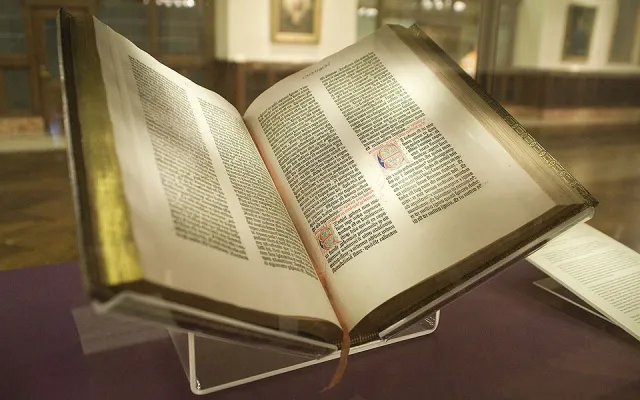
Gutenberg Bible, Lenox copy, printed book
Gutenberg Bible, Lenox copy, printed book, New York Public LibraryImage: Kevin Eng · CC BY-SA 2.0 · Wikimedia CommonsIn the table: Gutenberg's printing press

In 622 CE Muhammad moved from Mecca to Medina, and the Islamic calendar counts its years from this migration, the Hijra. In 750 CE the Abbasids overthrew the Umayyads, taking the caliphate, the Islamic empire's rule. In China, Bi Sheng invented movable type, baked clay pieces for printing. In the First Crusade, crusader armies besieged Jerusalem, captured it, and massacred many of its inhabitants. In 1206 CE Genghis Khan became leader of a tribal federation and founded the Mongol Empire.

A Mongol army seized Baghdad and executed the caliph, and the Abbasid Caliphate fell. Mansa Musa's pilgrimage to Mecca made Mali renowned for its wealth well beyond Africa, and Europe grew interested in its gold. After the Black Death, Europe lacked workers, and wages rose. The Ottoman state spread from Anatolia into southeastern Europe and took over the Balkans. Johannes Gutenberg invented a new method of printing, and it spread across Europe.

The early modern world

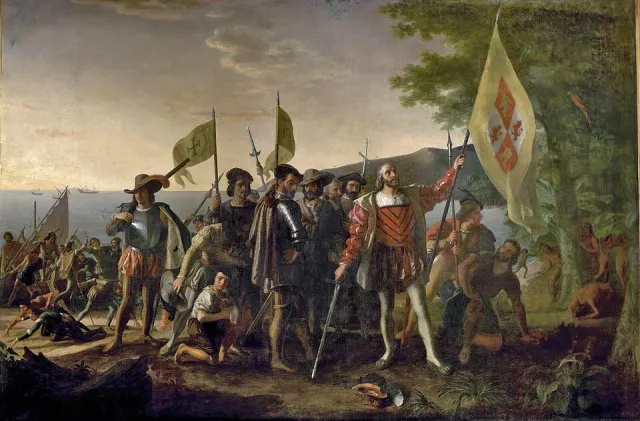
Landing of Columbus, painting
Landing of Columbus, painting, U.S. Capitol Rotunda, WashingtonImage: John Vanderlyn · Public domain · Wikimedia CommonsIn the table: Columbus's first voyage

The period opened when Mehmed II, Ottoman sultan, conquered Constantinople and ended the Byzantine Empire. On his first voyage for Spain, Christopher Columbus reached the Caribbean and claimed land for the Spanish crown. The Columbian Exchange then moved plants, animals and diseases both ways, linking the Americas with Europe and Africa. Helped by superior weapons and European diseases, Spanish forces under Hernán Cortés conquered the Aztec Empire. As sugar plantations spread across the Caribbean, demand for enslaved Africans to labor on them rose sharply.

The Protestant Reformation was later traced back to Martin Luther's Ninety-five Theses. The Mughal Empire, which had controlled the bulk of the Indian subcontinent, was declining by the 18th century. At Plassey, an East India Company force under Robert Clive defeated the Nawab of Bengal, opening Britain's rise to power in India. The Industrial Revolution began in Britain, bringing new machines and new ways of working, and spread to other countries. On 4 July 1776 CE, the Continental Congress adopted the Declaration of Independence, announcing the separation of the American colonies from Great Britain.

Revolutions and empires

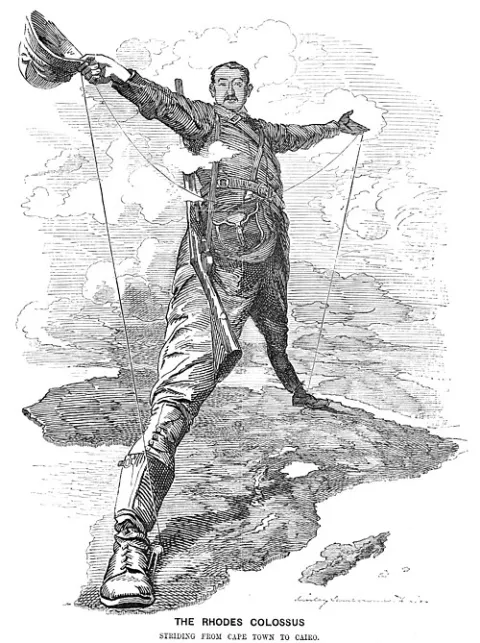
The Rhodes Colossus, Punch cartoon
The Rhodes Colossus, Punch cartoon, Cornell University Library, PJ Mode CollectionImage: Edward Linley Sambourne · Public domain · Wikimedia CommonsIn the table: Scramble for Africa

The French Revolution toppled France's monarchy and ended with Napoleon Bonaparte taking power. While the revolution unfolded, Saint-Domingue's free population split into rival camps, and the colony's enslaved people rebelled. That rebellion became the Haitian Revolution, which freed the colony's slaves and won Haiti its independence from French colonial rule. After Napoleon took control of Spain, Spain's colonies in the Americas began their wars of independence.

Britain defeated Qing China in the First Opium War and forced concessions from it. The Indian Rebellion then ended the East India Company; the British government took India over directly. China's defeat warned Japan's leaders of danger and pushed them to strengthen their country, and the Meiji Restoration of 1868 toppled the Tokugawa shogunate and carried Japan into the modern era. The Scramble for Africa gave European powers nearly the whole continent; only Ethiopia and Liberia stayed independent. Gandhi's nonviolent resistance began in South Africa; he later carried it to India.

The world wars and after

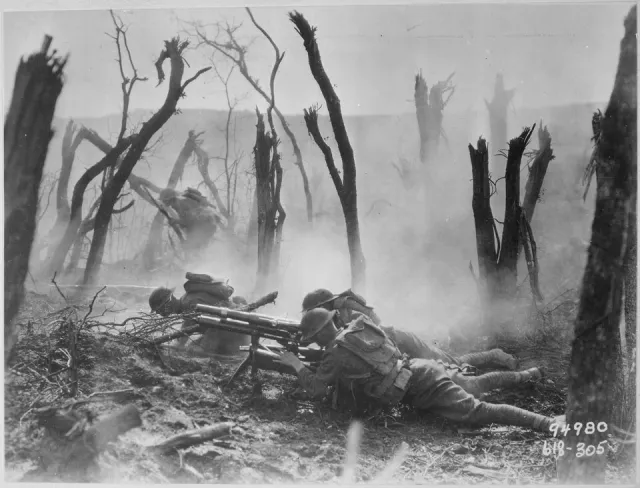
US 37mm gun crew firing in France, photograph
US 37mm gun crew firing in France, photograph, U.S. National ArchivesImage: U.S. Army Signal Corps · Public domain · Wikimedia CommonsIn the table: World War I

In World War I, the Allies, including Britain, France and Russia, fought the Central Powers, including Germany and Austria-Hungary. In 1917 CE, revolution toppled Russia's tsar, and the Bolsheviks under Vladimir Lenin seized power. The war destabilized Europe, laying the ground for World War II. The Great Depression's hardships fueled the Nazi Party's rise in Germany. Nazi Germany's invasion of Poland began World War II in Europe. In the Holocaust, Nazi Germany, with its collaborators, systematically murdered six million Jews.

The United States, the Soviet Union and their allies became Cold War rivals after World War II. Amid deadly religious violence, partition divided British India into the independent countries of India and Pakistan. Across eastern Europe, communist governments fell, and the Berlin Wall came down. Tim Berners-Lee conceived the World Wide Web so that researchers could share information.

Since 1990

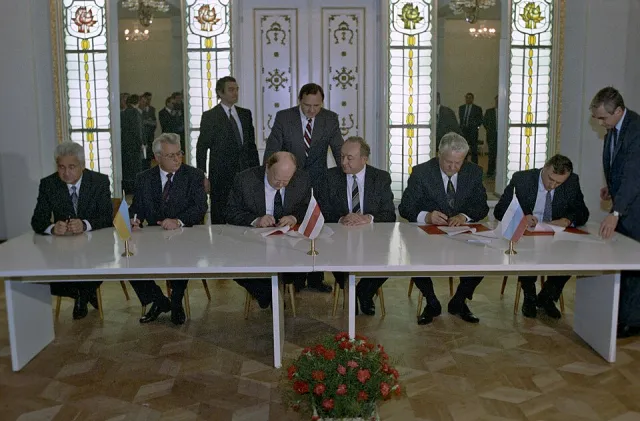
Signing of the Belovezha Accords, photograph
Signing of the Belovezha Accords, photograph, RIA Novosti archive, image 848095Image: U. Ivanov · CC BY-SA 3.0 · Wikimedia CommonsIn the table: Dissolution of the Soviet Union

The Cold War ended as the Soviet Union broke apart. In Rwanda, Hutu extremists waged a planned genocide against the Tutsi minority and those who opposed it, over about 100 days. The genocide ended after the rebel Rwandan Patriotic Front took over the country. In South Africa, elections open to every race marked apartheid's official end. Nelson Mandela won election as the country's first Black president.

On 11 September 2001 CE, al-Qaeda terrorists seized four airliners, flying two into New York's World Trade Center. The attacks brought a U.S.-led invasion of Afghanistan. A crisis in U.S. housing and mortgages caused the Great Recession, felt worldwide. On 15 September 2008 CE, Lehman Brothers filed the largest bankruptcy the United States had yet seen. Millions lost homes, savings and jobs in the financial crisis and the Great Recession.

World History timeline in Chronarium, Isometric view
Chronarium, Isometric viewall 119 entries · world-history.chronarium.json

Entries

Entries by period

c. approximate date · ? the sources give different dates · Scope the sources date different definitions of it · rows run by start date · how the dates are checked

Prehistory

c. 300,000 years ago – c. 3501 BCE · 6 entries · selective coverage
DateEventNote
c. 300 thousand years agoOrigin of Homo sapiens (World)#1, 2Our species first appears in Africa.
c. 58,000 BCEModern humans spread beyond Africa (World)#3, 4Reaching Asia, Australia, Europe.
c. 35,000 BCE–c. 26,000 BCEChauvet Cave paintings (Europe)#5, 6Cave art in the Ardèche, France.
c. 21,000 BCE?Peopling of the Americas (The Americas)#7, 8The first people reach the Americas; footprints survive at White Sands.Sources differ: University of Arizona gives over 23,000 years ago, National Geographic between 21,000 and 23,000 years ago, and U.S. Geological Survey 21,000–23,000 years ago.
c. 10,000 BCENeolithic Revolution (World)#9, 10Farming replaces foraging; Fertile Crescent among the first regions.
c. 9600 BCE?–c. 8200 BCEGöbekli Tepe (Near East and North Africa)#11, 12Hunter-gatherers raised monumental stone enclosures in southeastern Turkey.Sources differ: Start: 9600 BCE (Penn Museum, UNESCO), some 11,600 years ago (National Geographic), c. 9500 BCE (Wikipedia), c. 10000 BCE (World History Encyclopedia).

The first cities and states

c. 3500 BCE – c. 1201 BCE · 11 entries
DateEventNote
c. 3500 BCE?–c. 1800 BCECaral-Supe civilisation (The Americas)#13, 14The Americas' oldest known centre of civilisation, in Peru's Supe Valley.Sources differ: Wikipedia c.3500–c.1800 BCE; History.com roughly 3000–1800 B.C.; UNESCO 3000–1800 BCE.
c. 3200 BCECuneiform writing emerges (Near East and North Africa)#15, 16Sumerians at Uruk, in southern Mesopotamia, produce the first proto-cuneiform tablets.
c. 3100 BCEUnification of Egypt (Near East and North Africa)#17, 18Narmer (Menes) joins Upper and Lower Egypt under one rule; the First Dynasty begins.
c. 3100 BCE–c. 1500 BCEStonehenge (Europe)#19, 20A prehistoric stone monument on Salisbury Plain, England, raised in several stages.
c. 2600 BCE–c. 2560 BCEGreat Pyramid of Giza (Near East and North Africa)#21, 22Khufu's 4th Dynasty tomb
c. 2600 BCE?–c. 1900 BCEIndus Valley Civilisation, mature phase (South Asia)#23, 24The mature Harappan phase; its cities include Harappa and Mohenjo-daro.Sources differ: c. 2800–1900 BCE (World History Encyclopedia); c. 2600–1900 BCE (Wikipedia, Harappa archaeological research site).
c. 2000 BCE?–c. 1500 CE?Bantu expansion (Africa)#25, 26Bantu-speaking peoples spread from West Africa toward southern Africa.Sources differ: c. 2000 BCE–c. 1500 CE (World History Encyclopedia); c. 4,000 BC–500 AD (Wikipedia); 5,000–6,000 years ago (Max Planck Society).
c. 1750 BCECode of Hammurabi (Near East and North Africa)#27, 28The law code of Babylonian king Hammurabi, preserved on a stele found at Susa.
c. 1600 BCE?–c. 1046 BCE?Shang dynasty (East Asia)#29, 30China's second dynasty, brought down by King Wu of Zhou.Sources differ: Start and end are debated: Wikipedia cites 1554 BCE (David Pankenier) or 1766 BCE (Liu Xin) for the start, 1122 BCE for the end.
c. 1500 BCE–c. 500 BCEVedic period (South Asia)#31, 32The age in which the Vedas took shape and were set down in writing.
c. 1250 BCE–c. 1150 BCELate Bronze Age collapse (Near East and North Africa)#33, 34Major Mediterranean civilisations decline, with drought, earthquakes and invaders among the causes.

The ancient empires

c. 1200 BCE – c. 500 · 21 entries
DateEventNote
c. 1200 BCE?–c. 400 BCE?Olmec civilisation (The Americas)#35, 36A civilisation of Gulf Coast Mexico; its centres moved from San Lorenzo to La Venta.Sources differ: World History Encyclopedia: c.1200–c.400 BCE; National Geographic Education: 1200–500 B.C.E.; Metropolitan Museum of Art: c.1500–400 BCE.
c. 1070 BCE?–c. 350 CEKingdom of Kush (Africa)#37, 38Nubian kingdom in Sudan; over time its capital shifted from Napata to Meroe.Sources differ: World History Encyclopedia: c.1069 BCE–350 CE; Wikipedia: c.780 BC–c.350 AD; Metropolitan Museum of Art: c.760 BCE–350 CE.
c. 814 BCE–146 BCECarthage (Near East and North Africa)#39, 40A colony planted by Tyre's Phoenicians in North Africa; Rome destroyed it.
c. 563 BCE?–c. 483 BCE?Siddhartha Gautama (South Asia)#41, 42Founded Buddhism in India; he was a contemporary of Mahavira, though younger.Sources differ: c. 563–483 BCE (World History Encyclopedia), c. 563/480–c. 483/400 (Wikipedia), c. 560–480 (Stanford Encyclopedia of Philosophy).
c. 551 BCE–c. 479 BCEConfucius (East Asia)#43, 44A philosopher whose home was the state of Lu, in what is now Shandong.
c. 550 BCE–330 BCEAchaemenid Empire (Near East and North Africa)#45, 46Cyrus the Great founded it; Alexander the Great ended it.
c. 509 BCE–27 BCERoman Republic (Europe)#47, 48Rome after it threw out its kings; it ended when Octavian became Augustus.
c. 508 BCECleisthenes' reforms at Athens (Europe)#49, 50Reorganised Athens' citizen body, a step regarded as the founding of democracy.
356 BCE–323 BCEAlexander the Great (Europe)#51, 52Macedonian king from 336 BCE; died in Babylon at 32.
c. 322 BCE–185 BCEMauryan Empire (South Asia)#53, 54Chandragupta Maurya founded it in Magadha; its last ruler, Brihadratha, was assassinated.
c. 304 BCE–232 BCEAshoka (South Asia)#55, 56Third Mauryan ruler; reigned c. 268–232 BCE.
221 BCE–206 BCE?Qin dynasty (East Asia)#57, 58China's first imperial dynasty; Shi Huangdi brought the separate states under one rule.Sources differ: World History Encyclopedia, Asia for Educators, Columbia University and the Metropolitan Museum of Art give 206 BCE; Wikipedia and Encyclopaedia Britannica give 207 BCE.
206 BCE–220 CEHan dynasty (East Asia)#59, 58Founded by Liu Bang, with a break when the Xin dynasty briefly took over.Scope: The 206 BCE start follows sources beginning the Han dynasty at 206 BCE; the other date marks Liu Bang proclaimed emperor in 202 BCE.
c. 150 BCE–c. 750 CETeotihuacan (The Americas)#60, 61A city in central Mexico, home to the Pyramid of the Sun; its major buildings were later burned.Scope: These dates use city abandonment at c. 750 CE; the other dating marks major buildings burned at c. 550 CE or c. 600 CE.
138 BCE–126 BCEZhang Qian's mission to the West (East Asia)#62, 63Emperor Wu's envoy sought Yuezhi allies against the Xiongnu
27 BCE–476 CERoman Empire (Europe)#64, 65Augustus was the first emperor; the East survived as the Byzantine Empire until 1453.
c. 1 CE–c. 800 CE?Kingdom of Aksum (Africa)#66, 67A highland kingdom on the Red Sea coast, ruled from its capital city, Aksum.Sources differ: World History Encyclopedia and Metropolitan Museum of Art give 1st–8th century CE; Wikipedia gives 1st century–960 AD.
c. 250 CE–c. 900 CEClassic Maya civilisation (The Americas)#68, 69Lowland city-states with Long Count monuments
c. 300 CE?–c. 1250 CE?Ghana Empire (Africa)#70, 71A West African empire whose lands lay in Mauritania and Mali; the Mali Empire later absorbed it.Sources differ: World History Encyclopedia c. 500–1240 CE; Wikipedia c. 300–mid-13th century; Metropolitan Museum of Art c. 300?–1075 CE.
c. 320 CE–c. 550 CEGupta Empire (South Asia)#72, 73Based in northern India; Chandragupta I was its first sovereign ruler; Hun attacks wore it down.
476 CEFall of the Western Roman Empire (Europe)#74, 75Odoacer removed Romulus Augustulus, the last Western emperor.

The medieval world

501 – 1450 · 29 entries
DateEventNote
618 CE–907 CETang dynasty (East Asia)#76, 77Li Yuan (Gaozu) founded it; the warlord Zhu toppled Emperor Ai to end it.
622 CEHijra to Medina (Near East and North Africa)#78, 79Muhammad and Abu Bakr leave Mecca for Medina; the Islamic calendar starts here.
661 CE–750 CEUmayyad Caliphate (Near East and North Africa)#80, 81The Umayyad dynasty ruled the Islamic empire from Damascus; the Abbasids overthrew it.
750 CE–1258 CEAbbasid Caliphate (Near East and North Africa)#82, 83Took over from the Umayyads; ruled from Baghdad until a Mongol sack ended it.
c. 790 CE–c. 1100 CEViking Age (Europe)#84, 85An era of Viking raids, from the Lindisfarne attack to Harald Hardrada's death at Stamford Bridge.
c. 800 CE–c. 1400 CECahokia (The Americas)#86, 87A Mississippian city in Illinois; it reached its peak between 1050 and 1200 and was abandoned by 1400.Scope: Dates follow UNESCO dating for Cahokia site occupation, c. 800–1400; others date flourishing to 1000–1350 or c. 600–c. 1350, the city to c. 1050–1350, or first settlement to c. 600.
25 December 800 CECoronation of Charlemagne (Europe)#88, 89Pope Leo III crowned Charlemagne emperor in St Peter's, Rome.
c. 850 CE–1279 CEChola dynasty (South Asia)#90, 91Imperial Cholas of Tanjore; founded by Vijayalaya, ended under Rajendra III.
c. 900 CE?–1897 CEKingdom of Benin (Africa)#92, 93A kingdom of the Edo people in southern Nigeria, ended by the British conquest of 1897.Sources differ: Pitt Rivers Museum around 900–1897; Wikipedia 1180–1897; Städtische Museen Freiburg, Museum Natur und Mensch c. 900–1897.
960 CE–1279 CESong dynasty (East Asia)#94, 95First the Northern Song, then the Southern; the Mongols conquered it.
c. 1041 CE–c. 1048 CEBi Sheng's movable type (East Asia)#96, 97Bi Sheng, a commoner, made movable type from clay; the invention was written down by Shen Kuo.
15 July 1099 CECapture of Jerusalem in First Crusade (Near East and North Africa)#98, 99Crusaders took Jerusalem after a siege that had opened on 7 June.
c. 1100 CE–c. 1550 CE?Great Zimbabwe (Africa)#100, 101A city of granite stone near Masvingo; it was the capital of a Shona kingdom.Sources differ: World History Encyclopedia c. 1100–1550; UNESCO 1100–1450; National Geographic Education: left in the 15th century.
1113 CE?–c. 1150 CE?Angkor Wat (East Asia)#102, 103Khmer temple to Vishnu.Sources differ: World History Encyclopedia 1113–1150; Angkor National Museum 1116–1145; National Geographic: started early 12th century.
1206 CE–1368 CEMongol Empire (East Asia)#104, 105Founded by Genghis Khan; split into four khanates.Scope: Dates follow Mongol Empire 1206–1368, Genghis Khan to Yuan dynasty's fall in China; others date unity to 1260, four khanates from 1294 at Kublai Khan's death, and khanates outlasting 1368.
1206 CE–1526 CEDelhi Sultanate (South Asia)#106, 107Five dynasties in all, founded by Qutb-ud-din Aibak and ended by Babur.
c. 1235 CE?–1645 CE?Mali Empire (Africa)#108, 109West African empire of Sundiata Keita.Sources differ: World History Encyclopedia 1240–1645; Wikipedia c. 1235–1610; Encyclopaedia Africana c. 1235–1600.
February 1258 CEMongol sack of Baghdad (Near East and North Africa)#110, 111Hulagu's Mongols capture the city after a siege that began 29 January; the caliph is executed.
c. 1299 CE–1922 CEOttoman Empire (Near East and North Africa)#112, 113Osman founded this empire in Anatolia; the sultanate was abolished in 1922.
1324 CE–1325 CEMansa Musa's pilgrimage to Mecca (Africa)#114, 115The ruler of Mali journeys to Mecca by way of Cairo.
1336 CE–1646 CEVijayanagara Empire (South Asia)#116, 117Harihara and Bukka founded it; its capital at Hampi was sacked in 1565.Scope: Dates follow the empire's 1336–1646 span. Other sources take the Aravidu dynasty to 1675 or to the 17th century's end, or close the great age at Talikota in 1565.
1346 CE?–1353 CE?Black Death (World)#118, 119Pandemic that swept Eurasia, reaching Constantinople in 1347 and Moscow by 1353.Sources differ: Wikipedia and Nature (Springer Nature) give 1346 to 1353; World History Encyclopedia gives 1347 to 1352.
1368 CE–1644 CEMing dynasty (East Asia)#120, 58Zhu Yuanzhang founds it after the Mongol Yuan; the Qing follow.
c. 1390 CE–1914 CE?Kingdom of Kongo (Africa)#121, 122Central African kingdom that drew Portuguese traders from about 1482.Sources differ: Wikipedia 1390–1914, South African History Online c. 1390–1914, World History Encyclopedia 14th–19th century.
1428 CE–1521 CEAztec Empire (The Americas)#123, 124The Triple Alliance joins Tenochtitlan, Texcoco and Tlacopan; Spanish conquest ends it.
c. 1430 CE–1591 CESonghai Empire (Africa)#125, 126Empire on the Niger River, centred on Gao, defeated by Moroccan forces in 1591.Scope: Dates start with independence from Mali in the c. 1430s. Other sources date the empire c. 1460–c. 1591, or the imperial zenith 1460–1591.
1438 CE–1533 CEInca Empire (The Americas)#127, 128Pachacuti expanded this Cusco-centred Andean empire, which fell to Spanish conquest.Scope: Dates run 1438–1533, to Atahualpa's execution and Cusco's fall to Spain. Other sources end the Inca state at Atahualpa's capture in 1532, or the Vilcabamba resistance in 1572.
1443 CECreation of Hangul (East Asia)#129, 130King Sejong devises the Korean alphabet; it is promulgated in 1446.
c. 1450 CEGutenberg's printing press (Europe)#131, 132Movable-type printing begins at Mainz; the Gutenberg Bible follows in the mid-1450s.

The early modern world

1451 – 1788 · 15 entries
DateEventNote
29 May 1453 CEFall of Constantinople (Near East and North Africa)#133, 134Mehmed II's Ottomans take the city, bringing the Byzantine Empire to an end.
c. 1492 CE?–1866 CE?Atlantic slave trade (World)#135, 136Africans carried across the Atlantic to the Americas; roughly 10.7 million people survived the crossing.Sources differ: World History Encyclopedia c. 1492–1860; National Endowment for the Humanities 1526–1866; Smithsonian Magazine c. 1500–1866.
1492 CEColumbian Exchange (World)#137, 138Plants, animals and diseases move between the Old World and the Americas.
3 August 1492 CE–15 March 1493 CEColumbus's first voyage (The Americas)#139, 140Sailed from Palos with the Niña, Pinta and Santa María; reached the Bahamas on 12 October.
31 October 1517 CEProtestant Reformation (Europe)#141, 142Martin Luther sets out his ninety-five theses on indulgences at Wittenberg in Saxony.
13 August 1521 CEFall of Tenochtitlan (The Americas)#123, 143Spanish forces under Cortés take the Aztec capital after a siege.
1526 CE–1857 CEMughal Empire (South Asia)#144, 145Babur founded it after conquering Delhi; by 1857 the Mughals held only symbolic authority.Scope: Dates run 1526–1857, from Babur's taking of Delhi to the close of Mughal authority. Another Metropolitan Museum of Art catalogue dates the last emperor's formal deposition to 1858.
1543 CECopernicus publishes heliocentric theory (Europe)#146, 147De revolutionibus, printed in Nuremberg: the Earth moves around the Sun.
1603 CE–1868 CE?Tokugawa shogunate (East Asia)#148, 149The Tokugawa family's rule over Japan, the Edo period, closed with the Meiji Restoration.Sources differ: History.com 1867, World History Encyclopedia and Art Gallery of Greater Victoria 1868.
1632 CE–1653 CE?Taj Mahal (South Asia)#150, 151Agra mausoleum built by Shah Jahan for Mumtaz Mahal.Scope: These dates cover the whole complex, 1632–1653. The mausoleum alone was completed in 1648, and the commission came in 1631.Sources differ: completed 1649 (World History Encyclopedia), 1653 (Wikipedia); UNESCO: mausoleum 1648, outbuildings 1653.
1644 CE–1912 CEQing dynasty (East Asia)#152, 58The Manchu dynasty, China's last imperial one; it ends when Puyi abdicates.
23 June 1757 CEBattle of Plassey (South Asia)#153, 154Clive leads the Company army to victory over Bengal's nawab.
c. 1760 CE–c. 1840 CEIndustrial Revolution (World)#155, 156Steam-driven factories spread outward from Britain
15 August 1769 CE–5 May 1821 CENapoleon Bonaparte (Europe)#157, 158Born Ajaccio, Corsica; became French emperor; died on Saint Helena.
4 July 1776 CEAmerican Declaration of Independence (The Americas)#159, 160Jefferson's draft adopted by the Continental Congress; thirteen colonies declare independence.

Revolutions and empires

1789 – 1913 · 13 entries
DateEventNote
1789 CE–1799 CEFrench Revolution (Europe)#161, 162Upheaval in France that ends when Bonaparte seizes power in the Brumaire coup.
1791 CE–1804 CEHaitian Revolution (The Americas)#163, 164Slave uprising in Saint-Domingue ends French rule; Haiti becomes independent.
1808 CE–1826 CELatin American wars of independence (The Americas)#165, 166Spain's colonies break free, from Hidalgo's 1810 revolt to Ayacucho 1824.
1816 CE–1897 CEZulu Kingdom (Africa)#167, 168Shaka's centralised state; Anglo-Zulu War in 1879; absorbed into Natal in 1897.
1839 CE–1842 CEFirst Opium War (East Asia)#169, 170Britain's war with Qing China, closed by the Treaty of Nanjing.
1857 CE–1859 CEIndian Rebellion of 1857 (South Asia)#171, 172Sepoys rose at Meerut and seized Delhi; afterwards the Crown replaced East India Company rule.Scope: Dates follow the fighting, from Meerut, 10 May 1857, to Tantya Tope's hanging in April 1859. Canning announced peace in June 1858; some date the uprising 1857–58.
12 April 1861 CE–1865 CEAmerican Civil War (The Americas)#173, 174Union against the Confederacy, from Fort Sumter to Lee's surrender at Appomattox.
1868 CEMeiji Restoration (East Asia)#175, 149Tokugawa shogunate falls; imperial rule returns under Emperor Meiji.
2 October 1869 CE–30 January 1948 CEMahatma Gandhi (South Asia)#176, 177Born in Porbandar; led India's independence movement; assassinated in Delhi.
17 November 1869 CESuez Canal opens (Near East and North Africa)#178, 179Ferdinand de Lesseps's canal in Egypt links the Mediterranean and Red Seas.
18 January 1871 CEProclamation of the German Empire (Europe)#180, 181Wilhelm I becomes emperor at Versailles, with Prussia leading.
c. 1880 CE–1914 CE?Scramble for Africa (Africa)#182, 183European powers divided Africa among themselves, with the Berlin Conference of 1884-1885.Sources differ: 1900 (World History Encyclopedia), World War I (EBSCO), 1914 (Getty Research Institute).
1 March 1896 CEBattle of Adwa (Africa)#184, 185Menelik II's Ethiopian army defeats the invading Italians.

The world wars and after

1914 – 1989 · 19 entries
DateEventNote
1914 CE–11 November 1918 CEWorld War I (World)#186, 187Allied and Central Powers fought until an armistice ended the war.
1917 CERussian Revolution (Europe)#188, 189Uprisings in February and October brought Lenin's Bolsheviks to power.
1918 CE–1920 CE1918 influenza pandemic (World)#190, 191H1N1 flu spread across the world in several waves.
1929 CE–1941 CE?Great Depression (World)#192, 193Worldwide economic downturn; US banks collapsed in March 1933.Sources differ: 1941 (Federal Reserve History), 1939 (Wikipedia); National Gallery of Art says about 1939.
1933 CE–1945 CEThe Holocaust (Europe)#194, 195Nazi Germany persecuted and murdered Europe's Jews; about six million were murdered.Scope: Dates follow the broader definition: the murder and persecution of Europe's Jews, January 1933 to 1945. A narrower one, the 'Final Solution', dates systematic mass murder to 1941–1945.
1 September 1939 CE–2 September 1945 CEWorld War II (World)#196, 197From Germany's invasion of Poland to Japan's surrender, the Allies defeated the Axis.
1945 CE–1991 CECold War (World)#198, 199Rivalry between the US and Soviet Union, ending with the Soviet breakup.Scope: Dates run 1945-1991, ending with the USSR's dissolution, 26 December 1991. Some start with the Truman Doctrine, 12 March 1947; others end in 1989 with the Berlin Wall's fall.
24 October 1945 CEUnited Nations founded (World)#200, 201The UN Charter was signed 26 June 1945 and came into force months later.
14 August 1947 CE–15 August 1947 CEPartition of India (South Asia)#202, 203British India split into India and Pakistan, with mass migration and violence in Punjab.
14 May 1948 CEFounding of Israel (Near East and North Africa)#204, 205Declared at Tel Aviv; took effect as the Mandate ended 15 May.
1 October 1949 CEPeople's Republic of China founded (East Asia)#206, 207Mao Zedong proclaimed the republic, with Zhou Enlai as premier.
26 July 1953 CE–1 January 1959 CECuban Revolution (The Americas)#208, 209Castro's rebels, from the Moncada attack onward, overthrew Batista.
6 March 1957 CEGhana gains independence (Africa)#210, 211Nkrumah proclaimed independence from British rule, a first for sub-Saharan Africa.
4 October 1957 CESputnik 1 launched (World)#212, 213The first artificial satellite, sent up by the Soviet Union from Baikonur Cosmodrome.
20 July 1969 CEApollo 11 Moon landing (World)#214, 215Armstrong and Aldrin landed on the Moon; liftoff was 16 July.
1978 CE–1979 CEIranian Revolution (Near East and North Africa)#216, 217The Shah, Mohammad Reza Pahlavi, was overthrown; an Islamic Republic followed under Khomeini.
December 1978 CEChinese economic reforms (East Asia)#218, 219Deng Xiaoping's Third Plenum launched 'reform and opening.'
March 1989 CEWorld Wide Web proposed (World)#220, 221Tim Berners-Lee put forward the web at CERN; the first server ran in 1990.
9 November 1989 CEFall of the Berlin Wall (Europe)#222, 223East Germany opened border crossings and crowds streamed across the Wall.

Since 1990

1990 – 2008 · 5 entries
DateEventNote
26 December 1991 CEDissolution of the Soviet Union (Europe)#224, 225Gorbachev resigned on 25 December 1991; the Soviet Union was formally dissolved the next day.
7 April 1994 CE–July 1994 CERwandan genocide (Africa)#226, 227Tutsi were systematically killed in roughly 100 days; the Rwandan Patriotic Front took Kigali.
26 April 1994 CE–29 April 1994 CESouth Africa's first democratic election (Africa)#228, 229Special votes on 26 April; general polling ran 27-29 April.
11 September 2001 CESeptember 11 attacks (The Americas)#230, 231Al Qaeda hijackers flew airliners into the World Trade Center and the Pentagon.
15 September 2008 CELehman Brothers collapses (World)#232, 233Lehman Brothers filed for bankruptcy at the peak of the financial crisis.

Project file

Get this timeline in Chronarium

Open this timeline in Chronarium, the Mac app for history timelines: the project file, world-history.chronarium.json, is a free download. Chronarium's 4-week free trial includes every feature and asks only for an email address, no card.

world-history.chronarium.jsonChronarium project file · JSON · 34 KB

CC BY 4.0: free to share and adapt, with credit to Chronarium

Download the free trial

4-week free trial. Full access, no card needed.macOS 13 or later.

Available for Mac

$39 per year · $79 lifetime

4-week free trial. Full access, no card needed.

Leave your email and we'll send the download link to open on your Mac.

Sources

Sources

Each entry cites two published sources, with publisher and link below, and every date was verified against a third, independent source.

Report a correction · email support@chronarium.app with the entry's name or its # link · how the dates are checked

  1. Smithsonian National Museum of Natural History · humanorigins.si.edu/evidence/human-fossils/species/homo-sapiens
  2. Wikipedia · en.wikipedia.org/wiki/Homo_sapiens
  3. National Geographic Education · education.nationalgeographic.org/resource/their-footsteps-human-migration-out-africa
  4. Wikipedia · en.wikipedia.org/wiki/Recent_African_origin_of_modern_humans
  5. Wikipedia · en.wikipedia.org/wiki/Chauvet_Cave
  6. Archaeology Magazine (Archaeological Institute of America) · archaeology.org/issues/online/features/a-chauvet-primer
  7. University of Arizona · news.arizona.edu/news/earliest-evidence-human-activity-found-americas
  8. National Geographic · nationalgeographic.com/history/article/fossil-footprints-challenge-theory-when-people-first-arrived-americas
  9. World History Encyclopedia · worldhistory.org/Neolithic_Revolution
  10. Wikipedia · en.wikipedia.org/wiki/Neolithic_Revolution
  11. Penn Museum · penn.museum/sites/expedition/cult-as-a-driving-force-of-human-history
  12. National Geographic · nationalgeographic.com/magazine/article/gobeki-tepe
  13. Wikipedia · en.wikipedia.org/wiki/Caral%E2%80%93Supe_civilization
  14. History.com · history.com/articles/caral-peru-norte-chico-oldest-civilization-western-hemisphere
  15. World History Encyclopedia · worldhistory.org/uruk
  16. University of Texas at Austin · sites.utexas.edu/dsb/tokens/the-evolution-of-writing
  17. World History Encyclopedia · worldhistory.org/Narmer
  18. National Geographic · nationalgeographic.com/history/history-magazine/article/who-was-egypts-first-pharaoh
  19. English Heritage · english-heritage.org.uk/visit/places/stonehenge/history-and-stories/history
  20. World History Encyclopedia · worldhistory.org/Stonehenge
  21. World History Encyclopedia · worldhistory.org/Great_Pyramid_of_Giza
  22. Wikipedia · en.wikipedia.org/wiki/Great_Pyramid_of_Giza
  23. World History Encyclopedia · worldhistory.org/Indus_Valley_Civilization
  24. Wikipedia · en.wikipedia.org/wiki/Indus_Valley_Civilisation
  25. World History Encyclopedia · worldhistory.org/Bantu_Migration
  26. Wikipedia · en.wikipedia.org/wiki/Bantu_expansion
  27. Louvre · louvre.fr/en/the-code-of-hammurabi
  28. Wikipedia · en.wikipedia.org/wiki/Code_of_Hammurabi
  29. World History Encyclopedia · worldhistory.org/Shang_Dynasty
  30. Wikipedia · en.wikipedia.org/wiki/Shang_dynasty
  31. World History Encyclopedia · worldhistory.org/The_Vedas
  32. INFLIBNET Centre (UGC), Outlines of Indian History · ebooks.inflibnet.ac.in/icp01/chapter/vedic-culture
  33. World History Encyclopedia · worldhistory.org/Bronze_Age_Collapse
  34. Wikipedia · en.wikipedia.org/wiki/Late_Bronze_Age_collapse
  35. World History Encyclopedia · worldhistory.org/Olmec_Civilization
  36. National Geographic Education · education.nationalgeographic.org/resource/olmec-civilization
  37. World History Encyclopedia · worldhistory.org/Kush
  38. Wikipedia · en.wikipedia.org/wiki/Kingdom_of_Kush
  39. World History Encyclopedia · worldhistory.org/Carthage
  40. History.com · history.com/articles/punic-wars
  41. World History Encyclopedia · worldhistory.org/Buddha
  42. Wikipedia · en.wikipedia.org/wiki/The_Buddha
  43. World History Encyclopedia · worldhistory.org/confucius
  44. Stanford Encyclopedia of Philosophy · plato.stanford.edu/entries/confucius
  45. World History Encyclopedia · worldhistory.org/Achaemenid_Empire
  46. Wikipedia · en.wikipedia.org/wiki/Achaemenid_Empire
  47. History.com · history.com/articles/ancient-rome
  48. Wikipedia · en.wikipedia.org/wiki/Roman_Republic
  49. World History Encyclopedia · worldhistory.org/Cleisthenes
  50. EBSCO Research Starters · ebsco.com/research-starters/politics-and-government/reforms-cleisthenes
  51. World History Encyclopedia · worldhistory.org/Alexander_the_Great
  52. Wikipedia · en.wikipedia.org/wiki/Alexander_the_Great
  53. World History Encyclopedia · worldhistory.org/Maurya_Empire
  54. INFLIBNET Centre (UGC), Outlines of Indian History · ebooks.inflibnet.ac.in/icp01/chapter/the-mauryan-empire
  55. World History Encyclopedia · worldhistory.org/Ashoka
  56. Wikipedia · en.wikipedia.org/wiki/Ashoka
  57. World History Encyclopedia · worldhistory.org/Qin_Dynasty
  58. Asia for Educators, Columbia University · afe.easia.columbia.edu/timelines/china_timeline.htm
  59. World History Encyclopedia · worldhistory.org/Han_Dynasty
  60. World History Encyclopedia · worldhistory.org/Teotihuacan
  61. Wikipedia · en.wikipedia.org/wiki/Teotihuacan
  62. Encyclopaedia Iranica · iranicaonline.org/articles/chinese-turkestan-ii
  63. Wikipedia · en.wikipedia.org/wiki/Zhang_Qian
  64. World History Encyclopedia · worldhistory.org/Roman_Empire
  65. Wikipedia · en.wikipedia.org/wiki/Roman_Empire
  66. World History Encyclopedia · worldhistory.org/Kingdom_of_Aksum
  67. Wikipedia · en.wikipedia.org/wiki/Kingdom_of_Aksum
  68. Wikipedia · en.wikipedia.org/wiki/Maya_civilization
  69. History.com · history.com/articles/maya
  70. World History Encyclopedia · worldhistory.org/Ghana_Empire
  71. Wikipedia · en.wikipedia.org/wiki/Ghana_Empire
  72. World History Encyclopedia · worldhistory.org/Gupta_Empire
  73. INFLIBNET Centre (UGC), Outlines of Indian History · ebooks.inflibnet.ac.in/icp01/chapter/the-gupta-empire
  74. World History Encyclopedia · worldhistory.org/Odoacer
  75. Wikipedia · en.wikipedia.org/wiki/Fall_of_the_Western_Roman_Empire
  76. World History Encyclopedia · worldhistory.org/Tang_Dynasty
  77. Wikipedia · en.wikipedia.org/wiki/Tang_dynasty
  78. World History Encyclopedia · worldhistory.org/Prophet_Muhammad
  79. History.com · history.com/this-day-in-history/september-27/muhammad-completes-hegira
  80. World History Encyclopedia · worldhistory.org/Umayyad_Dynasty
  81. Wikipedia · en.wikipedia.org/wiki/Umayyad_Caliphate
  82. World History Encyclopedia · worldhistory.org/Abbasid_Dynasty
  83. Wikipedia · en.wikipedia.org/wiki/Abbasid_Caliphate
  84. World History Encyclopedia · worldhistory.org/Viking
  85. Wikipedia · en.wikipedia.org/wiki/Viking_Age
  86. National Park Service · nps.gov/articles/000/cahokia-mounds-state-historic-site-world-heritage-site.htm
  87. Wikipedia · en.wikipedia.org/wiki/Cahokia
  88. World History Encyclopedia · worldhistory.org/Charlemagne
  89. Wikipedia · en.wikipedia.org/wiki/Charlemagne
  90. INFLIBNET Centre (UGC), Outlines of Indian History · ebooks.inflibnet.ac.in/icp01/chapter/the-cholas
  91. Wikipedia · en.wikipedia.org/wiki/Chola_dynasty
  92. Pitt Rivers Museum · prm.ox.ac.uk/kingdom-benin
  93. Wikipedia · en.wikipedia.org/wiki/Kingdom_of_Benin
  94. World History Encyclopedia · worldhistory.org/Song_Dynasty
  95. Smithsonian National Museum of Asian Art · asia-archive.si.edu/learn/for-educators/teaching-china-with-the-smithsonian/explore-by-dynasty/song-dynasty
  96. Library of Congress · blogs.loc.gov/international-collections/2021/06/the-history-of-printing-in-asia-according-to-library-of-congress-asian-collections-part-1
  97. Asian Art Museum · education.asianart.org/resources/the-invention-of-woodblock-printing-in-the-tang-and-song-dynasties
  98. World History Encyclopedia · worldhistory.org/article/1254/the-capture-of-jerusalem-1099-ce
  99. History.com · history.com/this-day-in-history/july-15/jerusalem-captured-in-first-crusade
  100. World History Encyclopedia · worldhistory.org/Great_Zimbabwe
  101. National Geographic Education · education.nationalgeographic.org/resource/great-zimbabwe
  102. World History Encyclopedia · worldhistory.org/Angkor_Wat
  103. National Geographic · nationalgeographic.com/history/history-magazine/article/angkor-wat-the-worlds-biggest-religious-complex-served-two-faiths
  104. World History Encyclopedia · worldhistory.org/Mongol_Empire
  105. Wikipedia · en.wikipedia.org/wiki/Mongol_Empire
  106. Wikipedia · en.wikipedia.org/wiki/Delhi_Sultanate
  107. INFLIBNET Centre (UGC), Outlines of Indian History · ebooks.inflibnet.ac.in/icp01/chapter/the-slave-dynasty-1206-1290
  108. World History Encyclopedia · worldhistory.org/Mali_Empire
  109. Wikipedia · en.wikipedia.org/wiki/Mali_Empire
  110. World History Encyclopedia · worldhistory.org/Ilkhanate
  111. Encyclopaedia Iranica · iranicaonline.org/articles/hulagu-khan
  112. World History Encyclopedia · worldhistory.org/Ottoman_Empire
  113. National Geographic · nationalgeographic.com/history/article/why-ottoman-empire-rose-fell
  114. EBSCO Research Starters · ebsco.com/research-starters/history/mansa-musas-pilgrimage-mecca
  115. Wikipedia · en.wikipedia.org/wiki/Mansa_Musa
  116. Wikipedia · en.wikipedia.org/wiki/Vijayanagara_Empire
  117. INFLIBNET Centre (UGC), Outlines of Indian History · ebooks.inflibnet.ac.in/icp01/chapter/the-vijayanagara-empire
  118. Wikipedia · en.wikipedia.org/wiki/Black_Death
  119. World History Encyclopedia · worldhistory.org/Black_Death
  120. World History Encyclopedia · worldhistory.org/Ming_Dynasty
  121. World History Encyclopedia · worldhistory.org/Kingdom_of_Kongo
  122. Wikipedia · en.wikipedia.org/wiki/Kingdom_of_Kongo
  123. World History Encyclopedia · worldhistory.org/Aztec_Empire
  124. Wikipedia · en.wikipedia.org/wiki/Aztec_Empire
  125. World History Encyclopedia · worldhistory.org/Songhai_Empire
  126. Wikipedia · en.wikipedia.org/wiki/Songhai_Empire
  127. Wikipedia · en.wikipedia.org/wiki/Inca_Empire
  128. National Geographic Kids · kids.nationalgeographic.com/history/article/inca-civilization
  129. National Hangeul Museum · hangeul.go.kr/en/exhi/dailyExhibition.do
  130. Korea.net (Government of the Republic of Korea) · korea.net/NewsFocus/HonoraryReporters/view?articleId=190540
  131. World History Encyclopedia · worldhistory.org/Johannes_Gutenberg
  132. Wikipedia · en.wikipedia.org/wiki/Johannes_Gutenberg
  133. World History Encyclopedia · worldhistory.org/Mehmed_II
  134. British Library · bl.uk/stories/blogs/posts/the-last-day-of-constantinople
  135. World History Encyclopedia · worldhistory.org/Atlantic_Slave_Trade
  136. National Endowment for the Humanities · neh.gov/project/transatlantic-slave-trade-database
  137. World History Encyclopedia · worldhistory.org/Columbian_Exchange
  138. Wikipedia · en.wikipedia.org/wiki/Columbian_exchange
  139. EBSCO Research Starters · ebsco.com/research-starters/history/christopher-columbus-returns-spain
  140. Wikipedia · en.wikipedia.org/wiki/Voyages_of_Christopher_Columbus
  141. World History Encyclopedia · worldhistory.org/Protestant_Reformation
  142. Wikipedia · en.wikipedia.org/wiki/Reformation
  143. National Geographic Education · education.nationalgeographic.org/resource/aztec-civilization
  144. World History Encyclopedia · worldhistory.org/Mughal_Empire
  145. Smithsonian National Museum of Asian Art · asia-archive.si.edu/learn/worlds-within-worlds-imperial-paintings-from-india-and-iran/the-mughal-empire
  146. World History Encyclopedia · worldhistory.org/Nicolaus_Copernicus
  147. Wikipedia · en.wikipedia.org/wiki/De_revolutionibus_orbium_coelestium
  148. World History Encyclopedia · worldhistory.org/Tokugawa_Shogunate
  149. History.com · history.com/articles/meiji-restoration
  150. World History Encyclopedia · worldhistory.org/Taj_Mahal
  151. Wikipedia · en.wikipedia.org/wiki/Taj_Mahal
  152. World History Encyclopedia · worldhistory.org/Chinese_Emperor
  153. World History Encyclopedia · worldhistory.org/article/2107/battle-of-plassey
  154. National Army Museum · nam.ac.uk/explore/battle-plassey
  155. World History Encyclopedia · worldhistory.org/Industrial_Revolution
  156. Wikipedia · en.wikipedia.org/wiki/Industrial_Revolution
  157. World History Encyclopedia · worldhistory.org/Napoleon_Bonaparte
  158. Wikipedia · en.wikipedia.org/wiki/Napoleon
  159. Library of Congress · guides.loc.gov/declaration-of-independence
  160. American Battlefield Trust · battlefields.org/learn/articles/declaration-independence
  161. World History Encyclopedia · worldhistory.org/French_Revolution
  162. Wikipedia · en.wikipedia.org/wiki/French_Revolution
  163. U.S. Department of State, Office of the Historian · history.state.gov/milestones/1784-1800/haitian-rev
  164. Wikipedia · en.wikipedia.org/wiki/Haitian_Revolution
  165. EBSCO Research Starters · ebsco.com/research-starters/history/latin-american-wars-independence
  166. Encyclopedia.com · encyclopedia.com/history/dictionaries-thesauruses-pictures-and-press-releases/latin-american-wars-independence
  167. World History Encyclopedia · worldhistory.org/Zulu_Kingdom
  168. Wikipedia · en.wikipedia.org/wiki/Zulu_Kingdom
  169. U.S. Department of State, Office of the Historian · history.state.gov/milestones/1830-1860/china-1
  170. Wikipedia · en.wikipedia.org/wiki/First_Opium_War
  171. World History Encyclopedia · worldhistory.org/Sepoy_Mutiny
  172. National Army Museum · nam.ac.uk/subjects/indian-mutiny
  173. National Park Service · nps.gov/gett/learn/historyculture/civil-war-timeline.htm
  174. American Battlefield Trust · battlefields.org/learn/articles/brief-overview-american-civil-war
  175. World History Encyclopedia · worldhistory.org/Meiji_Restoration
  176. Library of Congress · blogs.loc.gov/international-collections/2019/09/the-150th-birth-anniversary-of-mahatma-gandhi-1869-1948
  177. Mani Bhavan Gandhi Sangrahalaya · gandhi-manibhavan.org/about-gandhi/chrono-gandhisbrithdays.html
  178. World History Encyclopedia · worldhistory.org/Suez_Canal
  179. History.com · history.com/this-day-in-history/november-17/suez-canal-opens
  180. Wikipedia · en.wikipedia.org/wiki/Unification_of_Germany
  181. Deutschlandmuseum · deutschlandmuseum.de/en/history/calendar/1871-01-18-imperial-proclamation-in-versailles
  182. World History Encyclopedia · worldhistory.org/Scramble_for_Africa
  183. EBSCO Research Starters · ebsco.com/research-starters/history/scramble-africa
  184. Wikipedia · en.wikipedia.org/wiki/Battle_of_Adwa
  185. EBSCO Research Starters · ebsco.com/research-starters/history/battle-adwa
  186. Wikipedia · en.wikipedia.org/wiki/World_War_I
  187. National WWI Museum and Memorial · theworldwar.org/learn/about-wwi/nov-11-1918
  188. Wikipedia · en.wikipedia.org/wiki/Russian_Revolution
  189. History.com · history.com/topics/russia/russian-revolution
  190. Wikipedia · en.wikipedia.org/wiki/Spanish_flu
  191. U.S. Census Bureau · census.gov/about/history/stories/monthly/2023/march-2023.html
  192. Federal Reserve History · federalreservehistory.org/essays/great-depression
  193. Wikipedia · en.wikipedia.org/wiki/Great_Depression
  194. United States Holocaust Memorial Museum · encyclopedia.ushmm.org/content/en/article/introduction-to-the-holocaust
  195. Wikipedia · en.wikipedia.org/wiki/The_Holocaust
  196. Wikipedia · en.wikipedia.org/wiki/World_War_II
  197. United States Holocaust Memorial Museum · encyclopedia.ushmm.org/content/en/article/world-war-ii-key-dates
  198. Wikipedia · en.wikipedia.org/wiki/Cold_War
  199. National Geographic · nationalgeographic.com/culture/article/cold-war
  200. United Nations · un.org/en/about-us/history-of-the-un
  201. Wikipedia · en.wikipedia.org/wiki/United_Nations
  202. The National Archives (UK) · nationalarchives.gov.uk/education/teaching-resources/partition-of-british-india
  203. Inner Temple Library · innertemplelibrary.org.uk/wp-content/uploads/2019/02/IndianPakistanIndependence.pdf
  204. U.S. Department of State, Office of the Historian · history.state.gov/milestones/1945-1952/arab-israeli-war
  205. Yale Law School Avalon Project · avalon.law.yale.edu/20th_century/israel.asp
  206. U.S. Department of State, Office of the Historian · history.state.gov/milestones/1945-1952/chinese-rev
  207. Origins (Ohio State University) · origins.osu.edu/watch/founding-prc
  208. Wikipedia · en.wikipedia.org/wiki/Cuban_Revolution
  209. Al Jazeera · aljazeera.com/news/2009/7/26/cuba-timeline-of-a-revolution
  210. U.S. National Archives · archives.gov/publications/prologue/1999/winter/us-and-ghana-1957-1966
  211. EBSCO Research Starters · ebsco.com/research-starters/history/ghana-gains-independence-united-kingdom
  212. NASA · nasa.gov/image-article/oct-4-1957-sputnik-dawn-of-space-age
  213. Wikipedia · en.wikipedia.org/wiki/Sputnik_1
  214. NASA · nasa.gov/mission/apollo-11
  215. Wikipedia · en.wikipedia.org/wiki/Apollo_11
  216. World History Encyclopedia · worldhistory.org/Iranian_Revolution
  217. History.com · history.com/articles/1979-iranian-revolution-causes
  218. Los Angeles Review of Books, China Channel · chinachannel.lareviewofbooks.org/2019/02/07/reform-opening
  219. Wikipedia · en.wikipedia.org/wiki/Chinese_economic_reform
  220. CERN · home.cern/science/computing/the-birth-of-the-web/short-history-web
  221. Wikipedia · en.wikipedia.org/wiki/World_Wide_Web
  222. History.com · history.com/topics/cold-war/berlin-wall
  223. Wikipedia · en.wikipedia.org/wiki/Berlin_Wall
  224. World History Encyclopedia · worldhistory.org/timeline/Soviet_Union
  225. Wikipedia · en.wikipedia.org/wiki/Dissolution_of_the_Soviet_Union
  226. United Nations · un.org/en/preventgenocide/rwanda/day-of-reflection.shtml
  227. Wikipedia · en.wikipedia.org/wiki/Rwandan_genocide
  228. Wikipedia · en.wikipedia.org/wiki/1994_South_African_general_election
  229. SABC Truth Commission Special Report · sabctrc.saha.org.za/glossary/april_1994_elections.htm?tab=report
  230. George W. Bush Presidential Library and Museum (National Archives) · georgewbushlibrary.gov/research/topic-guides/september-11-2001-terrorist-attacks
  231. History.com · history.com/articles/9-11-attacks
  232. EBSCO Research Starters · ebsco.com/research-starters/economics/collapse-lehman-brothers
  233. Wikipedia · en.wikipedia.org/wiki/Global_financial_crisis_of_2008