

Prehistoric Timeline

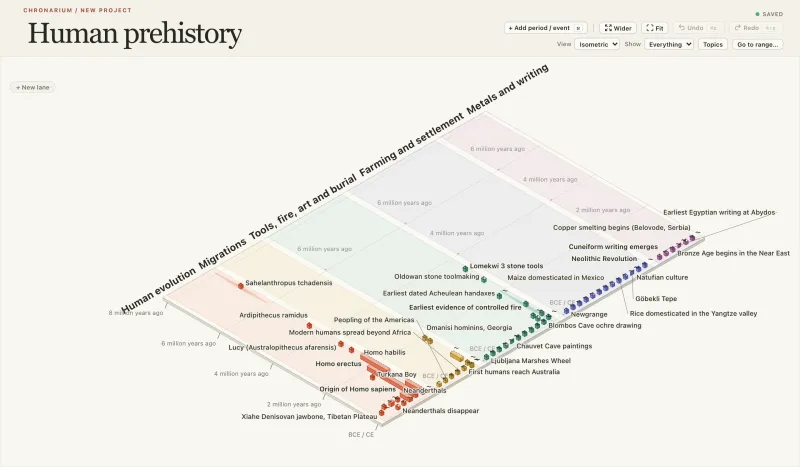
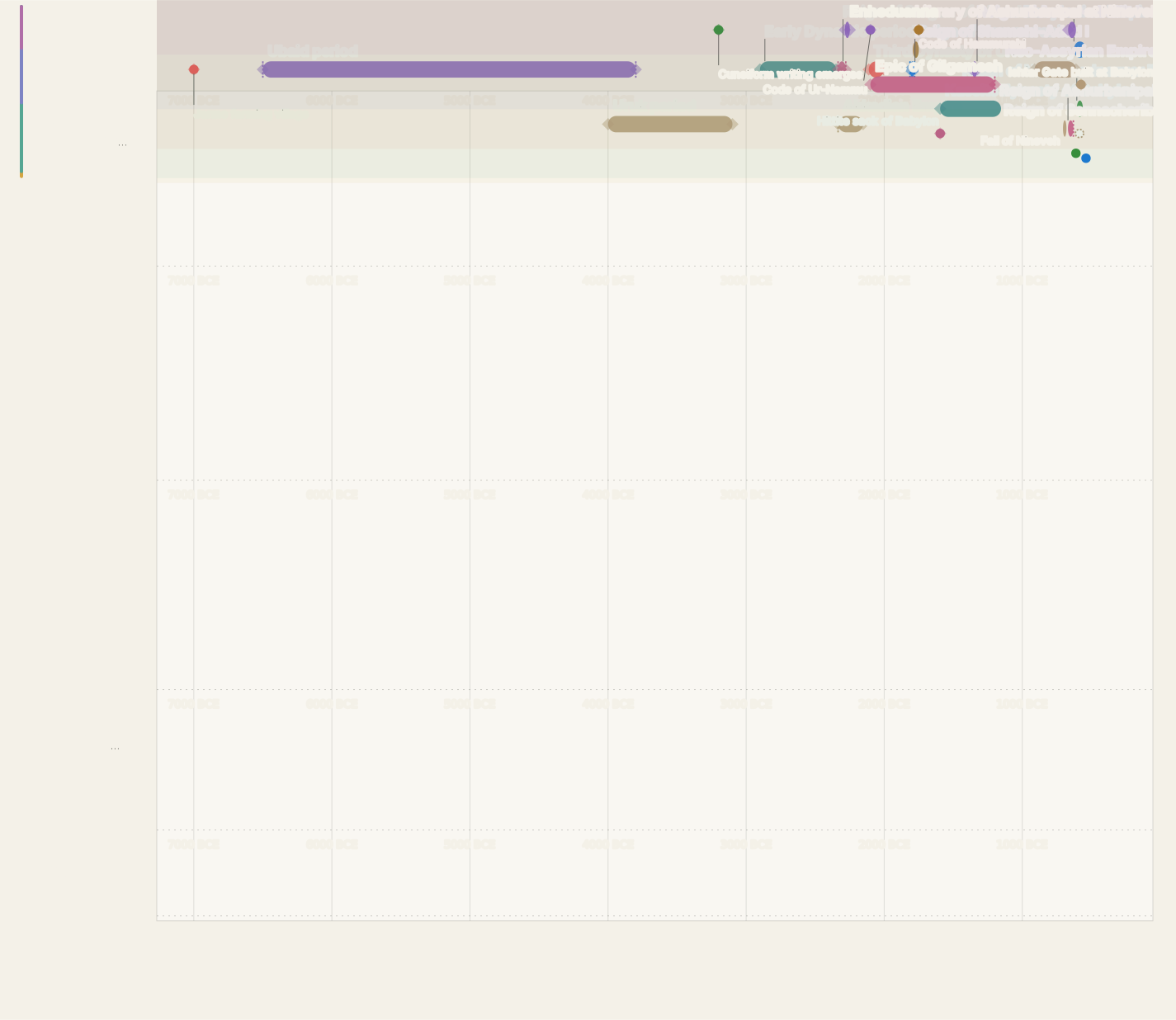
This timeline covers human prehistory from c. 7 million years ago to c. 3000 BCE, ending when the first writing appears. Five lanes run on a single time axis: Human evolution, Migrations, Tools, fire, art and burial, Farming and settlement, and Metals and writing. Because the lanes sit side by side, you can see what was happening at the same time across them.

Period covered
c. 7 million years ago – c. 3000 BCE
Entries
71
Lanes
5
Context entries
3 (to 1500 BCE)
Key dates
Chronarium’s picture of the Prehistoric timeline, major entries only, 7.28 million years ago – 2025 CE. Lanes: Human evolution, Migrations, Tools, fire, art and burial, Farming and settlement, Metals and writing.

Loading the live app…

Show the whole picture
· made by Chronarium’s Export → Picture, Major only · open the SVG (156 KB)
In the picture: 23 of 71 entries (major only) · all 71 in the table belowPicture range: 7.28 million years ago – 2025 CE

A “c.” in the table marks an approximate date, shown on the timeline with a fading band; a “?” means published sources disagree on the date. The table below groups all 71 entries under 6 period headings.

Closer view · c. 48,000 BCE – c. 3000 BCE

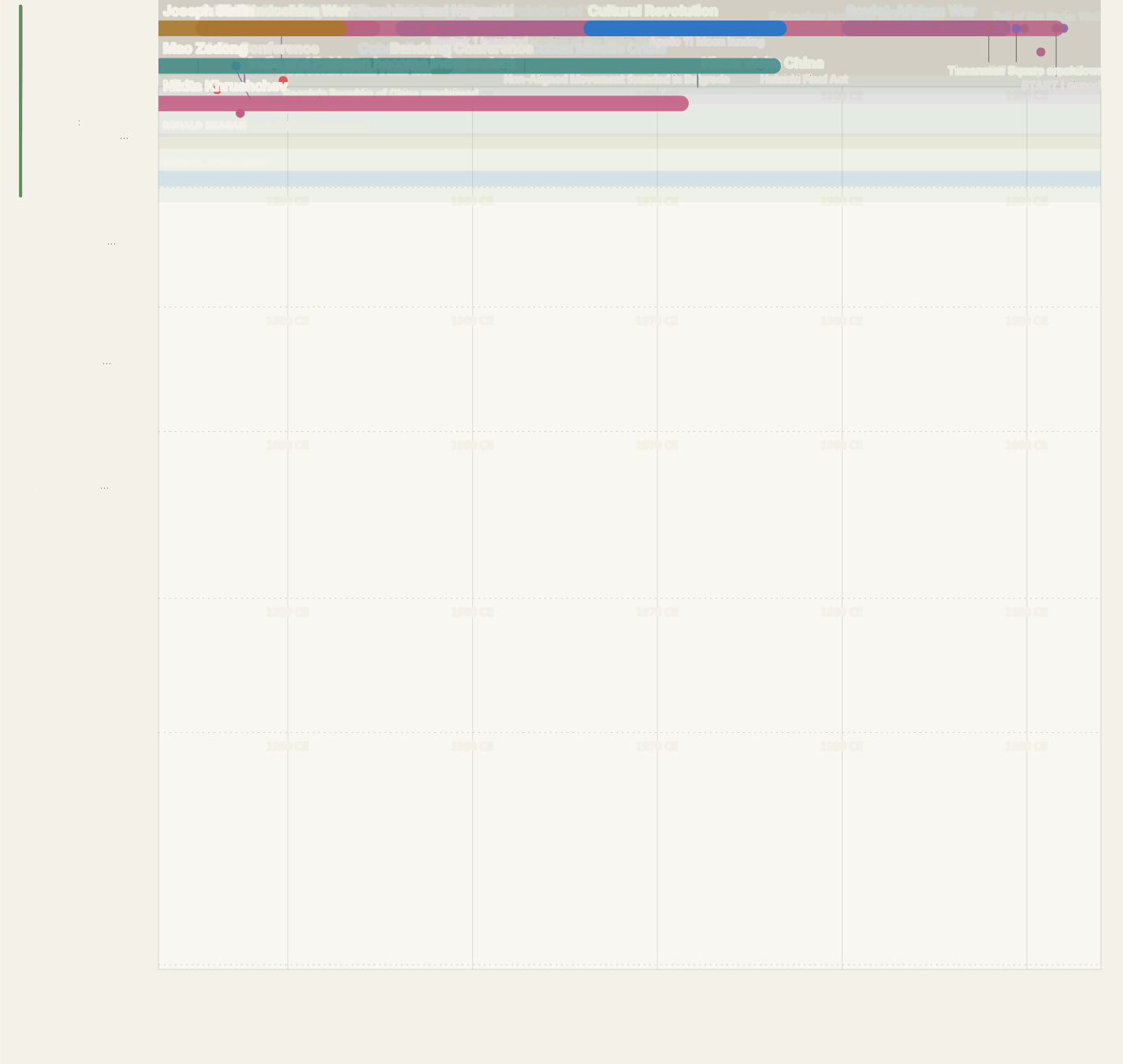
Chronarium’s picture of the Prehistoric timeline, major entries only, 49,801 BCE – 1199 BCE. Lanes: Human evolution, Migrations, Tools, fire, art and burial, Farming and settlement, Metals and writing.
Show the whole picture
· made by Chronarium’s Export → Picture, Major only · open the SVG (140 KB)
In this picture: 13 of 71 entries (major only) · all 71 in the table belowPicture range: 49,801 BCE – 1199 BCE
Not in this picture (in the table): 29 entries
  • Sahelanthropus tchadensis
  • Ardipithecus ramidus
  • Lomekwi 3 stone tools
  • Lucy (Australopithecus afarensis)
  • Ledi-Geraru jaw, earliest known Homo
  • Oldowan stone toolmaking
  • Homo habilis
  • Homo erectus
  • Dmanisi hominins, Georgia
  • Earliest dated Acheulean handaxes
  • Homo erectus on Java
  • Turkana Boy
  • Earliest evidence of controlled fire
  • Peking Man at Zhoukoudian
  • Homo heidelbergensis
  • Kalambo Falls wooden structure
  • Fire-making at Barnham, England
  • Homo naledi
  • Origin of Homo sapiens
  • Schöningen wooden spears
  • Jebel Irhoud Homo sapiens fossils
  • Misliya Cave jaw, Israel
  • Xiahe Denisovan jawbone, Tibetan Plateau
  • Shell beads at Bizmoune Cave, Morocco
  • Blombos Cave ochre drawing
  • Callao Cave foot bone (Homo luzonensis)
  • Hand stencil, Muna Island, Indonesia
  • First humans reach Australia
  • Modern humans spread beyond Africa

Closer view · c. 12,500 BCE – c. 3000 BCE

Chronarium’s picture of the Prehistoric timeline, major entries only, 12,881 BCE – 2619 BCE. Lanes: Human evolution, Migrations, Tools, fire, art and burial, Farming and settlement, Metals and writing.
Show the whole picture
· made by Chronarium’s Export → Picture, Major only · open the SVG (111 KB)
In this picture: 9 of 71 entries (major only) · all 71 in the table belowPicture range: 12,881 BCE – 2619 BCE
Not in this picture (in the table): 43 entries
  • Sahelanthropus tchadensis
  • Ardipithecus ramidus
  • Lomekwi 3 stone tools
  • Lucy (Australopithecus afarensis)
  • Ledi-Geraru jaw, earliest known Homo
  • Oldowan stone toolmaking
  • Homo habilis
  • Homo erectus
  • Dmanisi hominins, Georgia
  • Earliest dated Acheulean handaxes
  • Homo erectus on Java
  • Turkana Boy
  • Earliest evidence of controlled fire
  • Peking Man at Zhoukoudian
  • Homo heidelbergensis
  • Kalambo Falls wooden structure
  • Fire-making at Barnham, England
  • Neanderthals
  • Homo naledi
  • Origin of Homo sapiens
  • Schöningen wooden spears
  • Jebel Irhoud Homo sapiens fossils
  • Denisovans
  • Misliya Cave jaw, Israel
  • Xiahe Denisovan jawbone, Tibetan Plateau
  • Shell beads at Bizmoune Cave, Morocco
  • Homo floresiensis
  • Blombos Cave ochre drawing
  • Callao Cave foot bone (Homo luzonensis)
  • Hand stencil, Muna Island, Indonesia
  • First humans reach Australia
  • Modern humans spread beyond Africa
  • Narrative cave art, Leang Karampuang
  • Homo sapiens at Bacho Kiro Cave
  • Mungo Man burial, Lake Mungo
  • Neanderthals disappear
  • Venus of Hohle Fels
  • Chauvet Cave paintings
  • Ohalo II camp, Sea of Galilee
  • Peopling of the Americas
  • White Sands footprints, New Mexico
  • Lascaux cave paintings
  • Earliest known pottery, Xianrendong Cave

Story

Story by period

Early hominins and the Lower Paleolithic
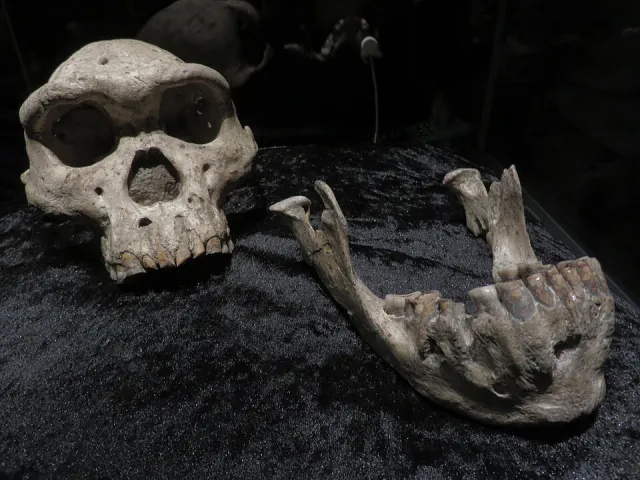
Dmanisi Skull 5, cranium and lower jaw
Dmanisi Skull 5, cranium and lower jaw, Georgian National Museum, Tbilisi; photographed at the Senckenberg Museum, FrankfurtImage: Gerbil · CC BY-SA 4.0 · Wikimedia CommonsIn the table: Dmanisi hominins, Georgia

Sahelanthropus tchadensis, a species identified from a skull unearthed in Chad, may rank among the earliest kin of humans. Ardipithecus ramidus is represented by Ardi, a partial skeleton that combined upright walking with life in the trees. Another upright walker was Lucy, an Australopithecus afarensis from c. 3.2 million years ago. Stone tools from beside Kenya's Lake Turkana go back to c. 3.3 million years ago. Ethiopia yielded a lower jaw, the earliest Homo fossil known, from c. 2.8 million years ago.

The Oldowan toolkit, among the earliest stone tool industries, featured hammerstones and simple stone cores. Homo habilis took the name "handy man", and simple stone tools turned up with its fossils. Homo erectus, the first human species with body proportions like ours, could walk far, and early humans spread out of Africa. Fossils from Dmanisi, in Georgia, offered some of the oldest evidence for early humans beyond Africa. Homo erectus also became the first human species to craft Acheulean handaxes, a major step forward for stone tools. Its fossils include finds on Java, in Indonesia, and Peking Man, from China.

Among the earliest signs that human ancestors used fire is wood ash found at Wonderwerk Cave in South Africa, dating to c. 1 million years ago. Populations of Homo erectus most likely evolved into later species such as Homo heidelbergensis, a hunter that butchered large animals, including horses and rhinos. Fire-making left its oldest clear traces at Barnham, England, c. 400 thousand years ago, where probably early Neanderthals were at work. From Jebel Irhoud, Morocco, c. 315 thousand years ago, come the earliest known remains thought to be Homo sapiens. Homo heidelbergensis is seen by many researchers as the shared ancestor of Neanderthals and Homo sapiens, with the step to Homo sapiens taken in Africa.
The Middle Paleolithic

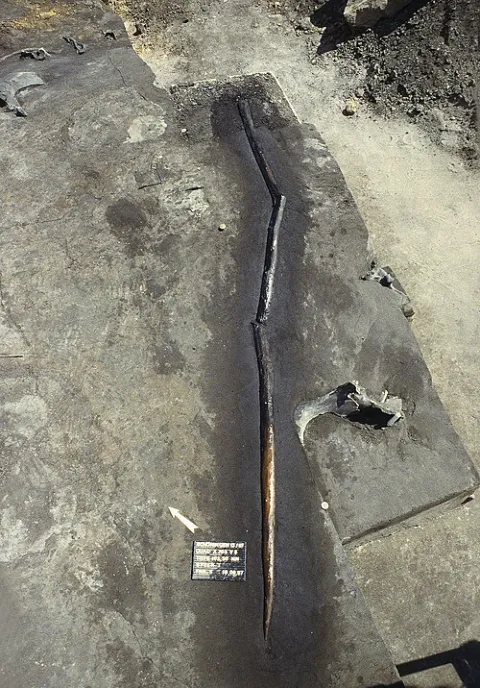
Schöningen spear VII where it was found, 1997
Schöningen spear VII where it was found, 1997, Schöningen, Lower Saxony, GermanyImage: P. Pfarr NLD · CC BY-SA 3.0 de · Wikimedia CommonsIn the table: Schöningen wooden spears

At Schöningen in Germany, archaeologists uncovered the earliest complete wooden hunting weapons that anyone knows of. A jawbone from Misliya Cave in Israel shows some Homo sapiens had already left Africa far sooner than scholars once thought. On Flores in Indonesia lived Homo floresiensis, a tiny species nicknamed the 'hobbit'. In Morocco, shell beads from Bizmoune Cave were likely worn as identity markers, and someone at Blombos Cave in South Africa drew a cross-hatched pattern in red ochre, the oldest drawing known.

The oldest known rock art is a hand stencil from a cave on Muna Island, Indonesia, and its makers likely belonged to the modern human population that later reached Australia. A drying climate may have helped drive modern humans out of Africa. Earlier groups that left had little lasting success, and nearly all people outside the continent descend from a later wave. A cave painting at Leang Karampuang on Sulawesi is the oldest known art to tell a story. As modern humans spread beyond Africa, they interbred with Neanderthals and Denisovans.

The Upper Paleolithic

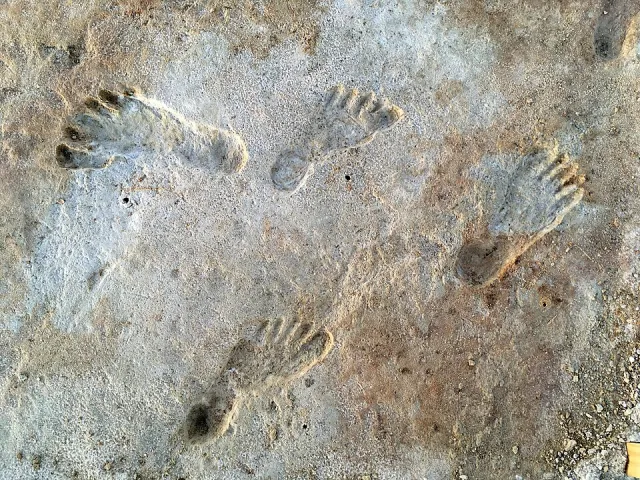
Fossil human footprints at White Sands
Fossil human footprints at White Sands, White Sands National Park, New MexicoImage: National Park Service · Public domain · Wikimedia CommonsIn the table: White Sands footprints, New Mexico

In Bulgaria, Bacho Kiro Cave held remains and ornaments of some of the earliest modern humans known in Europe. All had recent Neanderthal ancestors. In Australia, Mungo Man was buried at Lake Mungo, red ochre on his body. The Neanderthals died out soon after modern humans reached Europe. A German cave yielded the Venus of Hohle Fels, a woman carved from mammoth ivory. At Chauvet Cave in France, most painted animals were formidable: lions, rhinoceroses and bears.

Footprints at White Sands, New Mexico, were among the oldest signs of people in the Americas, earlier than once thought. Later, cave art at Lascaux in France showed mostly bison, horses, deer, aurochs and ibex. Xianrendong Cave in China yielded the oldest known pottery. Hunter-gatherers in East Asia made pottery thousands of years before farming took hold there, and at Ohalo II in Israel, people were already using wheat and barley grains long before crops were cultivated. Then, after the last Ice Age, people adapted these ways of life to new environments, a stage known as the Mesolithic.

The end of the Ice Age and the first farming

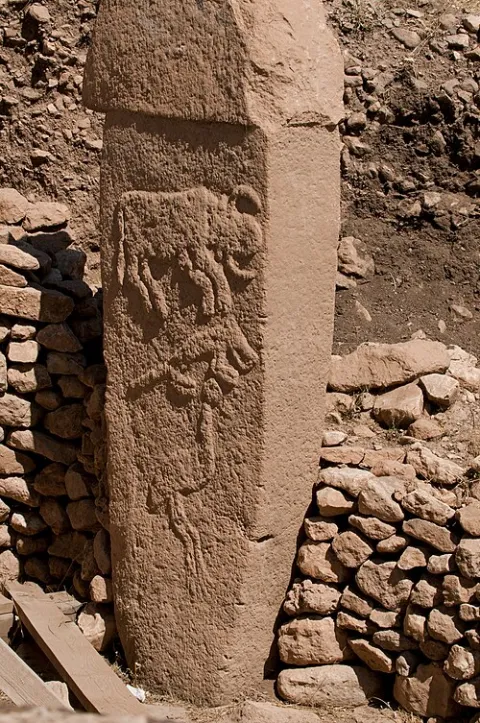
T-shaped pillar with animal reliefs
T-shaped pillar with animal reliefs, Göbekli Tepe, Şanlıurfa, TurkeyImage: Teomancimit · CC BY-SA 3.0 · Wikimedia CommonsIn the table: Göbekli Tepe

The last Ice Age ended; some scholars think the changing climate helped bring about farming. In North America, Clovis people made fluted spear points, hunting mammoths and other big game. A recent study argues southern Chile's Monte Verde is far younger than long thought. Natufian foragers of the Levant relied on wild cereals but likely did not yet farm. In the Middle East, farming first began c. 10,000 BCE, as people learned to cultivate crops and keep livestock. Hunter-gatherers had already built Göbekli Tepe, a monumental ritual site, challenging old ideas about the rise of complex societies.

Settlers at Jericho built a large stone tower and surrounded their settlement with a large stone wall. Farming began in China too, where people domesticated millet and rice first. Farming led many people into permanent communities and away from the hunter-gatherer life. At Çatalhöyük, houses were packed so tightly that people entered through roof openings. By the period's end, farming and permanent villages were firmly established across the Middle East, and from there farming, along with herd animals such as goats, began to spread into Europe.

The spread of farming and the Copper Age

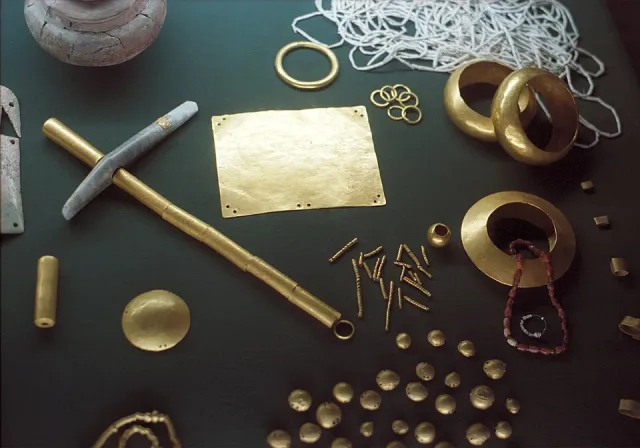
Gold grave goods from the Varna cemetery
Gold grave goods from the Varna cemetery, Varna Archaeological Museum, BulgariaImage: Zde · CC BY-SA 4.0 · Wikimedia CommonsIn the table: Varna Necropolis

Farming reached Europe's southeast first, its centre and north thousands of years later. Farmers of the Linear Pottery culture covered much of central Europe. In Mexico, teosinte, a wild grass of the Balsas River valley, was domesticated into maize. Indigenous farmers in the Andes domesticated the potato, a staple food of South America. South Asia's northwest saw its earliest known farming evidence at Mehrgarh, in Balochistan, Pakistan. In the New Guinea highlands, farming arose independently, based on bananas, taro and yam at Kuk Swamp and other sites.

By c. 5000 BCE, people in southeastern Europe were smelting copper from ore, perhaps inventing the technique independently; the earliest known smelting site lay in Serbia. At Varna in Bulgaria, a few graves held gold and other lavish goods, early evidence of social hierarchy. Malta's megalithic temples, including Ġgantija on Gozo, ranked among the world's oldest free-standing stone buildings. Altars and animal bones found there suggest rituals that likely included animal sacrifice. This Chalcolithic stage of copper working led toward the Bronze Age, when copper was combined with tin to make bronze. In southern Mesopotamia, Uruk grew into a true city, the largest in the region.

The Bronze Age and the first writing

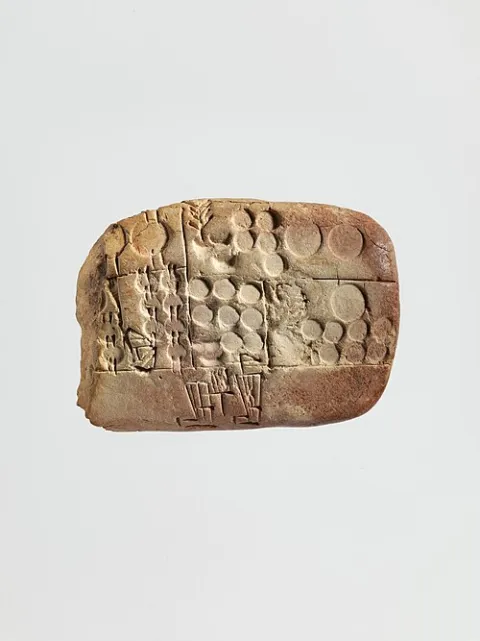
Proto-cuneiform tablet, barley and emmer account
Proto-cuneiform tablet, barley and emmer account, Metropolitan Museum of Art, New YorkImage: Metropolitan Museum of Art · CC0 · Wikimedia CommonsIn the table: Cuneiform writing emerges

In Mesopotamia, bronze began replacing copper for tools and weapons. The same age produced the wheel. Writing appeared c. 3200 BCE in Mesopotamia, and Uruk is known as its birthplace. It grew from accounting: the need to track goods and payments brought records on clay tablets. Because names were hard to render with picture signs, writers used signs for sounds. Egypt's earliest known writing, hieroglyphs on seals and on small labels, comes from Abydos.

In the Alps, an arrow struck a man now called Ötzi, who probably bled to death. At Newgrange in Ireland, solstice sunlight still travels the tomb's passage into its inner chamber. Skara Brae's Orkney villagers built stone houses and stone furniture. The Americas' oldest known civilisation built Caral in Peru's Supe Valley. Stonehenge, built and rebuilt in stages over many centuries, tracks society's move from the New Stone Age into the Bronze Age. Writing made written history possible; before it, people left objects and other remains rather than written records of their lives.

Prehistoric timeline in Chronarium, Isometric view
Chronarium, Isometric viewall 71 entries · prehistory.chronarium.json

Entries

Entries by period

c. approximate date · ? the sources give different dates · Scope the sources date different definitions of it · rows run by start date · how the dates are checked

Early hominins and the Lower Paleolithic

c. 7,000,000 years ago – c. 300,001 years ago · 20 entries
DateEventNote
c. 7 million years agoSahelanthropus tchadensis (Human evolution)#1, 2The Toumaï skull from Chad, a candidate for the earliest known hominin.
c. 4.4 million years agoArdipithecus ramidus (Human evolution)#3, 4The skeleton known as Ardi, from Ethiopia's Middle Awash.
c. 3.3 million years agoLomekwi 3 stone tools (Tools, fire, art and burial)#5, 6Found by Lake Turkana in Kenya; the oldest stone tools known anywhere.
c. 3.2 million years agoLucy (Australopithecus afarensis) (Human evolution)#7, 8Found at Hadar in 1974; a skeleton that walked upright.
c. 2.8 million years agoLedi-Geraru jaw, earliest known Homo (Human evolution)#9, 10From the Afar region of Ethiopia; the oldest fossil assigned to Homo.
c. 2.6 million years ago?Oldowan stone toolmaking (Tools, fire, art and burial)#11, 12Early African toolkit of hammerstones, cores and sharp cutting flakes.Sources differ: Smithsonian 2.6 million years ago or earlier; Wikipedia starts 2.9 million; The University of British Columbia 3.0–2.6 million.
c. 2.4 million years ago–c. 1.4 million years ago?Homo habilis (Human evolution)#13, 14Early toolmaker from East and southern Africa, nicknamed "handy man".Sources differ: Smithsonian National Museum of Natural History 2.4–1.4 million years ago; Wikipedia 2.4–1.65 million; Australian Museum 2.3–1.5 million.
c. 1.9 million years ago–c. 110 thousand years agoHomo erectus (Human evolution)#15, 16A widespread human species whose remains appear alongside Acheulean tools from Africa to western and East Asia.
c. 1.8 million years agoDmanisi hominins, Georgia (Migrations)#17, 18The earliest firmly dated human fossils found beyond Africa.
c. 1.76 million years agoEarliest dated Acheulean handaxes (Tools, fire, art and burial)#15, 19From West Turkana in Kenya; the toolkit had handaxes and cleavers.
c. 1.6 million years agoHomo erectus on Java (Migrations)#16, 20Fossils from Sangiran and Mojokerto, Indonesia, in the region known for Java Man.
c. 1.5 million years agoTurkana Boy (Human evolution)#21, 22The most complete skeleton of Homo erectus known, found at Nariokotome, Kenya.
c. 1 million years agoEarliest evidence of controlled fire (Tools, fire, art and burial)#23, 24Burned bone and wood ash at Wonderwerk Cave, South Africa, point to early fire use.
c. 780 thousand years ago–c. 400 thousand years ago?Peking Man at Zhoukoudian (Migrations)#25, 26Fossils of Homo erectus found near Beijing, China.Sources differ: Smithsonian National Museum of Natural History 780,000-400,000 years; Wikipedia 800,000-230,000 years; Natural History Museum, London 780,000-400,000 years.
c. 700 thousand years ago?–c. 200 thousand years ago?Homo heidelbergensis (Human evolution)#27, 28Late Acheulean toolmakers who lived across Europe and Africa.Sources differ: Smithsonian National Museum of Natural History about 700,000-200,000 years; Wikipedia 0.7-0.3 Ma; Australian Museum 600,000-300,000 years.
c. 476 thousand years agoKalambo Falls wooden structure (Tools, fire, art and burial)#29, 30In Zambia; the earliest known use of wood as a structure; the age is a minimum.
c. 400 thousand years agoFire-making at Barnham, England (Tools, fire, art and burial)#23, 31A hearth with pyrite in Suffolk; the oldest firm evidence of making fire.
c. 400 thousand years ago?–c. 38,000 BCE?Neanderthals (Human evolution)#32, 33Archaic humans who lived across Europe and western Asia.Sources differ: Start about 400,000 years ago (Smithsonian National Museum of Natural History; Natural History Museum, London), 240,000 (Wikipedia), 300,000 (Australian Museum); about 40,000 (Smithsonian; Wikipedia; Natural History Museum), 28,000 (Australian Museum).
c. 335 thousand years ago–c. 236 thousand years agoHomo naledi (Human evolution)#34, 35A small-brained human species from the Rising Star cave in South Africa.
c. 315 thousand years agoJebel Irhoud Homo sapiens fossils (Human evolution)#36, 37From Morocco; the earliest known fossils of Homo sapiens.

The Middle Paleolithic

c. 300,000 years ago – c. 48,001 BCE · 13 entries
DateEventNote
c. 300 thousand years agoOrigin of Homo sapiens (Human evolution)#38, 39Our species, Homo sapiens, first appears in Africa.
c. 300 thousand years ago?Schöningen wooden spears (Tools, fire, art and burial)#40, 41The oldest known complete wooden hunting weapons, found in Lower Saxony, Germany.Sources differ: Wikipedia gives 337,000–300,000 years, Forschungsmuseum Schöningen about 300,000 years ago, Leibniz-Zentrum für Archäologie about 200,000 years ago.
c. 200 thousand years ago–c. 30,000 BCE?Denisovans (Human evolution)#42, 43An archaic human group known mainly from DNA, from the Altai Mountains to the Tibetan Plateau.Scope: Dates follow Denisovan populations documented by fossils and DNA. A wider definition dates the lineage itself to 400,000 years ago or earlier.Sources differ: Wikipedia 200,000–32,000; World History Encyclopedia 200,000–55,000; Natural History Museum at least 400,000, perhaps until 30,000.
c. 185 thousand years agoMisliya Cave jaw, Israel (Migrations)#44, 45An upper jaw of early Homo sapiens, found on Mount Carmel.
c. 160 thousand years agoXiahe Denisovan jawbone, Tibetan Plateau (Human evolution)#46, 47From Baishiya Karst Cave in Gansu; a Denisovan found beyond the Altai; the age is a minimum.
c. 142 thousand years agoShell beads at Bizmoune Cave, Morocco (Tools, fire, art and burial)#48, 49Sea-snail shells with holes; the oldest shell beads known; the age is a minimum.
c. 100 thousand years ago–c. 48,000 BCEHomo floresiensis (Human evolution)#50, 51A small-bodied human species from Liang Bua cave on Flores, Indonesia.
c. 71,000 BCEBlombos Cave ochre drawing (Tools, fire, art and burial)#52, 53A cross-hatched drawing in ochre crayon on stone, from South Africa.
c. 65,800 BCEHand stencil, Muna Island, Indonesia (Tools, fire, art and burial)#54, 55From Liang Metanduno on Muna Island; the oldest hand stencil yet dated; the age is a minimum.
c. 65,000 BCE?Callao Cave foot bone (Homo luzonensis) (Human evolution)#56, 57A foot bone from Luzon, Philippines; the oldest human fossil yet found there.Sources differ: Springer Nature and Wikipedia about 67,000; Natural History Museum originally 67,000 but possibly at least 130,000.
c. 63,000 BCE?First humans reach Australia (Migrations)#58, 59Madjedbebe rock shelter in the Northern Territory holds the earliest dated occupation in Australia.Sources differ: minimum 65,000 years (Springer Nature, The University of Queensland) or 50,000-65,000 (Wikipedia)
c. 58,000 BCEModern humans spread beyond Africa (Migrations)#60, 61Homo sapiens move out of Africa and reach Asia, Australia and Europe.
c. 49,200 BCENarrative cave art, Leang Karampuang (Tools, fire, art and burial)#62, 63Sulawesi painting of people and a pig; the oldest known narrative scene, its age a minimum.

The Upper Paleolithic

c. 48,000 BCE – c. 12,501 BCE · 10 entries
DateEventNote
c. 43,000 BCEHomo sapiens at Bacho Kiro Cave (Migrations)#64, 65Europe's oldest directly dated Homo sapiens finds, from a Bulgarian cave.
c. 40,000 BCEMungo Man burial, Lake Mungo (Tools, fire, art and burial)#66, 67Australia's oldest human remains
c. 38,000 BCE?Neanderthals disappear (Human evolution)#32, 33Neanderthals vanish as modern humans spread across Europe.Sources differ: Smithsonian National Museum of Natural History, Wikipedia, Natural History Museum, London: about 40,000 years ago. Australian Museum: about 28,000 years ago.
c. 38,000 BCEVenus of Hohle Fels (Tools, fire, art and burial)#68, 69A mammoth-ivory figurine from the Swabian Jura in Germany.
c. 35,000 BCE–c. 26,000 BCEChauvet Cave paintings (Tools, fire, art and burial)#70, 71Painted cave in the Ardèche, France.
c. 21,000 BCEOhalo II camp, Sea of Galilee (Farming and settlement)#72, 73Camp in Israel where wild wheat and barley were ground, an early case of cereal use.
c. 21,000 BCE?Peopling of the Americas (Migrations)#74, 75First people reach the Americas; the White Sands footprints give a minimum age.Sources differ: National Geographic: 21,000–23,000 years ago. University of Arizona gives over 23,000 years ago. National Park Service: a minimum of 23,000 years ago.
c. 21,000 BCE–c. 19,000 BCEWhite Sands footprints, New Mexico (Migrations)#76, 77Footprints left in the Tularosa Basin, the oldest known in North America.
c. 19,000 BCE?Lascaux cave paintings (Tools, fire, art and burial)#78, 79Painted cave in the Dordogne, France, dated from reindeer bones found inside.Sources differ: French Ministry of Culture and PACEA, University of Bordeaux 21,500–21,000 years ago; Getty Research Institute c. 15,000–13,000 BCE.
c. 18,000 BCEEarliest known pottery, Xianrendong Cave (Tools, fire, art and burial)#80, 81Cave in Jiangxi, China holding the oldest known pottery, vessels made for cooking.

The end of the Ice Age and the first farming

c. 12,500 BCE – c. 7001 BCE · 10 entries
DateEventNote
c. 12,500 BCE?Monte Verde, Chile (Migrations)#82, 83An early camp at Monte Verde II in the Los Lagos region of southern Chile.Sources differ: Wikipedia suggests 14,500 years ago; National Geographic disputes that; University of Wyoming revision gives 4,200–8,200 years ago.
c. 12,500 BCE–c. 9500 BCENatufian culture (Farming and settlement)#84, 85Levant foragers harvesting wild cereals.
c. 11,100 BCE–c. 10,800 BCEClovis culture (Migrations)#86, 87North American Paleoindian culture known for its fluted spear points.
c. 10,000 BCENeolithic Revolution (Farming and settlement)#88, 89Farming takes hold in the Fertile Crescent of Southwest Asia.
c. 9600 BCE?–c. 8200 BCEGöbekli Tepe (Farming and settlement)#90, 91Monumental stone enclosures built by hunter-gatherers in southeastern Turkey, a Pre-Pottery Neolithic site.Sources differ: Start: 9600 BCE (Penn Museum; UNESCO), some 11,600 years ago (National Geographic), c. 9500 BCE (Wikipedia), c. 10000 BCE (World History Encyclopedia).
c. 9000 BCE?Jericho (Tell es-Sultan) (Farming and settlement)#92, 93An early Neolithic settlement in the West Bank, with a stone wall and tower.Sources differ: World History Encyclopedia says 9000 BCE, Wikipedia 9500–6500 BCE, UNESCO the 9th–8th millennia BCE.
c. 8000 BCE?Millet farming in northern China (Farming and settlement)#94, 95Broomcorn millet grown at Cishan in Hebei, in the Yellow River region.Sources differ: PubMed Central gives 10,000 years ago; Wikipedia gives about 10,000 BP; Cambridge University Press: Around 8000 BC.
c. 8000 BCEPesse canoe, Netherlands (Tools, fire, art and burial)#96, 49Dugout pine canoe found in Drenthe; the oldest known boat.
c. 8000 BCERice domesticated in the Yangtze valley (Farming and settlement)#97, 98Rice farming by the Shangshan culture of the lower Yangtze, China.
c. 7100 BCE?–c. 5600 BCE?Çatalhöyük (Farming and settlement)#99, 100A Neolithic proto-city on the Konya Plain in Turkey, spread over East and West mounds.Scope: Dates follow the site as a whole, both mounds. Other sources date the mounds separately: East Mound 7400-6200 BCE, West Mound 6200-5200 BCE, Neolithic East Mound ending 5975-5865 BCE.Sources differ: Wikipedia: c. 7100 BC to c. 5600 BC; World History Encyclopedia: 7400–7100 BCE to c. 5600 BCE; UNESCO: East 7400–6200 BCE, West 6200–5200 BCE.

The spread of farming and the Copper Age

c. 7000 BCE – c. 3501 BCE · 9 entries
DateEventNote
c. 7000 BCEMaize domesticated in Mexico (Farming and settlement)#101, 102Maize bred from wild teosinte in the central Balsas valley of Mexico.
c. 6000 BCEPotato domesticated near Lake Titicaca (Farming and settlement)#103, 104Andean farmers in Southern Peru and Bolivia grew potatoes.
c. 5500 BCE–c. 4900 BCELinear Pottery culture (Farming and settlement)#105, 106Danube and Rhine valleys' first farmersScope: Dates follow the Linear Pottery culture proper. A wider definition takes in the Stroke-ornamented ware phase, dated 5000-4500 BCE, and runs to c. 4500 BCE.
c. 5200 BCE?Farming at Mehrgarh, Balochistan (Farming and settlement)#107, 108Period I farming villageSources differ: Springer Nature gives 8000 BCE to 5200 BCE; Wikipedia gives Period I 5250-4650 BCE; United States National Library of Medicine: cemetery begins 5200–4900 BCE.
c. 5000 BCECopper smelting begins (Belovode, Serbia) (Metals and writing)#109, 110Vinča culture; oldest firmly dated high-temperature smelting.
c. 5000 BCEKuk Swamp cultivation, New Guinea (Farming and settlement)#111, 112Mounded plots for bananas and taroScope: The date tracks mounded cultivation. Some count land use from about 10,000 years ago as agriculture; drainage starts about 9,000 years ago, ditch digging from 4,000 BP.
c. 5000 BCE?Uruk, Mesopotamia (Metals and writing)#113, 114A Sumerian city in the south of Iraq, tied to the birth of writing.Sources differ: Wikipedia c. 5000 BC, World History Encyclopedia 5000/4500 BCE, Deutsches Archäologisches Institut late 5th millennium BCE.
c. 4600 BCE–c. 4300 BCEVarna Necropolis (Metals and writing)#115, 116Burial site on Bulgaria's Black Sea coast; its graves hold large gold hoards.
c. 3600 BCEĠgantija temples, Gozo (Farming and settlement)#117, 118Among the oldest stone buildings

The Bronze Age and the first writing

c. 3500 BCE – c. 3000 BCE · 9 entries
DateEventNote
c. 3500 BCE?–c. 1800 BCECaral-Supe civilisation (Farming and settlement)#119, 120Supe Valley, Peru: oldest known centre of civilisation in the Americas.Sources differ: Wikipedia c. 3500–1800 BCE, History.com roughly 3000–1800 B.C., UNESCO 3000–1800 BCE
c. 3300 BCEBronze Age begins in the Near East (Metals and writing)#121, 122Bronze tools and weapons come into use across the Middle East.
c. 3300 BCEDeath of Ötzi the Iceman (Farming and settlement)#123, 124His body remained naturally mummified in the Ötztal Alps, by the Italy-Austria border.
c. 3300 BCE?Earliest Egyptian writing at Abydos (Metals and writing)#125, 126Early hieroglyphs on tags and seals at Abydos, in Upper Egypt.Sources differ: Archaeology Magazine 3400–3200 B.C., Encyclopedia.com about 3300 B.C.E., University College London c. 3300/3100 BCE
c. 3200 BCECuneiform writing emerges (Metals and writing)#127, 128Sumerians at Uruk produced proto-cuneiform tablets in southern Mesopotamia.
c. 3200 BCELjubljana Marshes Wheel (Tools, fire, art and burial)#129, 49Found in Slovenia; the oldest known wooden wheel.
c. 3200 BCENewgrange (Farming and settlement)#130, 131A County Meath passage tomb in Ireland, older than Stonehenge.
c. 3180 BCE–c. 2500 BCESkara Brae (Farming and settlement)#132, 133A Neolithic village of stone in Orkney, Scotland.
c. 3100 BCE–c. 1500 BCEStonehenge (Farming and settlement)#134, 135A prehistoric stone monument on Salisbury Plain in England, raised in several stages.

Project file

Get this timeline in Chronarium

Open this timeline in Chronarium, the Mac timeline app: the project file prehistory.chronarium.json is a free download. The 4-week free trial covers every feature and needs just an email address, no card.

prehistory.chronarium.jsonChronarium project file · JSON · 20 KB

CC BY 4.0: free to share and adapt, with credit to Chronarium

Download the free trial

4-week free trial. Full access, no card needed.macOS 13 or later.

Available for Mac

$39 per year · $79 lifetime

4-week free trial. Full access, no card needed.

Leave your email and we'll send the download link to open on your Mac.

Sources

Sources

Each entry lists two published sources, with publisher and link, and every date was verified in a third, independent one.

Report a correction · email support@chronarium.app with the entry's name or its # link · how the dates are checked

  1. Wikipedia · en.wikipedia.org/wiki/Sahelanthropus
  2. Smithsonian National Museum of Natural History · humanorigins.si.edu/evidence/human-fossils/species/sahelanthropus-tchadensis
  3. Smithsonian National Museum of Natural History · humanorigins.si.edu/evidence/human-fossils/species/ardipithecus-ramidus
  4. Wikipedia · en.wikipedia.org/wiki/Ardipithecus
  5. Wikipedia · en.wikipedia.org/wiki/Lomekwi
  6. Springer Nature · nature.com/articles/nature14464
  7. Wikipedia · en.wikipedia.org/wiki/Lucy_(Australopithecus)
  8. Australian Museum · australian.museum/learn/science/human-evolution/australopithecus-afarensis
  9. Penn State University · news.psu.edu/story/347308/2015/03/04/research/earliest-known-fossil-genus-homo-dates-28-275-million-years-ago
  10. Wikipedia · en.wikipedia.org/wiki/Ledi-Geraru
  11. Smithsonian National Museum of Natural History · humanorigins.si.edu/evidence/behavior/stone-tools
  12. Wikipedia · en.wikipedia.org/wiki/Oldowan
  13. Smithsonian National Museum of Natural History · humanorigins.si.edu/evidence/human-fossils/species/homo-habilis
  14. Wikipedia · en.wikipedia.org/wiki/Homo_habilis
  15. Smithsonian National Museum of Natural History · humanorigins.si.edu/evidence/human-fossils/species/homo-erectus
  16. Wikipedia · en.wikipedia.org/wiki/Homo_erectus
  17. Wikipedia · en.wikipedia.org/wiki/Dmanisi
  18. Springer Nature · nature.com/articles/s41467-025-56154-9
  19. Wikipedia · en.wikipedia.org/wiki/Acheulean
  20. Australian Museum · australian.museum/learn/science/human-evolution/homo-erectus
  21. Wikipedia · en.wikipedia.org/wiki/Turkana_Boy
  22. Natural History Museum, London · nhm.ac.uk/discover/homo-erectus-our-ancient-ancestor.html
  23. Wikipedia · en.wikipedia.org/wiki/Control_of_fire_by_early_humans
  24. University of Toronto · utoronto.ca/news/humans-used-fire-million-years-ago
  25. Smithsonian National Museum of Natural History · humanorigins.si.edu/evidence/human-fossils/fossils/zhoukoudian
  26. Wikipedia · en.wikipedia.org/wiki/Peking_Man
  27. Smithsonian National Museum of Natural History · humanorigins.si.edu/evidence/human-fossils/species/homo-heidelbergensis
  28. Wikipedia · en.wikipedia.org/wiki/Homo_heidelbergensis
  29. Springer Nature · nature.com/articles/s41586-023-06557-9
  30. Wikipedia · en.wikipedia.org/wiki/Kalambo_Falls
  31. Science News · sciencenews.org/article/neandertal-fire-making-tools-flint-iron
  32. Smithsonian National Museum of Natural History · humanorigins.si.edu/evidence/human-fossils/species/homo-neanderthalensis
  33. Wikipedia · en.wikipedia.org/wiki/Neanderthal
  34. Smithsonian National Museum of Natural History · humanorigins.si.edu/evidence/human-fossils/species/homo-naledi
  35. Wikipedia · en.wikipedia.org/wiki/Homo_naledi
  36. Wikipedia · en.wikipedia.org/wiki/Jebel_Irhoud
  37. Springer Nature · nature.com/articles/nature22336
  38. Smithsonian National Museum of Natural History · humanorigins.si.edu/evidence/human-fossils/species/homo-sapiens
  39. Wikipedia · en.wikipedia.org/wiki/Homo_sapiens
  40. Wikipedia · en.wikipedia.org/wiki/Schöningen_spears
  41. Forschungsmuseum Schöningen · forschungsmuseum-schoeningen.de
  42. Wikipedia · en.wikipedia.org/wiki/Denisovan
  43. World History Encyclopedia · worldhistory.org/Denisovans
  44. Wikipedia · en.wikipedia.org/wiki/Misliya_Cave
  45. Tel Aviv University · english.tau.ac.il/news/modern_humans_jawbone_discovery
  46. Springer Nature · nature.com/articles/s41586-019-1139-x
  47. Wikipedia · en.wikipedia.org/wiki/Xiahe_mandible
  48. PubMed Central · pmc.ncbi.nlm.nih.gov/articles/PMC8457661
  49. History.com · history.com/articles/oldest-artifacts
  50. Smithsonian National Museum of Natural History · humanorigins.si.edu/evidence/human-fossils/species/homo-floresiensis
  51. Wikipedia · en.wikipedia.org/wiki/Homo_floresiensis
  52. Springer Nature · nature.com/articles/s41586-018-0514-3
  53. Natural History Museum, London · nhm.ac.uk/discover/news/2018/september/the-oldest-drawing-ever-found-is-a-stone-hashtag.html
  54. Archaeology Magazine (Archaeological Institute of America) · archaeology.org/news/2026/01/22/hand-stencil-in-indonesia-named-oldest-rock-art
  55. ABC News (Australia) · abc.net.au/news/science/2026-01-22/oldest-rock-art-hand-prints-sulawesi/106245480
  56. Springer Nature · nature.com/articles/s41586-019-1067-9
  57. Wikipedia · en.wikipedia.org/wiki/Homo_luzonensis
  58. Springer Nature · nature.com/articles/nature22968
  59. Wikipedia · en.wikipedia.org/wiki/Prehistory_of_Australia
  60. National Geographic Education · education.nationalgeographic.org/resource/their-footsteps-human-migration-out-africa
  61. Wikipedia · en.wikipedia.org/wiki/Recent_African_origin_of_modern_humans
  62. Springer Nature · nature.com/articles/s41586-024-07541-7
  63. Archaeology Magazine (Archaeological Institute of America) · archaeology.org/news/2024/07/09/artwork-in-indonesia-is-more-than-51000-years-old
  64. Max Planck Institute for Evolutionary Anthropology · eva.mpg.de/press/news/2020-04-24-091055-oldest-upper-palaeolithic-homo-sapiens
  65. Science News · sciencenews.org/article/earliest-known-humans-europe-bacho-kiro-bulgaria
  66. ABC News (Australia) · abc.net.au/news/deeptime/mungo-man
  67. Wikipedia · en.wikipedia.org/wiki/Mungo_Man
  68. Wikipedia · en.wikipedia.org/wiki/Venus_of_Hohle_Fels
  69. World History Encyclopedia · worldhistory.org/image/6346/venus-of-hohle-fels
  70. Wikipedia · en.wikipedia.org/wiki/Chauvet_Cave
  71. Archaeology Magazine (Archaeological Institute of America) · archaeology.org/issues/online/features/a-chauvet-primer
  72. Wikipedia · en.wikipedia.org/wiki/Ohalo_II
  73. PubMed Central · pmc.ncbi.nlm.nih.gov/articles/PMC5120854
  74. University of Arizona · news.arizona.edu/news/earliest-evidence-human-activity-found-americas
  75. National Geographic · nationalgeographic.com/history/article/fossil-footprints-challenge-theory-when-people-first-arrived-americas
  76. U.S. Geological Survey · usgs.gov/news/national-news-release/study-confirms-age-oldest-fossil-human-footprints-north-america
  77. Wikipedia · en.wikipedia.org/wiki/White_Sands_fossil_footprints
  78. French Ministry of Culture · archeologie.culture.gouv.fr/lascaux/en/dating-figures-lascaux
  79. PACEA, University of Bordeaux · pacea.u-bordeaux.fr/test1
  80. Wikipedia · en.wikipedia.org/wiki/Xianrendong_Cave
  81. Boston University · bu.edu/articles/2012/a-prehistoric-pottery-barn
  82. Wikipedia · en.wikipedia.org/wiki/Monte_Verde
  83. National Geographic · nationalgeographic.com/history/article/monte-verde-redated
  84. Wikipedia · en.wikipedia.org/wiki/Natufian_culture
  85. Encyclopedia.com · encyclopedia.com/social-sciences-and-law/anthropology-and-archaeology/archaeology-general/biblical-archaeology
  86. Wikipedia · en.wikipedia.org/wiki/Clovis_culture
  87. Archaeology Magazine (Archaeological Institute of America) · archaeology.org/news/2020/10/23/201026-clovis-new-dates
  88. History.com · history.com/topics/pre-history/neolithic-revolution
  89. Wikipedia · en.wikipedia.org/wiki/Neolithic_Revolution
  90. Penn Museum · penn.museum/sites/expedition/cult-as-a-driving-force-of-human-history
  91. National Geographic · nationalgeographic.com/magazine/article/gobeki-tepe
  92. World History Encyclopedia · worldhistory.org/article/951/early-jericho
  93. Wikipedia · en.wikipedia.org/wiki/Jericho
  94. PubMed Central · pmc.ncbi.nlm.nih.gov/articles/PMC2678631
  95. Wikipedia · en.wikipedia.org/wiki/Broomcorn_millet
  96. Wikipedia · en.wikipedia.org/wiki/Pesse_canoe
  97. Wikipedia · en.wikipedia.org/wiki/Rice
  98. Springer Nature · nature.com/articles/srep28136
  99. Wikipedia · en.wikipedia.org/wiki/Çatalhöyük
  100. World History Encyclopedia · worldhistory.org/Catalhoyuk
  101. Wikipedia · en.wikipedia.org/wiki/Maize
  102. PubMed Central · pmc.ncbi.nlm.nih.gov/articles/PMC2664064
  103. Wikipedia · en.wikipedia.org/wiki/Potato
  104. International Potato Center · cipotato.org/potato/native-potato-varieties
  105. Wikipedia · en.wikipedia.org/wiki/Linear_Pottery_culture
  106. The Conversation · theconversation.com/mass-grave-reveals-organised-violence-among-europes-first-farmers-46217
  107. Springer Nature · nature.com/articles/d44151-025-00060-y
  108. Wikipedia · en.wikipedia.org/wiki/Mehrgarh
  109. Wikipedia · en.wikipedia.org/wiki/Chalcolithic
  110. University College London · discovery.ucl.ac.uk/id/eprint/10078157/13/Radivojevi%C4%87_Roberts2021_Article_EarlyBalkanMetallurgyOriginsEv.pdf
  111. Wikipedia · en.wikipedia.org/wiki/Kuk_Swamp
  112. ANU Press · press-files.anu.edu.au/downloads/press/n2540/html/ch12.xhtml
  113. Wikipedia · en.wikipedia.org/wiki/Uruk
  114. World History Encyclopedia · worldhistory.org/Uruk
  115. Wikipedia · en.wikipedia.org/wiki/Varna_Necropolis
  116. Springer Nature · nature.com/articles/s41586-023-06334-8
  117. Wikipedia · en.wikipedia.org/wiki/%C4%A0gantija
  118. World History Encyclopedia · worldhistory.org/article/1678/the-megalithic-temples-of-malta
  119. Wikipedia · en.wikipedia.org/wiki/Caral%E2%80%93Supe_civilization
  120. History.com · history.com/articles/caral-peru-norte-chico-oldest-civilization-western-hemisphere
  121. Wikipedia · en.wikipedia.org/wiki/Bronze_Age
  122. History.com · history.com/articles/bronze-age
  123. Wikipedia · en.wikipedia.org/wiki/%C3%96tzi
  124. South Tyrol Museum of Archaeology · iceman.it/en/oetzi/the-iceman
  125. Archaeology Magazine (Archaeological Institute of America) · archive.archaeology.org/9903/newsbriefs/egypt.html
  126. Encyclopedia.com · encyclopedia.com/humanities/culture-magazines/egyptian-writing-and-language
  127. World History Encyclopedia · worldhistory.org/uruk
  128. University of Texas at Austin · sites.utexas.edu/dsb/tokens/the-evolution-of-writing
  129. Wikipedia · en.wikipedia.org/wiki/Ljubljana_Marshes_Wheel
  130. World History Encyclopedia · worldhistory.org/Newgrange
  131. Wikipedia · en.wikipedia.org/wiki/Newgrange
  132. Wikipedia · en.wikipedia.org/wiki/Skara_Brae
  133. World History Encyclopedia · worldhistory.org/Skara_Brae
  134. English Heritage · english-heritage.org.uk/visit/places/stonehenge/history-and-stories/history
  135. World History Encyclopedia · worldhistory.org/Stonehenge