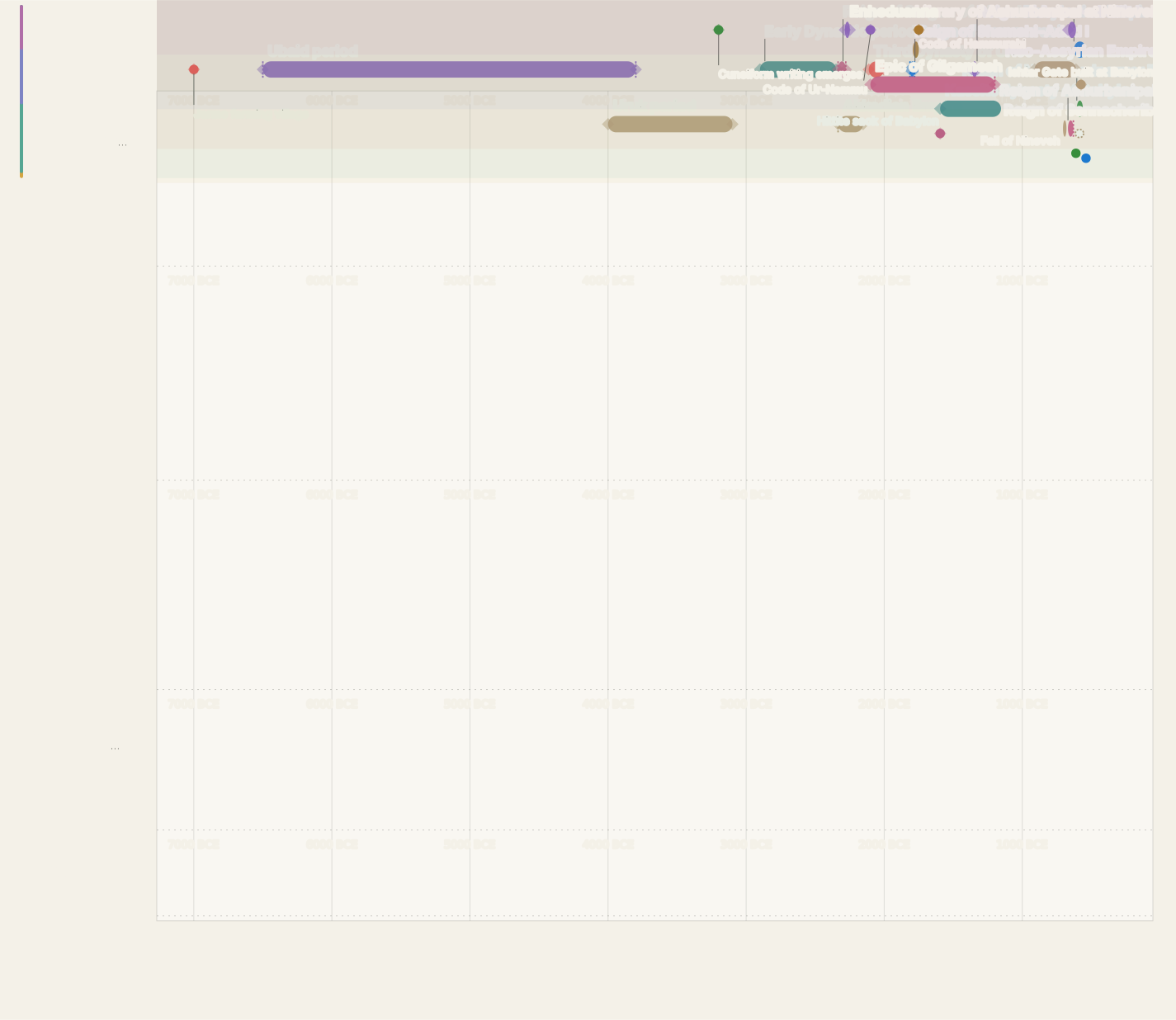
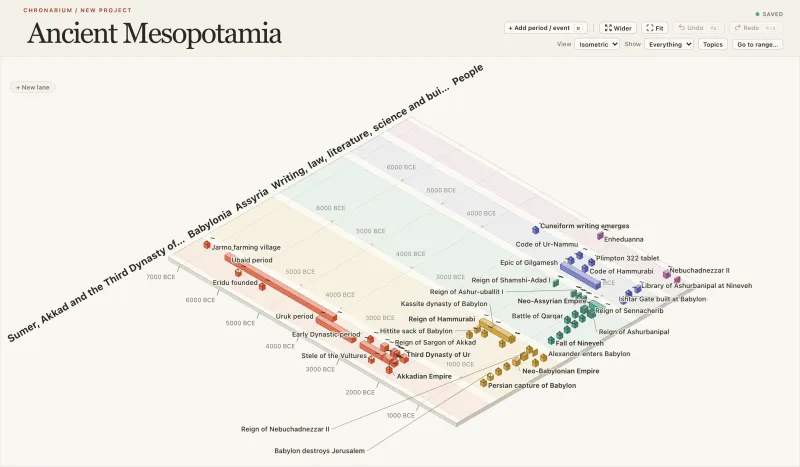
This timeline covers ancient Mesopotamia from the first villages around 7000 BCE to Alexander in 323 BCE. Its five lanes place Sumer, Akkad and the Third Dynasty of Ur, Babylonia, and Assyria beside writing, law, literature, science and buildings, and beside the people of the period. All entries sit on the same time axis, so events from the same century line up across lanes.
For dates earlier than about 1400 BCE, this page uses the middle chronology, which gives Hammurabi's reign as 1792-1750 BCE, and notes the alternatives where other chronologies disagree. Reigns are counted from the accession year.
Show the whole picture· made by Chronarium’s Export → Picture, Major only · open the SVG (184 KB)In the picture: 27 of 69 entries (major only) · all 69 in the table belowPicture range: 7268 BCE – 55 BCE
CC BY 4.0, credit Chronarium · Opens in Chronarium for Mac · 4-week free trial, no card · more below
In the table, 'c.' marks an approximate date, drawn on the timeline with a fading band, and '?' marks an uncertain one where published sources disagree. The table below lists all 69 entries under 6 period headings.
The story begins with farming: Jarmo, in northeastern Iraq, yielded some of the earliest evidence that people farmed domesticated crops. The Hassuna village culture, it seems, spread across northern Mesopotamia. On drier land, where rain alone could not water crops, farmers had to irrigate to grow enough food. The Ubaid culture, known for distinctive pottery, took hold across southern Mesopotamia. At Eridu, the temple of the god Enki was rebuilt on the same spot over many centuries. In the Uruk period, Uruk grew into southern Mesopotamia's largest city.
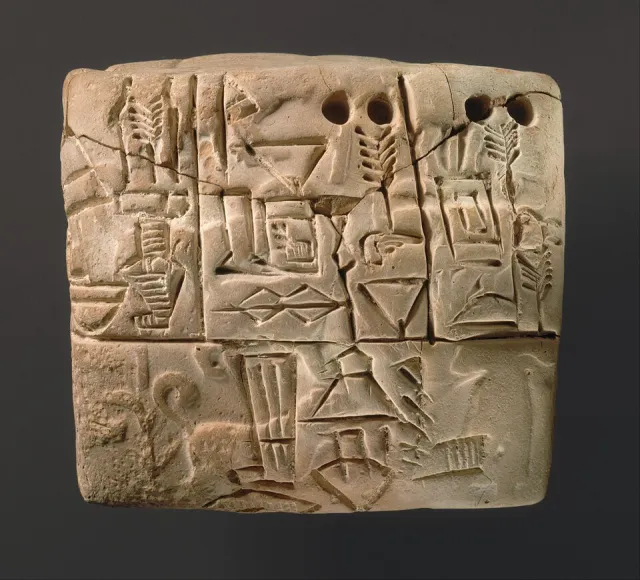
In the Uruk period, rations seem to have been handed out in standard-sized bowls. Cuneiform was invented in Sumer c. 3200 BCE. Writing began as a practical tool: people needed to keep accounts, and recorded goods on clay tablets. Most of the earliest tablets came from Uruk. Then Uruk's far-reaching culture seems to have ended abruptly. Cities went on growing, and afterward independent city-states dominated southern Mesopotamia.
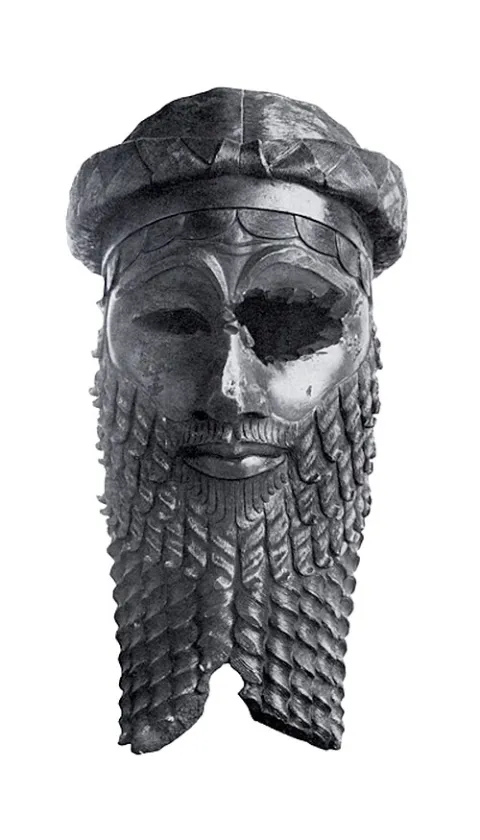
Sumer was divided among rival city-states, each ruled by a king. Mari was founded as a planned city near the Euphrates. Rich treasures filled Ur's royal tombs, where rulers were buried with their servants. Lagash and neighbouring Umma fought over the fertile farmland between them, and King Eannatum of Lagash defeated Umma, a victory the Stele of the Vultures was made to celebrate. Lugalzagesi had united Sumer's city-states, but Sargon of Akkad defeated him and took over the kingdom.
The Akkadian Empire was governed from Akkad, a city whose location has never been found. Sargon's daughter Enheduanna served as a high priestess and wrote hymns; she is the earliest author whose name is known. Naram-Sin took the title "king of the four quarters" and had his name written using the sign for a god. The empire's fall is blamed on Gutian invaders, but its own troubles may have let them in. Gutian rule in Sumer ended when Utu-hengal, king of Uruk, rose against them, and after Utu-hengal kingship passed to Ur-Nammu of Ur.
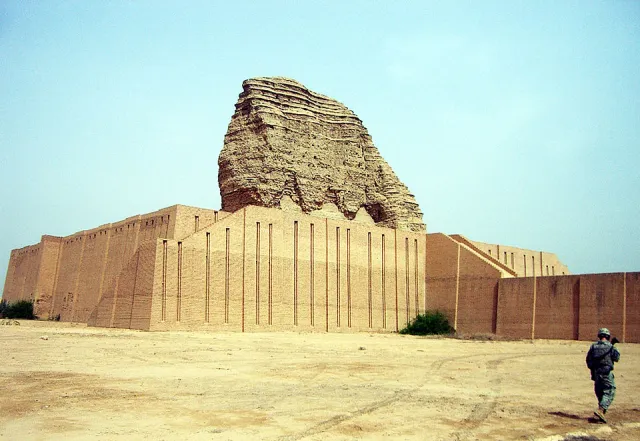
Ur-Nammu founded the Third Dynasty of Ur; the oldest law code yet discovered is credited to him. Under the dynasty, Ur's great ziggurat rose, a temple tower for Nanna, the moon god and the city's patron. His son Shulgi pushed Ur's rule far beyond Sumer, north up the Tigris. Amorite nomad raids weakened Ur, and they are seen as one cause of the dynasty's downfall. Under the last king, Ibbi-Sin, the dynasty fell to invading Elamites and Amorites. Amorite newcomers then took control of Isin, Larsa and Babylon.
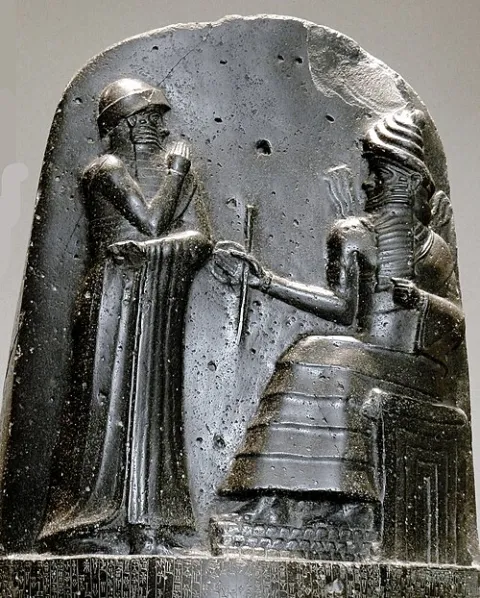
In the north, Shamshi-Adad I took Assur and ruled Assyria. Hammurabi of Babylon, formerly allied with Larsa against Elam, turned on its king Rim-Sin and defeated him. He then attacked his ally Zimri-Lim of Mari, took the city and destroyed it. His laws, unlike earlier Sumerian codes, punished by the 'eye for an eye' principle. Taking Eshnunna removed a buffer shielding Babylonia from eastern peoples, likely the Kassites among them. After Hammurabi died, the empire shrank under his successors, and the far south broke away, with rulers of its own.
The Hittite king Mursili I raided Babylon and ended its ruling dynasty. Kassite kings then took power in Babylon and founded a dynasty that lasted about four hundred years. Under Ashur-uballit I, Assyria shook off Mitanni rule and entered the Middle Assyrian period. Tukulti-Ninurta I of Assyria defeated Babylonia's Kassite king and held the land for a time. Kassite rule finally fell to wars with Elam, and Elamite invaders carried off ancient Mesopotamian monuments, including the stele that bore Hammurabi's law code.
Under Nebuchadnezzar I of the new Second Dynasty of Isin, Babylonia struck Elam and brought home the god Marduk's statue. Assyria's power waned after Tukulti-Ninurta I died, until Tiglath-Pileser I restored it. He campaigned as far north as Lake Van and west to the Mediterranean coast. His conquests did not outlast him: after his death Assyria declined, and Aramaean groups took over its western lands. Aramaean tribes likewise pressed into Babylonia after Nebuchadnezzar I's reign.
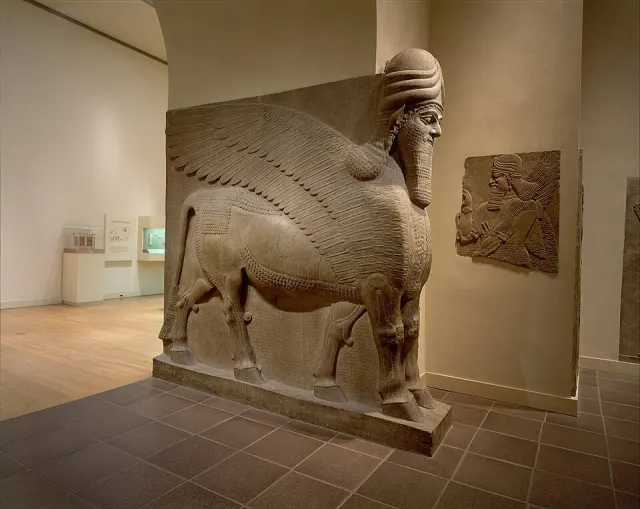
Adad-nirari II fought the Aramaean invaders, who had troubled Assyria for a long time, in campaign after campaign. Ashurnasirpal II restored Kalhu (Nimrud) as his capital; to celebrate, his stela records, he hosted a ten-day feast in 879 BCE for 69,574 guests. At Qarqar in 853 BCE, Shalmaneser III fought a coalition of local kings, and the indecisive clash halted Assyria's advance. Assyria then declined under feeble kings until a revolt placed Tiglath-Pileser III (745 BCE–727 BCE) on the throne. He carved the provinces into smaller ones to break the independence their governors had gained.
Sargon II, who probably took the throne by coup, built a new capital, Dur-Sharrukin (modern Khorsabad). Killed on campaign, he was succeeded by Sennacherib, who abandoned Dur-Sharrukin and made Nineveh his capital. In 701 BCE Sennacherib crushed a revolt in Judah, then besieged Jerusalem, sparing it after its king Hezekiah paid tribute. Babylon's repeated revolts wore him down, and in 689 BCE he destroyed the city, plundering its temples. His sons later assassinated him, a killing linked to the gods' anger at his sacrilege against Babylon. Another son, Esarhaddon, took the throne, rebuilt Babylon, declaring its destruction the gods' will.
To forestall a struggle over the succession, Esarhaddon named two heirs: Ashurbanipal for Assyria, and Shamash-shum-ukin, another son, for Babylonia. In 671 BCE he took Memphis and conquered Egypt; the country later revolted, and he died on the march to crush it. Ashurbanipal made Nineveh home to the ancient Middle East's first systematically organized library, which preserved epics like Gilgamesh. Shamash-shum-ukin in time rose against his brother; Babylon endured a long siege, and he died as his palace burned. Ashurbanipal then sacked Susa and destroyed Elam, a move that would later assist Assyria's enemies in toppling the empire. His death brought successors too weak to hold it together, and region after region, Babylon included, started to break away.
Nabopolassar took Babylon's throne and founded the Neo-Babylonian Empire. The Median king Cyaxares took the Assyrian city Assur, and Nabopolassar allied with him against Assyria. In 612 BCE the allies took Nineveh, and its fall is taken as the end of the Assyrian Empire. Nebuchadnezzar defeated an Egyptian army at Carchemish; soon after, Nabopolassar died, and his son returned to Babylon as king. In 597 BCE Nebuchadnezzar captured Jerusalem and deported Jehoiachin, Judah's king, to Babylon. Later, Babylon destroyed Jerusalem and its Temple, and many Judeans were deported to Babylon, a period known as the Exile.
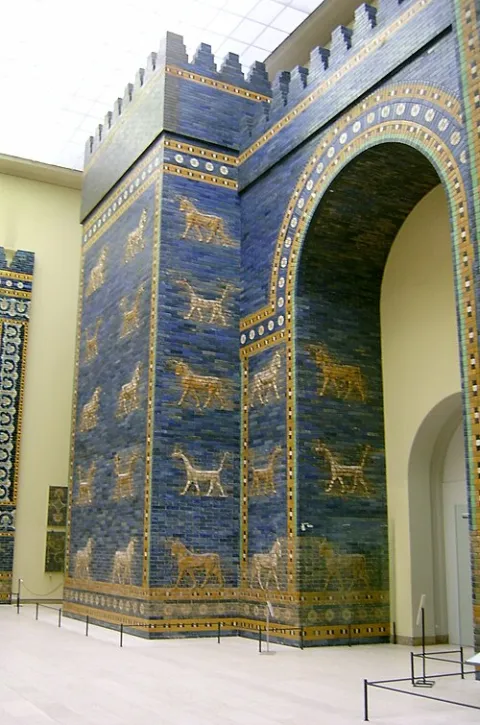
Nebuchadnezzar II turned Babylon into a magnificent capital and raised the Ishtar Gate. King Nabonidus honoured Sin, the moon god, above Marduk, Babylon's chief deity. Cyrus the Great took Babylon for Persia in 539 BCE, and the Neo-Babylonian Empire fell. Warring with Persia, Alexander the Great of Macedon seized the city in 331 BCE. He died there in June 323 BCE, his recent plans unrealised. His generals then fought over the empire, Babylon included.
c. approximate date · ? the sources give different dates · Scope the sources date different definitions of it · rows run by start date · how the dates are checked
First villages, Ubaid and Uruk
c. 7000 BCE – c. 2901 BCE · 6 entries · selective coverage
Date
Event
Note
c. 7000 BCE
Jarmo farming village (Sumer, Akkad and the Third Dynasty of Ur)#1, 2
One of the earliest farming villages, set in the Zagros foothills of northern Iraq.
c. 6500 BCE?–c. 3800 BCE?
Ubaid period (Sumer, Akkad and the Third Dynasty of Ur)#3, 4
Prehistoric culture of southern Mesopotamia with the first temples; named after Tell al-Ubaid.Sources differ: Wikipedia: 6500–3800 BC; World History Encyclopedia: 6500-4000 BCE; Metropolitan Museum of Art: 6200–4000 BCE.
c. 6000 BCE?
Hassuna culture farming villages (Sumer, Akkad and the Third Dynasty of Ur)#5, 6
The earliest dry-farming villages of northern Mesopotamia.Sources differ: Wikipedia: 6000 BC; University of New Mexico: 6000-5200 BC; Metropolitan Museum of Art: 6900–6500 BCE.
c. 5400 BCE
Eridu founded (Sumer, Akkad and the Third Dynasty of Ur)#4, 7
What may be the first Sumerian city, a southern settlement of the Ubaid period.
c. 4000 BCE–c. 3100 BCE
Uruk period (Sumer, Akkad and the Third Dynasty of Ur)#8, 9
Southern Mesopotamia's first cities appear; Uruk is the largest.
c. 3200 BCE
Cuneiform writing emerges (Writing, law, literature, science and buildings)#10, 11
Sumerians at Uruk produce the first proto-cuneiform tablets.
Early Dynastic Sumer and Akkad
c. 2900 BCE – c. 2113 BCE · 10 entries
Date
Event
Note
c. 2900 BCE
Mari founded on the Euphrates (Sumer, Akkad and the Third Dynasty of Ur)#12, 13
A planned trading city beside the middle Euphrates; later an Amorite capital.
c. 2900 BCE–c. 2350 BCE
Early Dynastic period (Sumer, Akkad and the Third Dynasty of Ur)#14, 15
Sumerian city-states compete; kings take over from priest-rulers.
c. 2600 BCE–c. 2500 BCE
Royal Tombs of Ur (Sumer, Akkad and the Third Dynasty of Ur)#16, 17
Royal burials at Ur, including Queen Puabi's, rich in gold and lyres.Scope: Dates follow Penn Museum's Early Dynastic IIIA royal burials, c. 2600-2500 BCE. Others date the whole Royal Cemetery's use, three centuries or more, or the finds, 2600-2300 BCE.
c. 2450 BCE?
Stele of the Vultures (Sumer, Akkad and the Third Dynasty of Ur)#18, 19
Eannatum of Lagash celebrates his victory over Umma.Sources differ: Louvre gives 2450–2425 BCE, Wikipedia circa 2475 BCE, University at Buffalo Libraries circa 2600–2500 BCE.
c. 2358 BCE–c. 2334 BCE
Reign of Lugalzagesi of Umma (Sumer, Akkad and the Third Dynasty of Ur)#20, 21
The king of Umma took over Sumer, then lost to Sargon of Akkad.
c. 2334 BCE?–c. 2279 BCE?
Reign of Sargon of Akkad (Sumer, Akkad and the Third Dynasty of Ur)#22, 23
Founds the Akkadian Empire, with his capital at Agade.Sources differ: Wikipedia, Encyclopedia.com, Store norske leksikon and World History Encyclopedia: c. 2334–2279 BCE; the Metropolitan Museum of Art and Archaeology Magazine: 2340-2285 B.C.; Livius: 2296-2240.
c. 2334 BCE?–c. 2154 BCE
Akkadian Empire (Sumer, Akkad and the Third Dynasty of Ur)#24, 25
The earliest empire in Mesopotamia; Sargon created it and ruled from Akkad.Sources differ: Wikipedia gives 2334–2154 BCE, World History Encyclopedia 2350/2334–2154 BCE, Metropolitan Museum of Art circa 2350–2150 BCE.
Sargon's daughter, high priestess at Ur, and the first named author.
c. 2254 BCE–c. 2218 BCE
Reign of Naram-Sin (Sumer, Akkad and the Third Dynasty of Ur)#28, 29
Akkadian king, Sargon's grandson, who claimed he was a god.
c. 2119 BCE–c. 2112 BCE
Reign of Utu-hengal of Uruk (Sumer, Akkad and the Third Dynasty of Ur)#30, 31
King of Uruk who expelled the Gutians; Ur-Nammu followed him.
Ur III and Old Babylonian
c. 2112 BCE – c. 1596 BCE · 13 entries
Date
Event
Note
c. 2112 BCE–c. 2094 BCE
Reign of Ur-Nammu (Sumer, Akkad and the Third Dynasty of Ur)#32, 33
Founds Ur's Third Dynasty; issues a law code and builds ziggurats.
c. 2112 BCE–c. 2004 BCE
Third Dynasty of Ur (Sumer, Akkad and the Third Dynasty of Ur)#34, 35
Five kings, starting with Ur-Nammu and then Shulgi, ruled Sumer and Akkad.
c. 2100 BCE
Code of Ur-Nammu (Writing, law, literature, science and buildings)#36, 37
The earliest law code still known, written in Sumerian under Ur-Nammu of Ur.
c. 2100 BCE
Great Ziggurat of Ur (Writing, law, literature, science and buildings)#38, 39
Temple tower at Ur honoring the moon god Nanna, begun under king Ur-Nammu.Scope: The date follows the start of work in Ur-Nammu's reign, c. 2100 BCE. Other sources date completion to Shulgi's reign, 2094-2046 BCE, while National Geographic says around 2000 BCE.
c. 2100 BCE–c. 1200 BCE?
Epic of Gilgamesh (Writing, law, literature, science and buildings)#40, 41
Grew from Sumerian poems into an Akkadian epic about Gilgamesh, king of Uruk.Sources differ: Wikipedia and Carnegie Mellon University Libraries give c. 2100–1200 BCE; World History Encyclopedia gives c. 2150–1400 BCE.
c. 2094 BCE–c. 2046 BCE
Reign of Shulgi (Sumer, Akkad and the Third Dynasty of Ur)#42, 33
Ur-Nammu's son, the greatest Ur III king; he declared himself a god.
c. 2004 BCE
Elamites sack Ur (Sumer, Akkad and the Third Dynasty of Ur)#43, 44
Elamite and Amorite forces overran Ur, ending the Ur III dynasty.
Amorite conqueror who built a kingdom across Upper Mesopotamia, ruling Assur and Mari.Sources differ: Wikipedia gives 1808–1776 BCE; Livius and the Metropolitan Museum of Art give 1813–1781 BCE.
c. 1800 BCE
Plimpton 322 tablet (Writing, law, literature, science and buildings)#49, 50
Babylonian mathematical table from Larsa listing Pythagorean triples.
Babylon razes the Euphrates city of Mari after it revolts.Scope: The date follows Mari's razing after the revolt, c. 1759 BCE. Other sources date Hammurabi's earlier defeat of Zimri-Lim to c. 1761 BCE.
c. 1750 BCE
Code of Hammurabi (Writing, law, literature, science and buildings)#53, 54
Law code of the Babylonian king Hammurabi; the stele was found at Susa in 1902.
Assyrian dominance across the Near East, stretching from Egypt to Elam.Scope: The end date follows Nineveh's fall, 612 BCE. Other sources end the empire at the Assyrians' last stand at Harran, 609 BCE, or in 610 BCE.
Last great Assyrian king; defeated Elam and collected the library.Sources differ: Wikipedia 669–631 BCE, World History Encyclopedia 668–627 BCE, Metropolitan Museum of Art c. 668–631 BCE.
c. 668 BCE–612 BCE
Library of Ashurbanipal at Nineveh (Writing, law, literature, science and buildings)#86, 87
A royal library of over 30,000 tablets, collected under Ashurbanipal and lost when Nineveh burned.
Ashurbanipal's brother, ruling Babylon as viceroy, rebels against him.Sources differ: Wikipedia 652–648 BCE, World History Encyclopedia 652–648/647 BCE, Encyclopaedia Iranica 653–648 BCE.
King of Babylon from the Chaldean dynasty, a son of Nabopolassar.Sources differ: Wikipedia c. 642 BCE, Encyclopedia.com c. 630, World History Encyclopedia c. 634
Solomon's Temple is burned and many Judeans are deported to Babylon.Sources differ: Encyclopedia.com says 586 BCE, Wikipedia a 589–587 BCE siege, Metropolitan Museum of Art 587 or 586 BCE.
c. 575 BCE
Ishtar Gate built at Babylon (Writing, law, literature, science and buildings)#103, 104
A glazed-brick gate built for Nebuchadnezzar II, reconstructed in the Pergamon Museum.
Download mesopotamia.chronarium.json, a free project file, and open it in Chronarium, the timeline app for Mac. The 4-week free trial includes every feature and asks only for an email address, not a card.