Maya Timeline

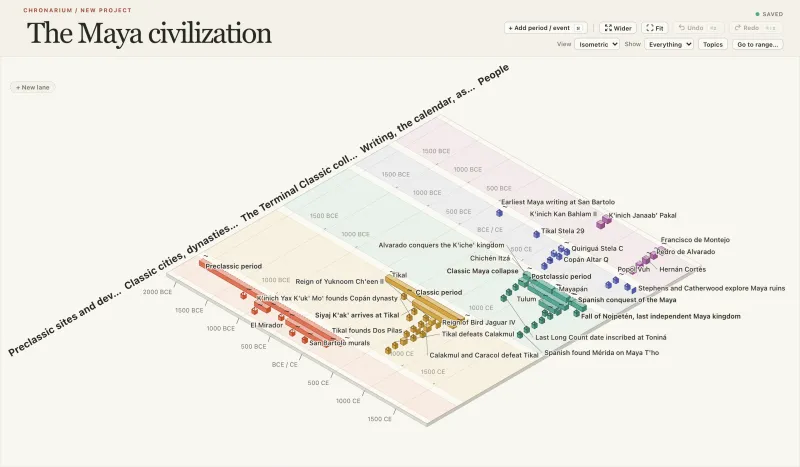
This timeline covers the Maya civilization from c. 2000 BCE to 1842 CE, from the Preclassic period through the Spanish conquest and the centuries after it. Five lanes run side by side on one time axis: Preclassic sites and developments; Classic cities, dynasties, wars and alliances; the Terminal Classic collapse, the Postclassic cities and the Spanish conquest; writing, calendar, astronomy, codices, art and religion; and the people. Reading across the lanes at any year shows what was happening in each part of Maya life at the same time.

Period covered
c. 2000 BCE – 1842 CE
Entries
63
Lanes
5
Key dates
Chronarium’s picture of the Maya timeline, major entries only, 2154 BCE – 1996 CE. Lanes: Preclassic sites and developments, Classic cities, dynasties, wars and alliances, The Terminal Classic collapse, Postclassic cities, the Spanish conquest, Writing, the calendar, astronomy, codices, art, religion, People.

Loading the live app…

Show the whole picture
· made by Chronarium’s Export → Picture, Major only · open the SVG (179 KB)
In the picture: 25 of 63 entries (major only) · all 63 in the table belowPicture range: 2154 BCE – 1996 CE

In the table, 'c.' before a date means it is approximate, and '?' after one means published sources disagree; approximate dates get a fading band on the timeline. The table below lists all 63 entries under 7 period headings.

Story

Story by period

Preclassic period

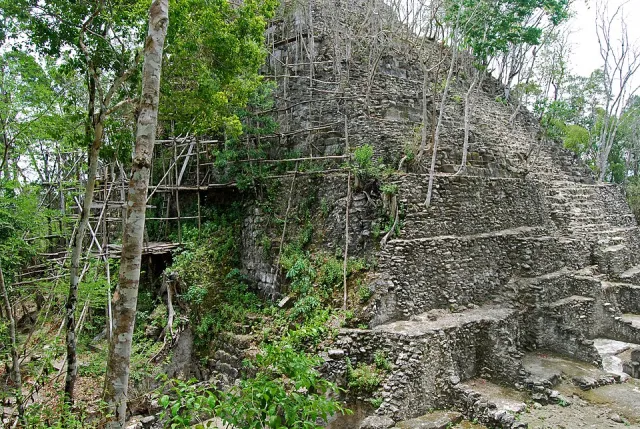
Stone pyramid under excavation at El Mirador, photo
Stone pyramid under excavation at El Mirador, photo, El Mirador, Petén, GuatemalaImage: Geoff Gallice · CC BY 2.0 · Wikimedia CommonsIn the table: El Mirador

The first Maya lived in villages, farming corn, beans and squash. Aguada Fénix is the oldest and largest known Maya monument. In the Middle Preclassic, Nakbe was already building big temples on raised platforms. Lowland centers rose to power by holding portages on the peninsula's trade routes. Northern Guatemala's El Mirador became the Maya lowlands' largest Preclassic capital. Tikal became a hub of monumental buildings in the Late Preclassic.

The earliest known Maya writing comes from San Bartolo in Guatemala. Its murals of c. 100 BCE told the Maya story of how the world was created and tied it to kings. Later Tikal texts named Yax Ehb' Xook the founder of its royal dynasty. El Mirador declined and lost its power as the Preclassic ended. Tikal then became a leading Maya power of the Early Classic period. The Classic period that followed grew from the Late Preclassic, carrying forward trends from its last centuries.

Early Classic period

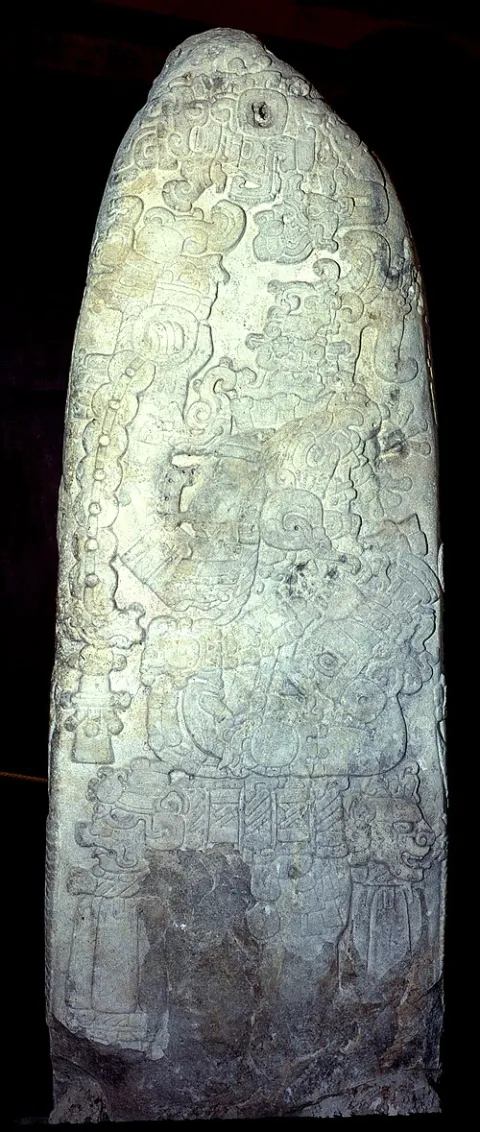
Tikal Stela 31, carved stone stela
Tikal Stela 31, carved stone stela, Museo Lítico, TikalImage: HJPD · CC BY 3.0 · Wikimedia CommonsIn the table: Siyaj K'ak' arrives at Tikal

Classic Maya kings raised carved stone monuments, dating the events of their reigns with the Long Count calendar. Tikal's Stela 29, dated 292 CE, is among the oldest of these, and its figure is thought to be a ruler. In 378 CE the warlord Siyaj K'ak' reached Tikal. Tikal's king died that same year, and Yax Nuun Ayiin, a new king, took the throne. Siyaj K'ak' had come apparently from Teotihuacan, and his arrival began an era of Teotihuacan influence at Tikal. Under the new king, Tikal then extended its authority over other lowland Maya cities.

K'inich Yax K'uk' Mo' became king at Copán in 426 CE and founded its royal dynasty, probably with Tikal's support. Teotihuacan's power faded later in the period. The Snake (Kaan) kings drew cities on every side of Tikal to their side, some of them Tikal's own allies, until the city stood encircled. A coalition under the Snake (Kaan) kings, Caracol among them, defeated Tikal in 562 CE. That defeat began a long decline for Tikal, the 'hiatus', when little was built and few monuments carried dates. The Late Classic era that came next brought the lowland Maya to their intellectual and artistic peak.

Late Classic period

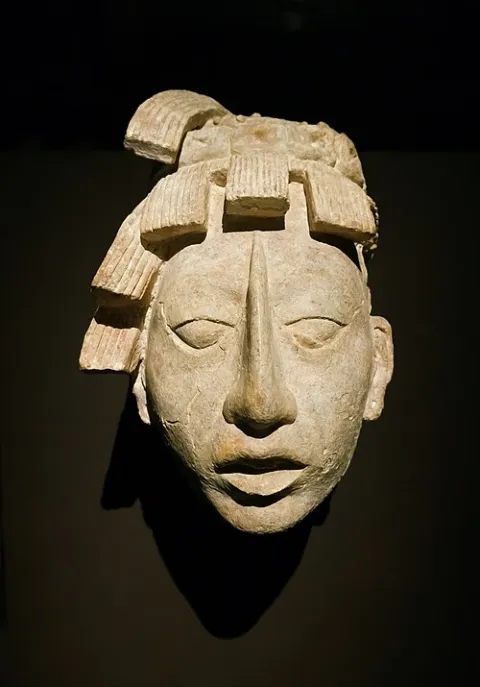
Stucco head of Pakal as a young man
Stucco head of Pakal as a young man, National Museum of Anthropology, Mexico City; photographed at the Musée du quai Branly, ParisImage: Jebulon · CC0 · Wikimedia CommonsIn the table: K'inich Janaab' Pakal

Two rival powers, Tikal and the Snake dynasty of Calakmul, struggled to control the Maya world. In 611 CE, for the second time, Calakmul attacked Palenque. In 615 CE, the 12-year-old K'inich Janaab' Pakal became king of Palenque. Those attacks may have spurred bursts of building and of new ideas under Pakal and his successors. Members of Tikal's royal family founded Dos Pilas. Calakmul's Snake kings reached their greatest success under Yuknoom Ch'een II, who governed through a web of loyal vassal kings.

Calakmul next attacked Dos Pilas, whose ruler changed sides, becoming its vassal. Pakal was buried in the Temple of the Inscriptions, a pyramid made as his tomb and carved with one of the lengthiest Maya texts. His son K'inich Kan Bahlam II raised the Group of the Cross, three temples to Palenque's gods. In 695 CE, Jasaw Chan K'awiil I, Tikal's king, defeated Calakmul, a victory that led Tikal's comeback. Toniná captured Palenque's king, K'inich K'an Joy Chitam II, in 711 CE, and Palenque had no king for some time.

A Yaxchilan lintel showed Lady Xook, King Shield Jaguar's wife, bleeding her tongue in a rite rulers owed the gods. In 738 CE, Quiriguá's lord, once Copán's vassal, seized Copán's king, Waxaklajuun Ub'aah K'awiil, and beheaded him. Copán then revived under its 15th king, K'ak' Yipyaj Chan K'awiil, who dedicated the Hieroglyphic Stairway, the longest Maya text known. Bonampak's murals portrayed combat and the war captives it produced. Maya kingdoms, Dos Pilas's realm among them, broke apart into smaller powers that warred without pause. Scholars think this fighting, by severing trade between cities, helped bring about the Classic Maya collapse.

Terminal Classic and the collapse

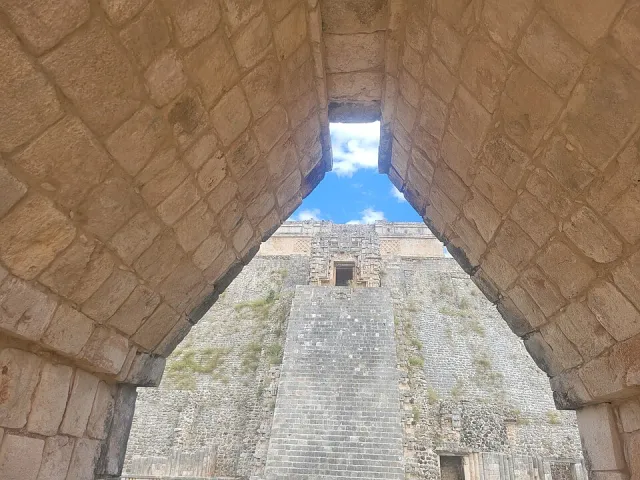
Pyramid of the Magician, Uxmal, photo
Pyramid of the Magician, Uxmal, photo, Uxmal, Yucatán, MexicoImage: Erik Cleves Kristensen · CC BY 2.0 · Wikimedia CommonsIn the table: Uxmal becomes capital of the Puuc region

Classic Maya civilization in the southern lowlands declined, then collapsed. Historians most often cite three possible causes: warfare between the city-states, overpopulation and drought. In 869 CE, Tikal raised its last royal portrait stela in the Great Plaza. Tikal, like the region's other cities, was later abandoned. Across the lowlands, the custom of raising dated stone monuments, stelae, ended. At Toniná in 909 CE, a monument was carved bearing the Long Count's last known date.

As the southern cities emptied, many inhabitants probably left, some heading north. Meanwhile, some northern Maya cities flourished as never before, even as the great southern centers declined. In the north, Uxmal became the Puuc region's leading city. Rain mattered deeply there, and its buildings bore many carvings of Chaac, the Maya rain god. The southern lowlands, once the Maya's most densely settled land, were never heavily resettled.

Postclassic period

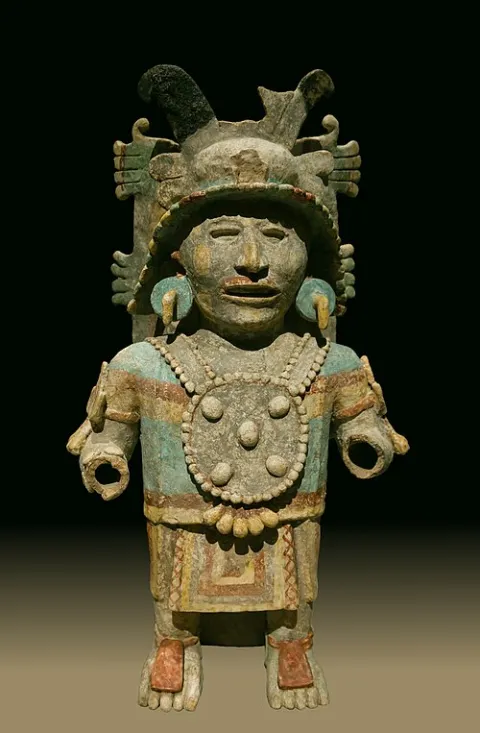
Effigy censer holder, painted ceramic
Effigy censer holder, painted ceramic, Palacio Cantón regional museum, Mérida; photographed at the Musée du quai Branly, ParisImage: Jebulon · CC0 · Wikimedia CommonsIn the table: Mayapán

The southern lowlands stood nearly empty, but the northern Yucatán Peninsula grew, its cities flourishing. Chichén Itzá led the north early on, probably heading a wider group of states. It then lost that role, and Mayapán rose to lead Yucatán. On the east coast, Tulum was an important center of trade and religion, and several of its buildings show stucco figures depicting a winged god diving downward.

Mayapán's rule over northern Yucatán ended when the rival Xiu family overthrew its ruling Cocom family. Northern Yucatán then broke into many small independent states. Several Maya kingdoms, the K'iche' among them, held the Guatemalan highlands, many based in fortified hilltop centers. Kaqchikel rulers Huntoh and Vukubatz founded Iximché after the Kaqchikel broke with their former K'iche' partners. When the Spanish arrived, most Maya were village farmers.

The Spanish conquest

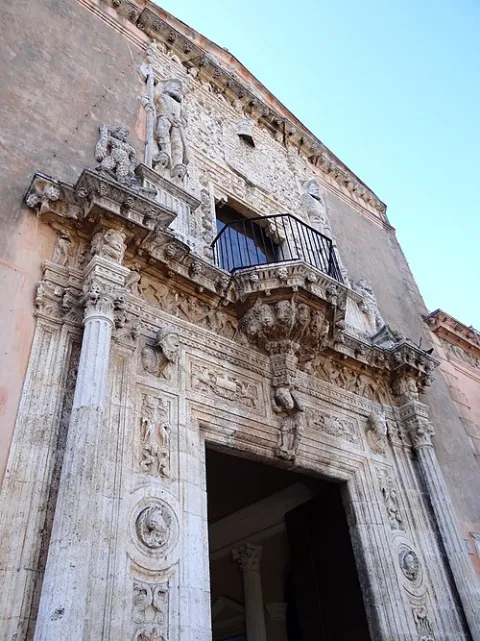
Doorway of the Casa de Montejo, Mérida
Doorway of the Casa de Montejo, Mérida, Casa de Montejo, MéridaImage: Adam Jones, Ph.D. · CC BY-SA 3.0 · Wikimedia CommonsIn the table: Spanish found Mérida on Maya T'ho

Francisco Hernández de Córdoba's Spanish expedition reached the Yucatán coast in 1517 CE. Epidemic disease struck the Maya even before Spanish troops arrived, and the Spanish used this to their benefit. They also exploited wars among Maya kingdoms, backing the Kaqchikel against the K'iche'. The Spanish overran the K'iche' in 1524 CE, and Pedro de Alvarado put their capital, Utatlán, to the torch. That same year, Alvarado founded Santiago de los Caballeros de Guatemala, Guatemala's first Spanish settlement and capital. In Yucatán, the Maya resisted Francisco de Montejo's invasion with fierce determination, and the Spanish conquest there advanced slowly.

Francisco de Montejo founded Mérida in 1542 CE on the site of the Maya town of T'ho. In the Spanish alphabet, K'iche' Maya writers recorded the Popol Vuh, their people's history and creation story. The Franciscan Diego de Landa held an auto-da-fé at Maní, suspecting the Maya of human sacrifice. He judged their books superstition and lies of the devil and burned them, and the Maya grieved deeply. The Itza Maya held out against conquest until 1697 CE, when their capital fell to the Spanish.

After the conquest

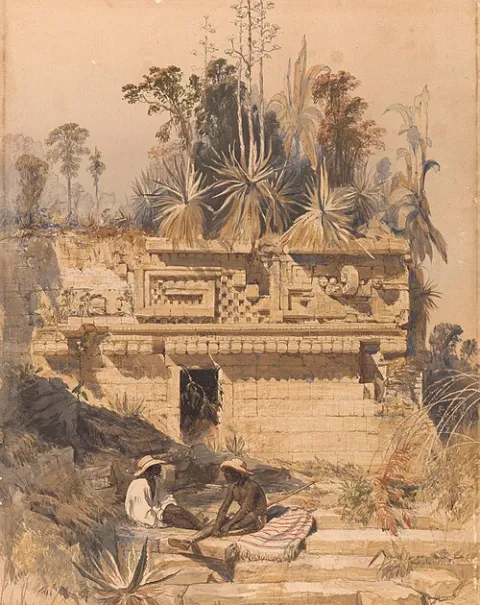
Ruins at Sabachtsche, watercolour by Catherwood
Ruins at Sabachtsche, watercolour by Catherwood, Yale Center for British ArtImage: Frederick Catherwood · CC0 · Wikimedia CommonsIn the table: Stephens and Catherwood explore Maya ruins

The Dresden Codex was among the few Maya books to survive the burning of Maya books. In 1739 CE, Johann Christian Götze, director of the Royal Library at Dresden, obtained it in Vienna from a private owner. Published reports describing ancient ruins in Central America stirred the American John Lloyd Stephens's curiosity, and he set out to find and explore them. From 1839 CE to 1842 CE, he and the English illustrator Frederick Catherwood explored and surveyed the Maya ruins of Central America and Mexico.

At Copán, Stephens bought the ruined city's site for $50. Catherwood drew the ruins using a camera lucida, which projected their outlines onto paper. Stephens argued that Native peoples of the Americas made them, not Old World migrants. Stephens's book, with Catherwood's drawings, caused a storm of interest in the Maya, popular and scholarly. Their explorations began Middle American archaeology and laid a foundation for the later study of the Maya. Maya peoples still live in southern Mexico, Guatemala and Belize, on their ancestors' lands.

Maya timeline in Chronarium, Isometric view
Chronarium, Isometric viewall 63 entries · maya.chronarium.json

Entries

Entries by period

c. approximate date · ? the sources give different dates · Scope the sources date different definitions of it · rows run by start date · how the dates are checked

Preclassic period

c. 2000 BCE – c. 249 · 11 entries
DateEventNote
c. 2000 BCE–c. 250 CE?Preclassic period (Preclassic sites and developments)#1, 2Maya society grows from farming villages into cities ruled by kings.Sources differ: Wikipedia gives 250 AD, EBSCO Research Starters ca. 250 CE, Gavilan College / Humanities LibreTexts 250; EBSCO's Maya Civilization gives 200 CE.
c. 1200 BCE?Cuello village first settled (Preclassic sites and developments)#3, 4An early farming village in northern Belize.Sources differ: Wikipedia and EBSCO say c. 1200 BCE, Frontiers says c. 1000 BCE.
c. 1000 BCE–c. 800 BCEAguada Fénix platform built (Preclassic sites and developments)#5, 6The biggest and earliest known Maya monument, in Tabasco, Mexico.
c. 900 BCE?Seibal first settled (Preclassic sites and developments)#7, 8Early houses and pottery of the Xe phase at this Pasión River site in Petén.Sources differ: Encyclopedia.com and Wikipedia give c. 900 BCE, Frontiers gives c. 950 BCE.
c. 600 BCE?Nakbe raises large platforms (Preclassic sites and developments)#9, 10The earliest well-documented Maya city in the lowlands, set in the Mirador Basin.Sources differ: FAMSI and Mirador Basin Project give c. 600–400 BCE, Cambridge gives 900–600 BCE.
c. 500 BCE–c. 150 CE?El Mirador (Preclassic sites and developments)#11, 12The largest Preclassic city in the lowlands, reoccupied during Classic times.Scope: These dates follow the Preclassic city: rise by c. 500 BCE, collapse c. 150. The whole site ran longer, with Late Classic reoccupation 600–900 and final abandonment c. 900.Sources differ: Penn Museum 250 CE, Wikipedia about 150, Mesoweb partial c. 150, full c. 900.
c. 300 BCE?Cerros settled as a Late Preclassic village (Preclassic sites and developments)#13, 14A trading village on the Belize coast that later became a political capital.Sources differ: Encyclopedia.com 300–200 BCE, Wikipedia c. 400 BCE, Florida Museum of Natural History 300 BCE–150 CE.
c. 300 BCEEarliest Maya writing at San Bartolo (Writing, the calendar, astronomy, codices, art, religion)#15, 16Mural fragments painted with glyphs and a 260-day calendar date.
c. 300 BCE–c. 900 CETikal (Classic cities, dynasties, wars and alliances)#17, 18The Mutal kingdom's capital in Petén, with Temple I, abandoned around 900.Scope: Dates follow the ceremonial center and city, c. 300 BCE to abandonment c. 900. Others reach earlier: kingdom 800 BCE–900 CE, first settlers 800 BCE, farming traces 1000 BCE.
c. 100 BCESan Bartolo murals (Preclassic sites and developments)#19, 20Scenes of the Maya creation story and kingship, in Petén, Guatemala.
c. 90 CEYax Ehb' Xook founds Tikal's dynasty (Classic cities, dynasties, wars and alliances)#21, 22Remembered as the legendary founder of Tikal's royal line.

Early Classic period

c. 250 – c. 599 · 5 entries
DateEventNote
c. 250 CE?–c. 900 CE?Classic period (Classic cities, dynasties, wars and alliances)#1, 23An era of dated monuments and great cities, when Maya civilization reached its peak.Sources differ: Other starts: 200 CE (EBSCO's Maya Civilization), A.D. 200 (National Geographic), 300 CE (EBSCO's Ancient Maya). Other end: 950 CE (World History Encyclopedia).
292 CETikal Stela 29 (Writing, the calendar, astronomy, codices, art, religion)#18, 24Carries the oldest Long Count date still known from the lowlands.
378 CESiyaj K'ak' arrives at Tikal (Classic cities, dynasties, wars and alliances)#25, 26Warlord linked to Teotihuacan; Chak Tok Ich'aak I, Tikal's king, dies.
426 CEK'inich Yax K'uk' Mo' founds Copán dynasty (Classic cities, dynasties, wars and alliances)#22, 27Arrived at Copán in 427, a year after his 426 inauguration.
562 CECalakmul and Caracol defeat Tikal (Classic cities, dynasties, wars and alliances)#22, 17Starts Tikal's long hiatus; Caracol rises.

Late Classic period

c. 600 – c. 799 · 21 entries
DateEventNote
603 CE–683 CEK'inich Janaab' Pakal (People)#28, 29Known as Pakal the Great; ruled Palenque from 615 to 683.
611 CECalakmul sacks Palenque (Classic cities, dynasties, wars and alliances)#29, 30Calakmul's second attack; Palenque loses its king.
615 CEPakal becomes king of Palenque at 12 (Classic cities, dynasties, wars and alliances)#31, 28He rebuilds Palenque, which had suffered two Calakmul attacks.
629 CETikal founds Dos Pilas (Classic cities, dynasties, wars and alliances)#32, 33A military outpost in the Petexbatún, governed by a prince from Tikal.
635 CE–702 CEK'inich Kan Bahlam II (People)#34, 29Pakal's son; ruled Palenque from 684 to 702 and built the Cross Group.
636 CE–686 CE?Reign of Yuknoom Ch'een II (Classic cities, dynasties, wars and alliances)#22, 35The Calakmul king under whom the Kaan (Snake) kingdom reached its height.Sources differ: Penn Museum and Archaeology Magazine (Archaeological Institute of America) 636–686 CE; Mesoweb 636–685 or 686.
681 CE–742 CEReign of Itzamnaaj Bahlam III (Classic cities, dynasties, wars and alliances)#36, 37Yaxchilan ruler called Shield Jaguar the Great; husband of Lady Xook.
682 CE–693 CEReign of Lady Six Sky at Naranjo (Classic cities, dynasties, wars and alliances)#22, 38Came from Dos Pilas and ruled Naranjo in practice; regent until 741.
682 CE–734 CEReign of Jasaw Chan K'awiil I (Classic cities, dynasties, wars and alliances)#22, 39Revived Tikal after the hiatus and defeated Calakmul.
c. 683 CE?Temple of the Inscriptions completed (Writing, the calendar, astronomy, codices, art, religion)#40, 41The pyramid tomb of Pakal at Palenque, inscribed with long glyph texts.Sources differ: World History Encyclopedia c. 682 CE; Wikipedia after 683 CE; Springer Nature c. 690.
692 CE?Palenque Group of the Cross dedicated (Writing, the calendar, astronomy, codices, art, religion)#40, 42K'inich Kan Bahlam II's three temples.Sources differ: 692 CE (World History Encyclopedia, Mesoweb), 690 CE (Smithsonian).
695 CETikal defeats Calakmul (Classic cities, dynasties, wars and alliances)#22, 43Jasaw Chan K'awiil I restores Tikal's strength
711 CEToniná captures Palenque's K'inich K'an Joy Chitam II (Classic cities, dynasties, wars and alliances)#30, 44The king's capture left a ten-year break in Palenque's royal line.
738 CEQuiriguá captures Waxaklajuun Ub'aah K'awiil (Classic cities, dynasties, wars and alliances)#45, 46Copán's king was beheaded; the victor Quiriguá won its independence.
c. 750 CE?–c. 1200 CE?Chichén Itzá (The Terminal Classic collapse, Postclassic cities, the Spanish conquest)#47, 48Northern capital; El Castillo.Scope: Dates cover its flourishing as the capital of the northern region, c. 750–c. 1200. Other accounts put the first settlement at 415–435 or 455, with rapid decline following c. 1440.Sources differ: Flourishing: 550 (EBSCO) to 950 (Smithsonian National Museum of the American Indian), c. 750 (World History Encyclopedia); ends 1050 (National Geographic) to mid-13th century (EBSCO), c. 1200 (World History Encyclopedia).
752 CE–768 CEReign of Bird Jaguar IV (Classic cities, dynasties, wars and alliances)#36, 49Yaxchilan king whose father was Itzamnaaj Bahlam III; linked to Structure 33.
755 CECopán Hieroglyphic Stairway completed (Writing, the calendar, astronomy, codices, art, religion)#50, 51The longest known Maya inscription, carved with roughly 2,200 glyphs.
761 CEPetexbatún rivals defeat Dos Pilas (Classic cities, dynasties, wars and alliances)#52, 33Dos Pilas was besieged, then abandoned, and its kingdom broke apart.
775 CEQuiriguá Stela C (Writing, the calendar, astronomy, codices, art, religion)#46, 53The longest Maya creation account, recording the creation date of 3114 BCE.
776 CECopán Altar Q (Writing, the calendar, astronomy, codices, art, religion)#22, 54Carved with 16 of Copán's rulers, including Yax Pasaj.
c. 790 CEBonampak murals (Writing, the calendar, astronomy, codices, art, religion)#55, 56Structure 1 scenes of court, war, sacrifice, unfinished.

Terminal Classic and the collapse

c. 800 – c. 949 · 4 entries
DateEventNote
c. 800 CE?–c. 900 CE?Classic Maya collapse (The Terminal Classic collapse, Postclassic cities, the Spanish conquest)#2, 57Southern lowland cities abandoned as dated monuments stop.Sources differ: c. 800–900 (EBSCO), c. 750–950 (Dumbarton Oaks).
c. 850 CEUxmal becomes capital of the Puuc region (The Terminal Classic collapse, Postclassic cities, the Spanish conquest)#58, 59Puuc city in Yucatán's northwest.
869 CETikal's last monument, Stela 11 (The Terminal Classic collapse, Postclassic cities, the Spanish conquest)#18, 21Raised under Jasaw Chan K'awiil II; after it, Tikal falls silent.
909 CELast Long Count date inscribed at Toniná (The Terminal Classic collapse, Postclassic cities, the Spanish conquest)#1, 24The final Long Count inscription known from the Maya area; the Classic age ends.

Postclassic period

c. 950 – 1516 · 9 entries
DateEventNote
c. 950 CE?–c. 1539 CE?Postclassic period (The Terminal Classic collapse, Postclassic cities, the Spanish conquest)#1, 24Mayapán, northern cities and highland kingdoms; Spanish arrival.Sources differ: Start: c. 950 (Wikipedia, Cambridge University Press, World History Encyclopedia), 900 (National Geographic, History.com). End: c. 1539 (Wikipedia, Cambridge University Press), 1524 (World History Encyclopedia), around 1540 (National Geographic).
c. 1220 CE?–c. 1441 CE?Mayapán (The Terminal Classic collapse, Postclassic cities, the Spanish conquest)#60, 47Walled Cocom capital in northern Yucatán.Sources differ: 1220s–1440s (Wikipedia), from 1200 (World History Encyclopedia), c. 1150–1450 (University of Pittsburgh).
c. 1250 CE?–c. 1500 CETulum (The Terminal Classic collapse, Postclassic cities, the Spanish conquest)#61, 62A walled Caribbean port.Scope: Dates mark the port's peak, c. 1250–c. 1500. Other definitions give a late occupation phase 1250–1550, Stela 1 at 564, and the first European sighting in 1518.Sources differ: 1250–1500 (Encyclopedia.com), 13th–15th centuries (Wikipedia), 1250–1550 (Instituto Nacional de Antropología e Historia).
c. 1441 CEXiu overthrow Mayapán's Cocom rulers (The Terminal Classic collapse, Postclassic cities, the Spanish conquest)#63, 64A Xiu attack kills many Cocom and brings Mayapán down.
c. 1470 CE?–1524 CEIximché (The Terminal Classic collapse, Postclassic cities, the Spanish conquest)#65, 66The Kaqchikel capital; in 1524 it became Spain's first capital in Guatemala.Sources differ: Wikipedia: 1470 to 1524. Ministerio de Cultura y Deportes de Guatemala: 1470 to 1524. Encyclopedia.com: 1470/1480 to 1524.
c. 1479 CE–1553 CEFrancisco de Montejo (People)#67, 68Conquistador whose first attempt to conquer Yucatán came in 1527.
c. 1485 CE–1541 CEPedro de Alvarado (People)#69, 70The conquistador who subdued Guatemala and broke K'iche' power.
c. 1485 CE–1547 CEHernán Cortés (People)#71, 72Conqueror of the Aztecs; marched across Petén in 1525.
1508 CE?–1565 CEFrancisco de Montejo the Younger (People)#73, 67Montejo's son, who conquered Yucatán and founded Mérida.Sources differ: Birth year uncertain. Wikipedia: 1508 to 1565. Universidad Nacional Autónoma de México: 1508 to 1565. Encyclopedia.com: 1507 to 1565.

The Spanish conquest

1517 – 1697 · 11 entries
DateEventNote
1517 CEHernández de Córdoba reaches Yucatán (The Terminal Classic collapse, Postclassic cities, the Spanish conquest)#74, 75Came ashore at Cabo Catoche, then took heavy losses in fighting at Champotón.
1523 CE–1697 CESpanish conquest of the Maya (The Terminal Classic collapse, Postclassic cities, the Spanish conquest)#2, 76Began with Alvarado's 1523 campaign and ended when the Itza fell in 1697.
1524 CEAlvarado conquers the K'iche' kingdom (The Terminal Classic collapse, Postclassic cities, the Spanish conquest)#69, 77Q'umarkaj was burned, and the highland war continued until 1530.
1524 CE–1579 CEDiego de Landa (People)#78, 79Franciscan friar who became bishop of Yucatán; he wrote the Relación.
July 1524 CESantiago de los Caballeros founded at Iximché (The Terminal Classic collapse, Postclassic cities, the Spanish conquest)#69, 80Alvarado made Iximché the first capital of Guatemala.
1525 CECortés visits the Itza at Lake Petén Itzá (The Terminal Classic collapse, Postclassic cities, the Spanish conquest)#81, 82Honduras-bound march; mass celebrated in the Itza king's presence
1527 CE–1546 CESpanish conquest of Yucatán (The Terminal Classic collapse, Postclassic cities, the Spanish conquest)#83, 84Montejo's expeditions took the western Yucatán by 1542; a later eastern revolt was crushed.Scope: Dates follow Montejo's first expedition, 1527, through the eastern revolt crushed in 1546. Other readings date from Cortés's march (1524) or the royal grant (1526), or end with Mérida (1542).
6 January 1542 CESpanish found Mérida on Maya T'ho (The Terminal Classic collapse, Postclassic cities, the Spanish conquest)#85, 86Built by the Montejo family; it served as capital of colonial Yucatán.
c. 1554 CEPopol Vuh (Writing, the calendar, astronomy, codices, art, religion)#87, 88Creation story and history of the K'iche' Maya, written down in Latin script.
12 July 1562 CELanda burns Maya books at Maní (Writing, the calendar, astronomy, codices, art, religion)#24, 78The friar burned codices and idols; only four books survive.
13 March 1697 CEFall of Nojpetén, last independent Maya kingdom (The Terminal Classic collapse, Postclassic cities, the Spanish conquest)#82, 81The Itza island capital fell to Spanish forces under Ursúa.

After the conquest

1698 – 1842 · 2 entries
DateEventNote
1739 CEDresden Codex acquired in Vienna (Writing, the calendar, astronomy, codices, art, religion)#89, 90Götze obtained the Maya book; it reached the Dresden library in 1744.
1839 CE–1842 CEStephens and Catherwood explore Maya ruins (Writing, the calendar, astronomy, codices, art, religion)#91, 92Their two journeys covered dozens of sites and produced two bestselling travel books.

Project file

Get this timeline in Chronarium

Open this timeline in Chronarium on a Mac with maya.chronarium.json, a free project file. The 4-week free trial includes every feature and needs only an email address, never a card.

maya.chronarium.jsonChronarium project file · JSON · 21 KB

CC BY 4.0: free to share and adapt, with credit to Chronarium

Download the free trial

4-week free trial. Full access, no card needed.macOS 13 or later.

Available for Mac

$39 per year · $79 lifetime

4-week free trial. Full access, no card needed.

Leave your email and we'll send the download link to open on your Mac.

Sources

Sources

Each entry cites two published sources, with the publisher named and linked below, and every date was verified with a third, independent source.

Report a correction · email support@chronarium.app with the entry's name or its # link · how the dates are checked

  1. Wikipedia · en.wikipedia.org/wiki/Maya_civilization
  2. EBSCO Research Starters · ebsco.com/research-starters/social-sciences-and-humanities/maya
  3. Wikipedia · en.wikipedia.org/wiki/Cuello
  4. EBSCO Research Starters · ebsco.com/research-starters/anthropology/cuello
  5. Wikipedia · en.wikipedia.org/wiki/Aguada_F%C3%A9nix
  6. Life & Letters, University of Texas at Austin · lifeandletters.la.utexas.edu/2020/06/earliest-mayan-ceremonial-structure-unearthed
  7. Encyclopedia.com · encyclopedia.com/humanities/encyclopedias-almanacs-transcripts-and-maps/seibal
  8. Wikipedia · en.wikipedia.org/wiki/Seibal
  9. Foundation for the Advancement of Mesoamerican Studies · famsi.org/reports/95113/95113Hansen01.pdf
  10. Mirador Basin Project · miradorbasin.com/wp-content/uploads/2017/06/continuitydisjunction.pdf
  11. Penn Museum · penn.museum/sites/expedition/who-were-the-maya
  12. Wikipedia · en.wikipedia.org/wiki/El_Mirador
  13. Encyclopedia.com · encyclopedia.com/humanities/encyclopedias-almanacs-transcripts-and-maps/cerros
  14. Wikipedia · en.wikipedia.org/wiki/Cerros
  15. Wikipedia · en.wikipedia.org/wiki/San_Bartolo_(Maya_site)
  16. Archaeological Institute of America · archaeological.org/the-murals-of-san-bartolo-a-maya-masterpiece-in-pieces
  17. World History Encyclopedia · worldhistory.org/tikal
  18. Wikipedia · en.wikipedia.org/wiki/Tikal
  19. Mesoweb · mesoweb.com/reports/SanBartoloWest.html
  20. Tang Teaching Museum, Skidmore College · tang.skidmore.edu/exhibitions/248-7000-fragments-maya-murals-from-san-bartolo-guatemala
  21. EBSCO Research Starters · ebsco.com/research-starters/anthropology/maya-royal-dynasty-tikal
  22. Penn Museum · penn.museum/sites/expedition/time-of-kings-and-queens
  23. MesoAmerican Research Center, University of California, Santa Barbara · marc.ucsb.edu/research/maya/ancient-maya-civilization/classic-period
  24. World History Encyclopedia · worldhistory.org/Maya_Civilization
  25. Wikipedia · en.wikipedia.org/wiki/Siyaj_K%27ak%27
  26. National Geographic · nationalgeographic.com/history/article/maya-tikal-altar-child-sacrifice-teotihuacan
  27. World History Encyclopedia · worldhistory.org/Yax_Kuk_Mo
  28. Wikipedia · en.wikipedia.org/wiki/K%27inich_Janaab%27_Pakal
  29. National Geographic · nationalgeographic.com/history/article/palenque
  30. Mesoweb · mesoweb.com/palenque/resources/dates/dates_all.html
  31. World History Encyclopedia · worldhistory.org/Kinich_Janaab_Pacal
  32. Vanderbilt University News · news.vanderbilt.edu/2002/09/19/newly-revealed-hieroglyphs-tell-story-of-superpower-conflict-in-the-maya-world-60195
  33. Wikipedia · en.wikipedia.org/wiki/Dos_Pilas
  34. Wikipedia · en.wikipedia.org/wiki/K%27inich_Kan_Bahlam_II
  35. Archaeology Magazine (Archaeological Institute of America) · archaeology.org/issues/january-february-2023/features/maya-snake-queens
  36. World History Encyclopedia · worldhistory.org/Yaxchilan
  37. Wikipedia · en.wikipedia.org/wiki/Itzamnaaj_Bahlam_III
  38. Wikipedia · en.wikipedia.org/wiki/Lady_Six_Sky
  39. Wikipedia · en.wikipedia.org/wiki/Jasaw_Chan_K%27awiil_I
  40. World History Encyclopedia · worldhistory.org/Palenque
  41. Wikipedia · en.wikipedia.org/wiki/Temple_of_the_Inscriptions
  42. Smithsonian National Museum of the American Indian · maya.nmai.si.edu/gallery/palenque
  43. EBSCO Research Starters · ebsco.com/research-starters/anthropology/calakmul
  44. Wikipedia · en.wikipedia.org/wiki/Tonin%C3%A1
  45. Encyclopedia.com · encyclopedia.com/humanities/encyclopedias-almanacs-transcripts-and-maps/quirigua
  46. Smithsonian National Museum of the American Indian · maya.nmai.si.edu/gallery/quirigua
  47. World History Encyclopedia · worldhistory.org/Chichen_Itza
  48. Wikipedia · en.wikipedia.org/wiki/Chichen_Itza
  49. Wikipedia · en.wikipedia.org/wiki/Bird_Jaguar_IV
  50. Penn Museum · penn.museum/sites/expedition/the-excavation-of-the-hieroglyphic-stairway-at-copan
  51. Wikipedia · en.wikipedia.org/wiki/Cop%C3%A1n
  52. Encyclopedia.com · encyclopedia.com/humanities/encyclopedias-almanacs-transcripts-and-maps/dos-pilas
  53. Wikipedia · en.wikipedia.org/wiki/Quirigu%C3%A1
  54. Smithsonian National Museum of the American Indian · maya.nmai.si.edu/gallery/copan
  55. Smithsonian National Museum of the American Indian · maya.nmai.si.edu/gallery/bonampak
  56. Wikipedia · en.wikipedia.org/wiki/Bonampak
  57. History.com · history.com/topics/ancient-americas/maya
  58. World History Encyclopedia · worldhistory.org/Uxmal
  59. EBSCO Research Starters · ebsco.com/research-starters/anthropology/pre-hispanic-town-uxmal
  60. Wikipedia · en.wikipedia.org/wiki/Mayapan
  61. Encyclopedia.com · encyclopedia.com/humanities/encyclopedias-almanacs-transcripts-and-maps/tulum
  62. Wikipedia · en.wikipedia.org/wiki/Tulum
  63. National Geographic · nationalgeographic.com/history/article/maya
  64. Encyclopedia.com · encyclopedia.com/humanities/encyclopedias-almanacs-transcripts-and-maps/mayapan
  65. Wikipedia · en.wikipedia.org/wiki/Iximch%C3%A9
  66. Encyclopedia.com · encyclopedia.com/humanities/encyclopedias-almanacs-transcripts-and-maps/iximche
  67. Encyclopedia.com · encyclopedia.com/humanities/encyclopedias-almanacs-transcripts-and-maps/montejo-francisco-de-1479-1553
  68. Wikipedia · en.wikipedia.org/wiki/Francisco_de_Montejo
  69. World History Encyclopedia · worldhistory.org/Pedro_de_Alvarado
  70. Wikipedia · en.wikipedia.org/wiki/Pedro_de_Alvarado
  71. History.com · history.com/topics/exploration/hernan-cortes
  72. Wikipedia · en.wikipedia.org/wiki/Hern%C3%A1n_Cort%C3%A9s
  73. Wikipedia · en.wikipedia.org/wiki/Francisco_de_Montejo_the_Younger
  74. Wikipedia · en.wikipedia.org/wiki/Hern%C3%A1ndez_de_C%C3%B3rdoba_expedition
  75. Encyclopedia.com · encyclopedia.com/history/encyclopedias-almanacs-transcripts-and-maps/cortes-hernan
  76. Wikipedia · en.wikipedia.org/wiki/Spanish_conquest_of_the_Maya
  77. Encyclopedia.com · encyclopedia.com/humanities/encyclopedias-almanacs-transcripts-and-maps/kiche
  78. Encyclopedia.com · encyclopedia.com/humanities/encyclopedias-almanacs-transcripts-and-maps/landa-diego-de-1524-1579
  79. Wikipedia · en.wikipedia.org/wiki/Diego_de_Landa
  80. Wikipedia · en.wikipedia.org/wiki/Spanish_conquest_of_Guatemala
  81. Wikipedia · en.wikipedia.org/wiki/Spanish_conquest_of_Pet%C3%A9n
  82. Encyclopedia.com · encyclopedia.com/humanities/encyclopedias-almanacs-transcripts-and-maps/tayasal
  83. Wikipedia · en.wikipedia.org/wiki/Spanish_conquest_of_Yucat%C3%A1n
  84. Encyclopedia.com · encyclopedia.com/reference/encyclopedias-almanacs-transcripts-and-maps/montejo-francisco-de
  85. Encyclopedia.com · encyclopedia.com/humanities/encyclopedias-almanacs-transcripts-and-maps/merida
  86. Wikipedia · en.wikipedia.org/wiki/M%C3%A9rida,_Yucat%C3%A1n
  87. World History Encyclopedia · worldhistory.org/Popol_Vuh
  88. Wikipedia · en.wikipedia.org/wiki/Popol_Vuh
  89. Foundation for the Advancement of Mesoamerican Studies · famsi.org/mayawriting/codices/dresden.html
  90. Wikipedia · en.wikipedia.org/wiki/Dresden_Codex
  91. Encyclopedia.com · encyclopedia.com/humanities/encyclopedias-almanacs-transcripts-and-maps/catherwood-frederick-1799-1854
  92. EBSCO Research Starters · ebsco.com/research-starters/anthropology/uncovering-mayan-antiquities