Crusades Timeline

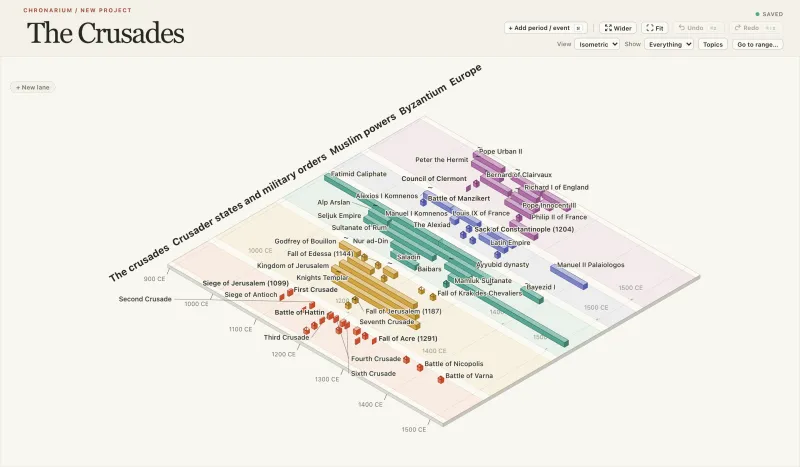
This timeline covers the crusades from 1071 CE to 1444 CE. Five lanes place the crusades, the crusader states and military orders, the Muslim powers, Byzantium and Europe on one shared time axis, so what happened at the same time in different places lines up side by side.

Period covered
1071 – 1444
Entries
70
Lanes
5
Context entries
8 (909 – 1517)
Key dates
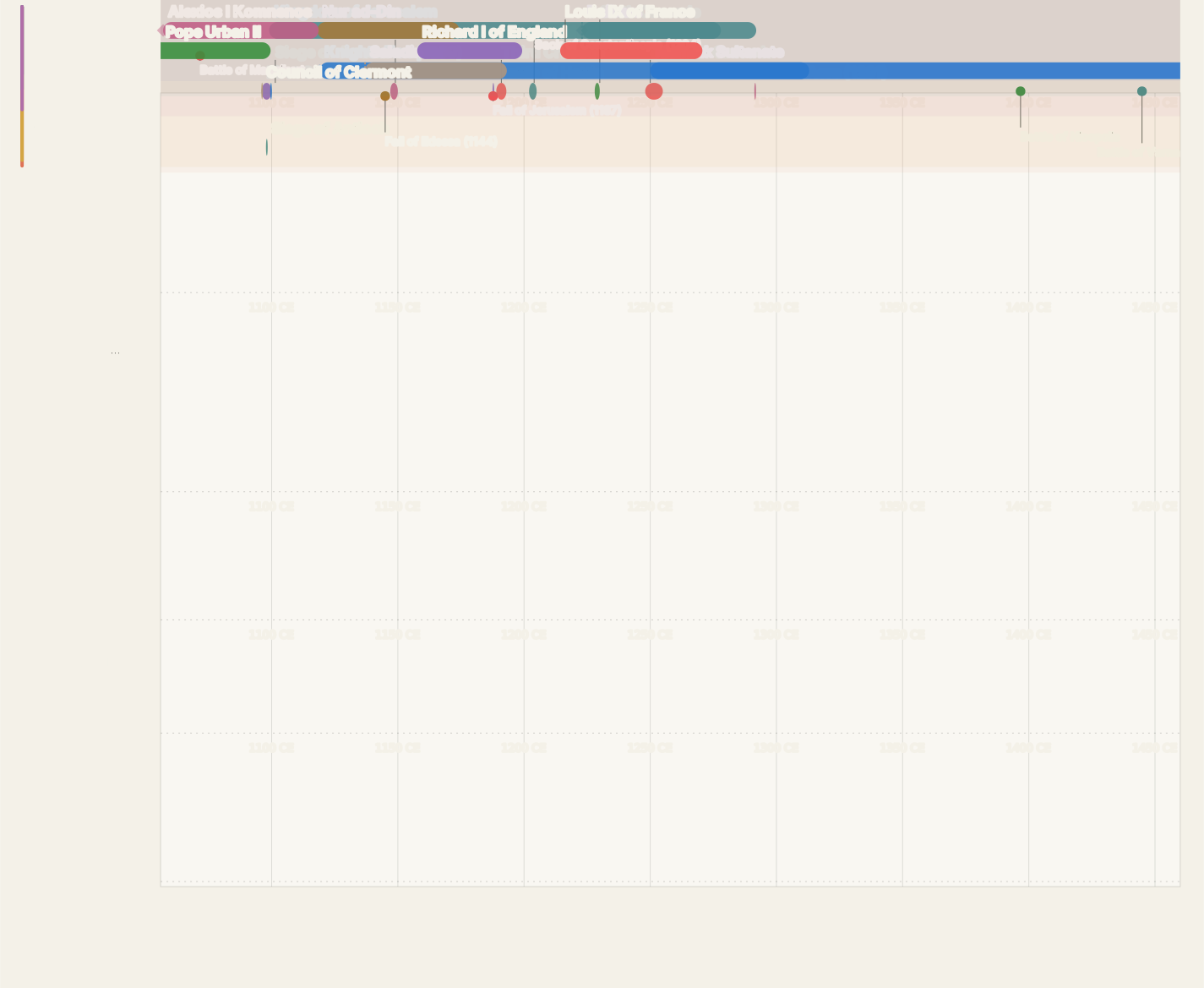
Chronarium’s picture of the Crusades timeline, major entries only, 1056 CE – 1459 CE. Lanes: The crusades, Crusader states and military orders, Muslim powers, Byzantium, Europe.

Loading the live app…

Show the whole picture
· made by Chronarium’s Export → Picture, Major only · open the SVG (177 KB)
In the picture: 27 of 70 entries (major only) · all 70 in the table belowPicture range: 1056 CE – 1459 CE

In the table, 'c.' marks an approximate date, drawn on the timeline with a fading band, and '?' marks a date that published sources disagree on. The table below lists all 70 entries under 5 period headings.

Story

Story by period

Before the crusades

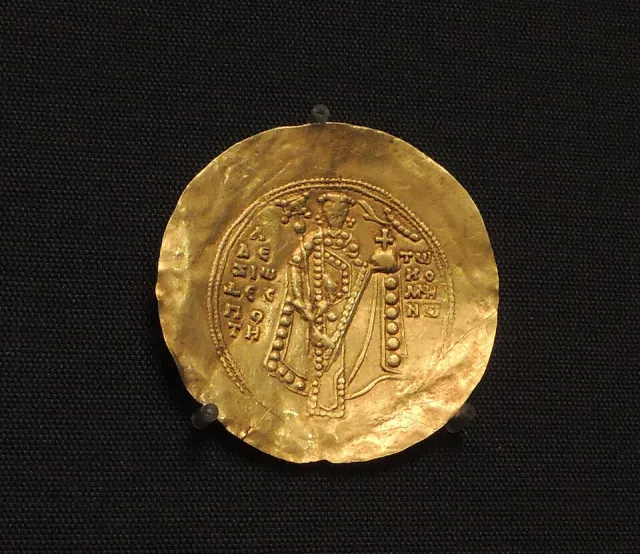
Gold hyperpyron of Alexios I Komnenos
Gold hyperpyron of Alexios I Komnenos, Moscow Kremlin MuseumsImage: shakko · CC BY-SA 4.0 · Wikimedia CommonsIn the table: Alexios I Komnenos

The Seljuk Turks, a Sunni Muslim empire ruling Iran and Iraq, faced Egypt's Shia Fatimid caliphs as bitter rivals. On 26 August 1071 their sultan, Alp Arslan, defeated the Byzantine army at Manzikert and took Emperor Romanos IV Diogenes prisoner. Anatolia, the land also called Asia Minor, now stood open to Turkish conquest, and Byzantine generals fighting one another for the throne helped the Turks take it over. The Seljuks founded the Sultanate of Rum there, ruling from Nicaea. From the Fatimids they seized Jerusalem and the Holy Land, a loss that helped push Western Christians toward a crusade.

Alexios I Komnenos, a general, took the Byzantine throne after a string of defeats had shrunk the empire. The Venetian fleet helped him drive off a Norman invasion, and in return Venice received wide trading privileges throughout the empire. From Isfahan, Malik-Shah, Alp Arslan's son, governed the Seljuks, and his reign is associated with the poet Omar Khayyam and a calendar reform. Rival lords fought for power when Sultan Malik-Shah died, and the Seljuk empire came apart. Facing the Seljuk advance in Anatolia, Alexios I looked to the West for military aid, an appeal that eventually set the First Crusade in motion.

The First Crusade and the crusader states

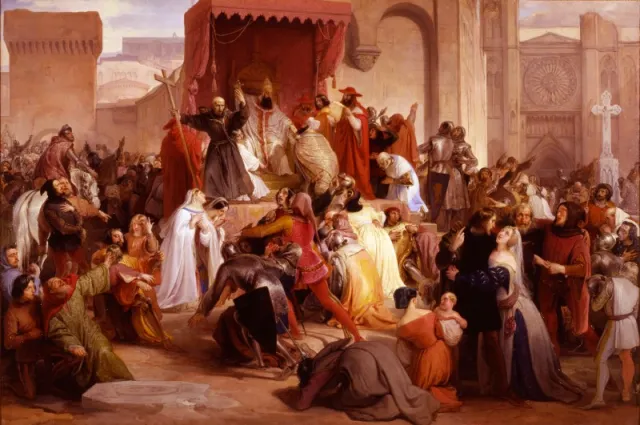
Pope Urban II at Clermont, painting (1835)
Pope Urban II at Clermont, painting (1835), Fondazione Cariplo, MilanImage: Francesco Hayez · CC BY-SA 3.0 · Wikimedia CommonsIn the table: Council of Clermont

In March 1095, envoys of Byzantine emperor Alexios I asked Pope Urban II's Council of Piacenza for military help. Urban II proclaimed a crusade at the Council of Clermont in November 1095, promising remission of sins to those who went. Jewish communities in the Rhineland came under attack from some crusader bands. On 21 October 1096 the Turks destroyed most of the People's Crusade, Peter the Hermit's popular army. Antioch fell to the crusaders on 3 June 1098. Bohemond kept it for himself, breaking his vow to hand captured lands back to the Byzantine emperor.

The crusaders took Jerusalem on 15 July 1099 and slaughtered many of the city's Muslim and Jewish inhabitants. The conquests produced four crusader states: the Kingdom of Jerusalem, the Principality of Antioch, and the Counties of Edessa and Tripoli. Knights who lived like monks made up the new military orders, Templars and Hospitallers among them. Afterward most crusaders went home, and the new states ran short of fighting men. The crusaders also gained from rivalries dividing the region's Muslim rulers, who had not yet united against them. Then a strong Muslim leader came to power against the crusader states: Zangi, ruler of Mosul.

From the fall of Edessa to the Third Crusade

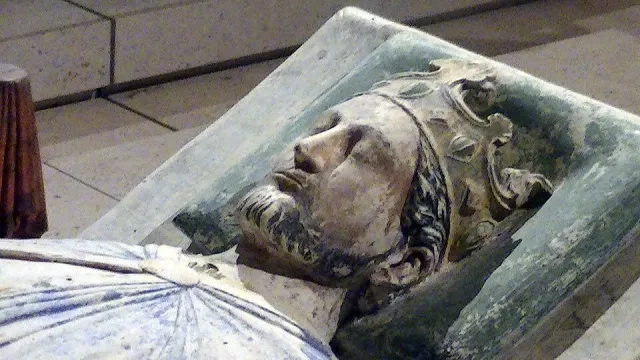
Tomb effigy of Richard I
Tomb effigy of Richard I, Fontevraud AbbeyImage: Adam Bishop · CC BY-SA 3.0 · Wikimedia CommonsIn the table: Richard I of England

Muslim forces captured the crusader city of Edessa on 24 December 1144, sparking the Second Crusade. King Louis VII of France and Conrad III of Germany led it, attacking Damascus but abandoning the siege after just four days. Then Saladin, founder of the Ayyubid dynasty, ruled Egypt and Muslim Syria. At Hattin he destroyed the Kingdom of Jerusalem's army, stripping the crusaders of most of their states and sparking the Third Crusade. On 2 October 1187 Jerusalem surrendered to Saladin, who let its Christians purchase their freedom with a ransom.

Emperor Frederick I Barbarossa, Philip II of France and Richard I of England led the Third Crusade. Germans at the siege of Acre founded a hospital brotherhood for the sick, the beginning of the Teutonic Order. Richard I's arrival revived the siege of Acre, and its garrison surrendered. On 7 September 1191, Richard's crusaders defeated Saladin's army in a battle at Arsuf. He then made peace with Saladin: the crusaders held a coastal strip, and the holy places were open to Christian pilgrims. Jerusalem stayed in Muslim hands, and Acre became the centre of the crusaders' Kingdom of Jerusalem.

The thirteenth-century crusades

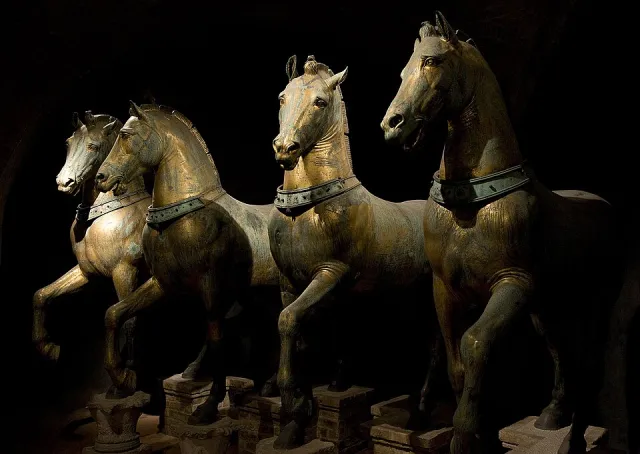
Horses of Saint Mark, bronze
Horses of Saint Mark, bronze, St Mark's Basilica, VeniceImage: Tteske · CC BY 3.0 · Wikimedia CommonsIn the table: Sack of Constantinople (1204)

The Fourth Crusade, meant for the Holy Land, was diverted against Constantinople, a Byzantine city. The crusaders could not pay Venice for its ships, so they seized Zara for the Venetians. On 12 April 1204 they took Constantinople and sacked the city. Baldwin of Flanders, one of the crusade's leaders, became the first Latin emperor of Constantinople. In 1261, forces of the Empire of Nicaea retook Constantinople, and the Byzantine Empire was restored in the city.

From 1209 to 1229 the Albigensian Crusade was waged against the Cathars, a religious movement in the south of France that the Catholic Church had condemned as heretical. In 1212 the Children's Crusade, an outpouring of popular faith, left for Jerusalem without ever reaching the Holy Land. The Fifth Crusade took Damietta in Egypt, but its army later capitulated to Sultan al-Kamil and handed the city back. Despite excommunication, Frederick II secured Jerusalem from the same sultan by diplomacy. Later, Khwarazmian forces in alliance with Egypt's Ayyubid rulers seized Jerusalem from Christian hands. In Egypt, Louis IX's Seventh Crusade met defeat at Mansurah, and the king was taken prisoner and ransomed later.

Soon after, Mamluk officers murdered Turan Shah, Egypt's final Ayyubid sultan, and seized power. On 3 September 1260 the Mamluks defeated the Mongol invasion at the Battle of Ain Jalut. Louis IX died of illness at Tunis, in North Africa, while leading the Eighth Crusade in 1270. Krak des Chevaliers, a castle of the Knights Hospitaller, fell to the Mamluk leader Baibars. The Mamluks then took Acre, the crusaders' last stronghold on the mainland, and the crusader states ceased to exist. Crusading itself went on after Acre, with more crusades in the years to come.

Later crusades

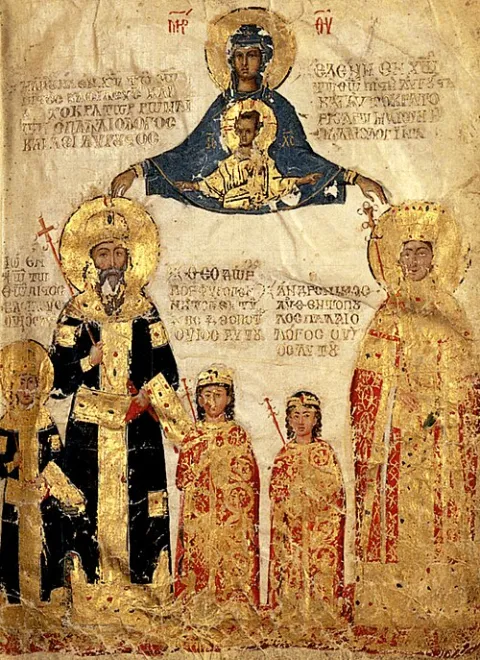
Manuel II and his family, manuscript miniature
Manuel II and his family, manuscript miniature, Louvre, ParisImage: Unknown author · Public domain · Wikimedia CommonsIn the table: Manuel II Palaiologos

From the 14th century on, crusading in the East consisted mostly of small expeditions with narrow goals. In 1365, King Peter I of Cyprus took Alexandria, but his crusade held the city only briefly. Under Sultan Bayezid I, Ottoman armies gained control over much of the Balkans, then turned against the Byzantine Empire. By the 14th century, crusades aimed not just at the Holy Land but also at defending Christians in Europe from the Ottomans. On 25 September 1396, a crusade army of Hungarians and other Europeans was crushed by the Ottomans at Nicopolis. That disaster closed the age of huge international crusades against the Ottoman advance.

Byzantine emperor Manuel II visited Italy, Paris and London seeking Western aid, and was welcomed with honor, but no military help came. Near Ankara, the conqueror Timur, or Tamerlane, overcame Bayezid and held him captive. The Ottomans were weakened for a time after this defeat, but under Sultan Murad II they advanced into Europe once more. King Władysław III of Poland and Hungary broke his truce with the Ottomans, was beaten at Varna, and died in the fighting. The Varna defeat of 1444 ended the West's attempts to save Constantinople, and the Byzantines were left on their own. It was the last major offensive Christians mounted in Europe against the Ottomans, who later conquered Constantinople.

Crusades timeline in Chronarium, Isometric view
Chronarium, Isometric viewall 70 entries · crusades.chronarium.json

Entries

Entries by period

c. approximate date · ? the sources give different dates · Scope the sources date different definitions of it · rows run by start date · how the dates are checked

Before the crusades

1071 – 1094 · 10 entries
DateEventNote
909 CE–1171 CEFatimid Caliphate (Muslim powers)#1, 2Shia caliphate based in Egypt, later abolished by Saladin
c. 1029 CE?–1072 CE?Alp Arslan (Muslim powers)#3, 4Seljuk sultan from 1063, victor at Manzikert.Sources differ: Wikipedia: 20 January 1029 to 24 November 1072. Encyclopaedia Britannica: c. 1030 to November 1072/January 1073. Encyclopedia.com: born 1026, 1029 or 1032, died 1072.
c. 1035 CE–29 July 1099 CEPope Urban II (Europe)#5, 6Pope from 1088; called the First Crusade.
1037 CE?–1194 CESeljuk Empire (Muslim powers)#7, 8A Turkic dynasty holding Iran, Iraq and Syria.Sources differ: Dated 1037–1194 (Wikipedia, Saint Louis Art Museum); 1038–1194 (Encyclopedia.com).
c. 1050 CE–8 July 1115 CEPeter the Hermit (Europe)#9, 10Preacher who led the People's Crusade.
c. 1057 CE–15 August 1118 CEAlexios I Komnenos (Byzantium)#11, 12Emperor from 1081; appealed to the West for aid.
c. 1060 CE–18 July 1100 CEGodfrey of Bouillon (Crusader states and military orders)#13, 14First Crusade leader who became Jerusalem's first ruler; birth year approximate
26 August 1071 CEBattle of Manzikert (Byzantium)#15, 16Emperor Romanos IV defeated and captured by the Seljuks
1077 CE–1308 CE?Sultanate of Rum (Muslim powers)#17, 8Seljuk breakaway state in Anatolia, initially based at Nicaea.Sources differ: Wikipedia and Larousse: 1077–1308. Encyclopedia.com: 1077–1307
c. 1090 CE–20 August 1153 CEBernard of Clairvaux (Europe)#18, 19Cistercian abbot who promoted the Second Crusade; birth year approximate

The First Crusade and the crusader states

1095 – 1143 · 16 entries
DateEventNote
March 1095 CECouncil of Piacenza (Europe)#20, 21Eastern envoys request military aid from Urban II
18 November 1095 CE–28 November 1095 CECouncil of Clermont (Europe)#22, 23Urban II proclaimed the crusade on 27 November.
1096 CE–21 October 1096 CEPeople's Crusade (The crusades)#24, 25A popular army raised by Peter the Hermit; wiped out near Nicaea.
1096 CE–1099 CEFirst Crusade (The crusades)#26, 27Called by Urban II, the armies left in 1096 and Jerusalem fell in 1099
October 1097 CE–3 June 1098 CESiege of Antioch (The crusades)#28, 29Antioch taken after eight months; Bohemond keeps the city
1098 CE–1150 CECounty of Edessa (Crusader states and military orders)#30, 31The earliest crusader state, established by Baldwin of Boulogne.
1098 CE–1268 CEPrincipality of Antioch (Crusader states and military orders)#32, 33Bohemond's principality; surrendered to Baibars in 1268
1099 CE–1291 CEKingdom of Jerusalem (Crusader states and military orders)#34, 35After 1187 the capital moved to Acre
7 June 1099 CE–15 July 1099 CESiege of Jerusalem (1099) (The crusades)#36, 25City fell on 15 July 1099; its inhabitants were massacred
1113 CEKnights Hospitaller (Crusader states and military orders)#37, 38A hospital order in Jerusalem; the pope recognised it in 1113.
February 1118 CE–15 May 1174 CENur ad-Din (Muslim powers)#39, 40Ruled Aleppo and Damascus, preparing the ground for Saladin
28 November 1118 CE–24 September 1180 CEManuel I Komnenos (Byzantium)#41, 42Emperor from 1143; suffered defeat at Myriokephalon
c. 1119 CE–1312 CEKnights Templar (Crusader states and military orders)#43, 44Knights who guarded pilgrims, later dissolved by the pope.
c. 1122 CE–10 June 1190 CEFrederick Barbarossa (Europe)#45, 46Holy Roman emperor who drowned during the Third Crusade.
c. 1137 CE–c. 1148 CEThe Alexiad (Byzantium)#47, 48Anna Komnene's account of her father's reign.
1137 CE?–4 March 1193 CESaladin (Muslim powers)#49, 50Sultan ruling Egypt and Syria; victor at Hattin, took Jerusalem.Sources differ: Born 1137 (World History Encyclopedia) or 1137/38 (Britannica, Encyclopedia.com).

From the fall of Edessa to the Third Crusade

1144 – 1192 · 18 entries
DateEventNote
24 December 1144 CEFall of Edessa (1144) (Crusader states and military orders)#51, 31Zengi's capture of Edessa set off the Second Crusade.
1147 CE–1149 CESecond Crusade (The crusades)#52, 27Conrad III and Louis VII led it; the attack on Damascus failed.
24 July 1148 CE?–28 July 1148 CESiege of Damascus (1148) (The crusades)#53, 54The crusaders abandoned the attack after only four days.Sources differ: Sources give 24–28 July 1148 (Wikipedia, World History Encyclopedia); Britannica gives 23–28 July 1148.
8 September 1157 CE–6 April 1199 CERichard I of England (Europe)#55, 56King of England; a leader of the Third Crusade.
c. 1160 CE–1216 CEPope Innocent III (Europe)#57, 58Pope from 1198 to 1216; he summoned the Fourth Crusade.
c. 1161 CE–1185 CEBaldwin IV of Jerusalem (Crusader states and military orders)#59, 60The leper king; his birth year is approximate; victorious at Montgisard at sixteen.
1165 CE–1223 CEPhilip II of France (Europe)#61, 62King of France; joined the Third Crusade but went home early.
1171 CE–1260 CEAyyubid dynasty (Muslim powers)#63, 64Saladin's dynasty; ruled Egypt until 1250, Syria until 1260, Hama until 1341.
17 September 1176 CEBattle of Myriokephalon (Byzantium)#65, 66The Seljuks trapped Manuel I's army inside a Phrygian pass.
November 1177 CEBattle of Montgisard (Crusader states and military orders)#67, 59Sixteen-year-old Baldwin IV routed Saladin's raiding army.
1182 CEMassacre of the Latins (Byzantium)#68, 69A Constantinople mob killed Genoese and Pisan residents.
3 July 1187 CE–4 July 1187 CEBattle of Hattin (The crusades)#70, 71Saladin's forces wiped out the Latin army of Guy of Lusignan.Scope: Dates here use the dated definition: 3-4 July 1187, march fighting on 3 July and main battle 4 July. The other definition is 4 July 1187 only, the main fighting.
2 October 1187 CEFall of Jerusalem (1187) (Crusader states and military orders)#70, 71Saladin took the city; Balian negotiated its surrender.
1189 CE–1192 CEThird Crusade (The crusades)#72, 73Richard, Philip and Barbarossa answered the call after Hattin.
August 1189 CE–12 July 1191 CESiege of Acre (1189-1191) (The crusades)#72, 74The crusaders retook Acre after a siege lasting two years.
c. 1190 CETeutonic Knights (Crusader states and military orders)#75, 76German hospital order begun at Acre amid the siege
7 September 1191 CEBattle of Arsuf (The crusades)#77, 72Richard I beat Saladin's army near Arsuf.
2 September 1192 CE?Treaty of Ramla (1192) (The crusades)#78, 79A three-year truce between Richard and SaladinSources differ: Wikipedia gives 1 or 2 September 1192, Britannica and Encyclopedia.com 2 September.

The thirteenth-century crusades

1193 – 1291 · 21 entries
DateEventNote
1194 CE–1250 CEEmperor Frederick II (Europe)#80, 81Holy Roman Emperor who led the Sixth Crusade.
1202 CE–1204 CEFourth Crusade (The crusades)#82, 83Venice diverted it to Zara and Constantinople.
1204 CE–1261 CEEmpire of Nicaea (Byzantium)#84, 85Greek government in exile, led by Theodore I Lascaris.
1204 CE–1261 CELatin Empire (Byzantium)#86, 87Crusader state ruling Constantinople, with Baldwin I as first emperor.
12 April 1204 CESack of Constantinople (1204) (Byzantium)#88, 83Fourth Crusade storms the city, followed by three days of looting.
1209 CE–1229 CEAlbigensian Crusade (Europe)#89, 90Papal campaign against the Cathars of southern France.
1212 CEChildren's Crusade (Europe)#91, 92Youth movements across France and Germany; never reached the Holy Land.
25 April 1214 CE–25 August 1270 CELouis IX of France (Europe)#93, 94King of France; he led the Seventh Crusade and the Eighth.
1217 CE–1221 CEFifth Crusade (The crusades)#95, 96Crusaders capture Damietta but surrender at Mansurah.
c. 1223 CE?–1277 CEBaibars (Muslim powers)#97, 98Mamluk sultan from 1260 to 1277; he captured Antioch and Krak.Sources differ: Encyclopaedia Britannica: 1223–1 July 1277; Wikipedia: 19 July 1223 or 1228–30 June 1277; Encyclopedia.com: c. 1223–1 July 1277.
1228 CE–1229 CESixth Crusade (The crusades)#81, 99Frederick II, though excommunicated, regains Jerusalem by treaty.
18 February 1229 CETreaty of Jaffa (1229) (The crusades)#100, 99Al-Kamil and Frederick II agree Jerusalem passes to the Franks.
17 October 1244 CE?Battle of La Forbie (Crusader states and military orders)#101, 31Near Gaza, a force allied with the Ayyubids crushed a Latin army.Sources differ: Wikipedia gives 17–18 October 1244; World History Encyclopedia and University of Edinburgh give 17 October 1244.
1248 CE–1254 CESeventh Crusade (The crusades)#27, 102Louis IX invades Egypt, is captured and later ransomed.
1250 CE–1517 CEMamluk Sultanate (Muslim powers)#103, 104Dynasty of slave-soldiers ruling Egypt and Syria.
3 September 1260 CEBattle of Ain Jalut (Muslim powers)#105, 106Mamluks defeat the Mongols in Galilee.
1261 CERecapture of Constantinople (1261) (Byzantium)#107, 84Strategopoulos takes Constantinople back for Michael VIII.
1270 CEEighth Crusade (The crusades)#106, 108Landing at Tunis, Louis IX dies of illness.
1271 CE–1272 CELord Edward's Crusade (The crusades)#109, 110Edward of England campaigns in Palestine, closed by a ten-year truce.
8 April 1271 CEFall of Krak des Chevaliers (Crusader states and military orders)#111, 112The Hospitaller castle in Syria falls to Baibars.
April 1291 CE–18 May 1291 CEFall of Acre (1291) (The crusades)#113, 114Khalil's Mamluks take Acre, ending Latin mainland rule.

Later crusades

1292 – 1444 · 5 entries · selective coverage
DateEventNote
1350 CE–21 July 1425 CEManuel II Palaiologos (Byzantium)#115, 116Byzantine emperor 1391–1425 who sought help from Western Europe.
c. 1360 CE–1403 CEBayezid I (Muslim powers)#117, 118Ottoman sultan from 1389 to 1402; he was the victor at Nicopolis.
1365 CEAlexandrian Crusade (The crusades)#119, 120Alexandria sacked by Peter I of Cyprus.
25 September 1396 CEBattle of Nicopolis (The crusades)#121, 122Ottomans crush Sigismund's Hungarian-led crusader army.
10 November 1444 CEBattle of Varna (The crusades)#123, 124Ottoman victory over the Hungarian-led crusade in Bulgaria.

Project file

Get this timeline in Chronarium

Open this timeline in Chronarium by downloading crusades.chronarium.json, a free project file. The 4-week free trial includes every feature and needs only an email address, no card.
crusades.chronarium.jsonChronarium project file · JSON · 32 KB

CC BY 4.0: free to share and adapt, with credit to Chronarium

Download the free trial

4-week free trial. Full access, no card needed.macOS 13 or later.

Available for Mac

$39 per year · $79 lifetime

4-week free trial. Full access, no card needed.

Leave your email and we'll send the download link to open on your Mac.

Sources

Sources

Each entry rests on two published sources, with publisher and link listed below, and each date was verified against a third, independent one.

Report a correction · email support@chronarium.app with the entry's name or its # link · how the dates are checked

  1. Encyclopaedia Britannica · britannica.com/topic/Fatimid-dynasty
  2. Wikipedia · en.wikipedia.org/wiki/Fatimid_Caliphate
  3. Wikipedia · en.wikipedia.org/wiki/Alp_Arslan
  4. Encyclopaedia Britannica · britannica.com/biography/Alp-Arslan
  5. Encyclopaedia Britannica · britannica.com/biography/Urban-II
  6. Wikipedia · en.wikipedia.org/wiki/Pope_Urban_II
  7. Wikipedia · en.wikipedia.org/wiki/Seljuk_Empire
  8. Encyclopedia.com · encyclopedia.com/literature-and-arts/art-and-architecture/architecture/seljuk
  9. Encyclopaedia Britannica · britannica.com/biography/Peter-the-Hermit
  10. Wikipedia · en.wikipedia.org/wiki/Peter_the_Hermit
  11. Encyclopaedia Britannica · britannica.com/biography/Alexius-I-Comnenus
  12. Wikipedia · en.wikipedia.org/wiki/Alexios_I_Komnenos
  13. Encyclopaedia Britannica · britannica.com/biography/Godfrey-of-Bouillon
  14. Wikipedia · en.wikipedia.org/wiki/Godfrey_of_Bouillon
  15. Wikipedia · en.wikipedia.org/wiki/Battle_of_Manzikert
  16. Encyclopaedia Britannica · britannica.com/event/Battle-of-Manzikert
  17. Wikipedia · en.wikipedia.org/wiki/Sultanate_of_Rum
  18. Encyclopaedia Britannica · britannica.com/biography/Saint-Bernard-of-Clairvaux
  19. Wikipedia · en.wikipedia.org/wiki/Bernard_of_Clairvaux
  20. Wikipedia · en.wikipedia.org/wiki/Council_of_Piacenza
  21. Encyclopedia.com · encyclopedia.com/people/philosophy-and-religion/roman-catholic-popes-and-antipopes/urban-ii
  22. World History Encyclopedia · worldhistory.org/Council_of_Clermont
  23. Wikipedia · en.wikipedia.org/wiki/Council_of_Clermont
  24. Wikipedia · en.wikipedia.org/wiki/People%27s_Crusade
  25. World History Encyclopedia · worldhistory.org/First_Crusade
  26. Wikipedia · en.wikipedia.org/wiki/First_Crusade
  27. World History Encyclopedia · worldhistory.org/Crusades
  28. Wikipedia · en.wikipedia.org/wiki/Siege_of_Antioch
  29. World History Encyclopedia · worldhistory.org/article/1252/the-siege-of-antioch-1097-98-ce
  30. Wikipedia · en.wikipedia.org/wiki/County_of_Edessa
  31. World History Encyclopedia · worldhistory.org/Crusader_States
  32. Encyclopaedia Britannica · britannica.com/place/Antioch-medieval-principality-Turkey
  33. Wikipedia · en.wikipedia.org/wiki/Principality_of_Antioch
  34. Wikipedia · en.wikipedia.org/wiki/Kingdom_of_Jerusalem
  35. World History Encyclopedia · worldhistory.org/Kingdom_of_Jerusalem
  36. Wikipedia · en.wikipedia.org/wiki/Siege_of_Jerusalem_(1099)
  37. Wikipedia · en.wikipedia.org/wiki/Knights_Hospitaller
  38. World History Encyclopedia · worldhistory.org/Knights_Hospitaller
  39. Encyclopaedia Britannica · britannica.com/biography/Nur-al-Din
  40. Wikipedia · en.wikipedia.org/wiki/Nur_ad-Din_(died_1174)
  41. Encyclopaedia Britannica · britannica.com/biography/Manuel-I-Comnenus
  42. Wikipedia · en.wikipedia.org/wiki/Manuel_I_Komnenos
  43. World History Encyclopedia · worldhistory.org/Knights_Templar
  44. Wikipedia · en.wikipedia.org/wiki/Knights_Templar
  45. Encyclopaedia Britannica · britannica.com/biography/Frederick-I-Holy-Roman-emperor
  46. Wikipedia · en.wikipedia.org/wiki/Frederick_Barbarossa
  47. World History Encyclopedia · worldhistory.org/Anna_Komnene
  48. Wikipedia · en.wikipedia.org/wiki/Alexiad
  49. World History Encyclopedia · worldhistory.org/Saladin
  50. Encyclopaedia Britannica · britannica.com/biography/Saladin
  51. Wikipedia · en.wikipedia.org/wiki/Siege_of_Edessa_(1144)
  52. Wikipedia · en.wikipedia.org/wiki/Second_Crusade
  53. Wikipedia · en.wikipedia.org/wiki/Siege_of_Damascus_(1148)
  54. World History Encyclopedia · worldhistory.org/Second_Crusade
  55. World History Encyclopedia · worldhistory.org/Richard_I_of_England
  56. Wikipedia · en.wikipedia.org/wiki/Richard_I_of_England
  57. Encyclopaedia Britannica · britannica.com/biography/Innocent-III-pope
  58. Wikipedia · en.wikipedia.org/wiki/Pope_Innocent_III
  59. Encyclopaedia Britannica · britannica.com/biography/Baldwin-IV-king-of-Jerusalem
  60. Wikipedia · en.wikipedia.org/wiki/Baldwin_IV_of_Jerusalem
  61. Encyclopaedia Britannica · britannica.com/biography/Philip-II-king-of-France
  62. Wikipedia · en.wikipedia.org/wiki/Philip_II_of_France
  63. Encyclopaedia Britannica · britannica.com/topic/Ayyubid-dynasty
  64. Wikipedia · en.wikipedia.org/wiki/Ayyubid_dynasty
  65. Wikipedia · en.wikipedia.org/wiki/Battle_of_Myriokephalon
  66. World History Encyclopedia · worldhistory.org/Manuel_I_Komnenos
  67. Wikipedia · en.wikipedia.org/wiki/Battle_of_Montgisard
  68. Wikipedia · en.wikipedia.org/wiki/Massacre_of_the_Latins
  69. Encyclopaedia Britannica · britannica.com/biography/Andronicus-I-Comnenus
  70. World History Encyclopedia · worldhistory.org/Battle_of_Hattin
  71. Wikipedia · en.wikipedia.org/wiki/Battle_of_Hattin
  72. World History Encyclopedia · worldhistory.org/Third_Crusade
  73. Wikipedia · en.wikipedia.org/wiki/Third_Crusade
  74. Wikipedia · en.wikipedia.org/wiki/Siege_of_Acre_(1189%E2%80%931191)
  75. World History Encyclopedia · worldhistory.org/Teutonic_Knights
  76. Wikipedia · en.wikipedia.org/wiki/Teutonic_Order
  77. Wikipedia · en.wikipedia.org/wiki/Battle_of_Arsuf
  78. Wikipedia · en.wikipedia.org/wiki/Treaty_of_Ramla
  79. Encyclopaedia Britannica · britannica.com/event/Crusades/The-Third-Crusade
  80. Encyclopaedia Britannica · britannica.com/biography/Frederick-II-Holy-Roman-emperor
  81. World History Encyclopedia · worldhistory.org/Frederick_II
  82. Wikipedia · en.wikipedia.org/wiki/Fourth_Crusade
  83. World History Encyclopedia · worldhistory.org/Fourth_Crusade
  84. Encyclopaedia Britannica · britannica.com/place/empire-of-Nicaea
  85. World History Encyclopedia · worldhistory.org/Empire_of_Nicaea
  86. Wikipedia · en.wikipedia.org/wiki/Latin_Empire
  87. World History Encyclopedia · worldhistory.org/Latin_Empire
  88. Wikipedia · en.wikipedia.org/wiki/Siege_of_Constantinople_(1204)
  89. Encyclopaedia Britannica · britannica.com/event/Albigensian-Crusade
  90. Wikipedia · en.wikipedia.org/wiki/Albigensian_Crusade
  91. World History Encyclopedia · worldhistory.org/Children's_Crusade
  92. Encyclopaedia Britannica · britannica.com/event/Childrens-Crusade
  93. Encyclopedia.com · encyclopedia.com/people/history/french-history-biographies/louis-ix
  94. Wikipedia · en.wikipedia.org/wiki/Louis_IX_of_France
  95. World History Encyclopedia · worldhistory.org/Fifth_Crusade
  96. Wikipedia · en.wikipedia.org/wiki/Fifth_Crusade
  97. Encyclopaedia Britannica · britannica.com/biography/Baybars-I
  98. Wikipedia · en.wikipedia.org/wiki/Baibars
  99. Wikipedia · en.wikipedia.org/wiki/Sixth_Crusade
  100. World History Encyclopedia · worldhistory.org/Sixth_Crusade
  101. Wikipedia · en.wikipedia.org/wiki/Battle_of_La_Forbie
  102. Wikipedia · en.wikipedia.org/wiki/Seventh_Crusade
  103. Wikipedia · en.wikipedia.org/wiki/Mamluk_Sultanate
  104. World History Encyclopedia · worldhistory.org/Mamluk_Sultanate
  105. Wikipedia · en.wikipedia.org/wiki/Battle_of_Ain_Jalut
  106. World History Encyclopedia · worldhistory.org/Eighth_Crusade
  107. Wikipedia · en.wikipedia.org/wiki/Recapture_of_Constantinople
  108. Wikipedia · en.wikipedia.org/wiki/Eighth_Crusade
  109. Wikipedia · en.wikipedia.org/wiki/Ninth_Crusade
  110. World History Encyclopedia · worldhistory.org/Edward_I_of_England
  111. Wikipedia · en.wikipedia.org/wiki/Krak_des_Chevaliers
  112. World History Encyclopedia · worldhistory.org/Krak_des_Chevaliers
  113. World History Encyclopedia · worldhistory.org/article/1267/the-siege-of-acre-1291-ce
  114. Wikipedia · en.wikipedia.org/wiki/Siege_of_Acre_(1291)
  115. Encyclopaedia Britannica · britannica.com/biography/Manuel-II-Palaeologus
  116. Wikipedia · en.wikipedia.org/wiki/Manuel_II_Palaiologos
  117. Encyclopaedia Britannica · britannica.com/biography/Bayezid-I
  118. Wikipedia · en.wikipedia.org/wiki/Bayezid_I
  119. Wikipedia · en.wikipedia.org/wiki/Alexandrian_Crusade
  120. Encyclopaedia Britannica · britannica.com/biography/Peter-I-king-of-Cyprus
  121. Wikipedia · en.wikipedia.org/wiki/Battle_of_Nicopolis
  122. Encyclopaedia Britannica · britannica.com/event/Battle-of-Nicopolis
  123. Wikipedia · en.wikipedia.org/wiki/Battle_of_Varna
  124. Encyclopaedia Britannica · britannica.com/event/Battle-of-Varna