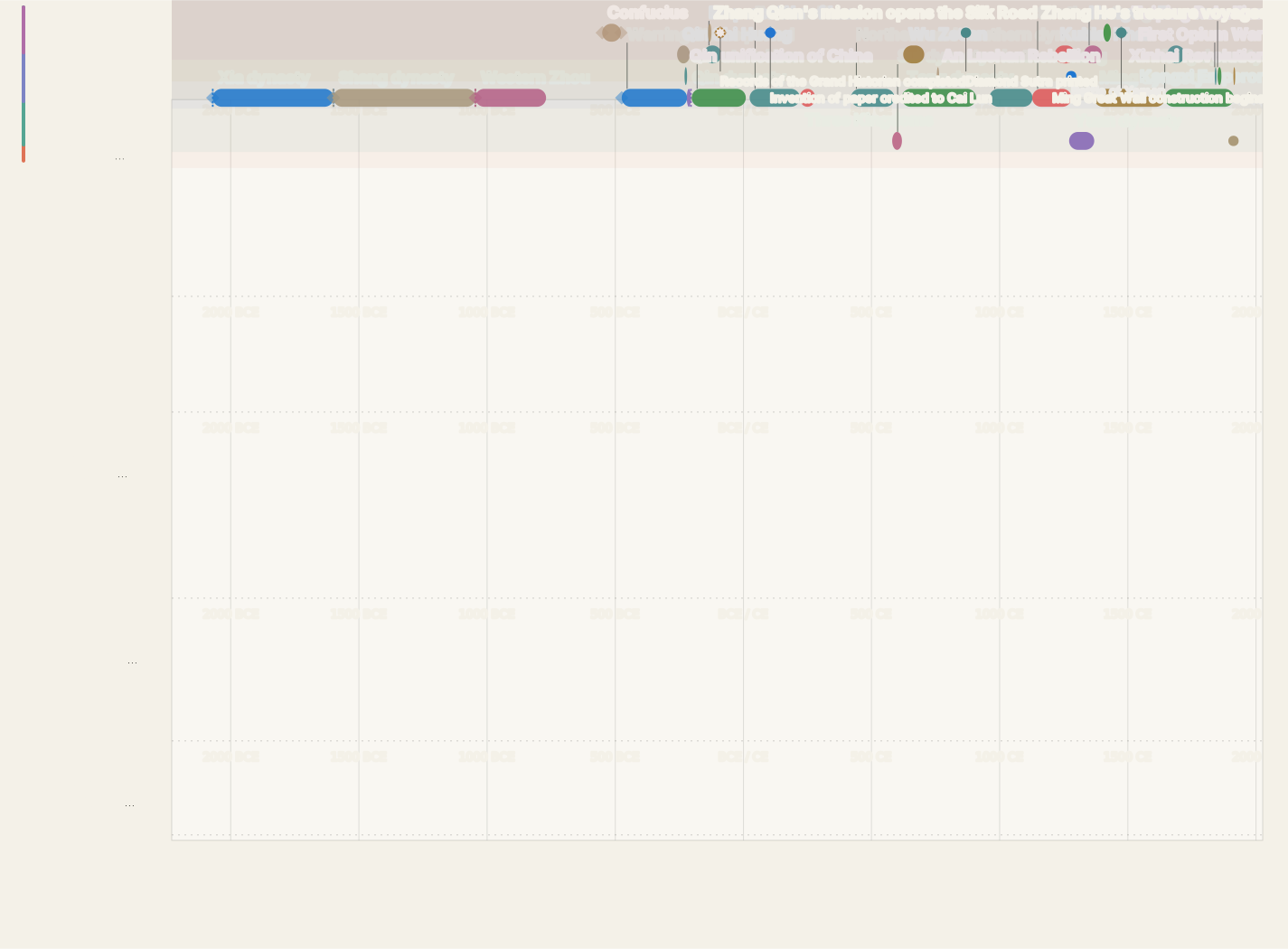
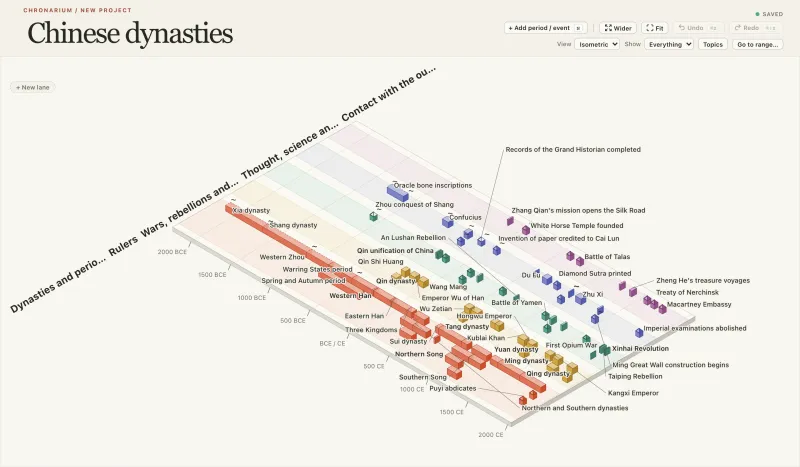
This timeline covers China from c. 2070 BCE to 1912 CE, spanning Xia, Shang and Zhou through Qing and the end of the empire. Five lanes put the record side by side: Dynasties and periods of division, Rulers, Wars, rebellions and conquests, Thought, science and culture, and Contact with the outside world. Events from the same time appear next to each other, so what was happening in one place lines up with what was happening elsewhere.
Show the whole picture· made by Chronarium’s Export → Picture, Major only · open the SVG (212 KB)In the picture: 36 of 89 entries (major only) · all 89 in the table belowPicture range: 2230 BCE – 2025 CE
CC BY 4.0, credit Chronarium · Opens in Chronarium for Mac · 4-week free trial, no card · more below
A "c." before a date means it is approximate (drawn on the timeline as a fading band); a "?" after a date means sources disagree on it. The table below lists all 89 entries, grouped under 7 period headings.
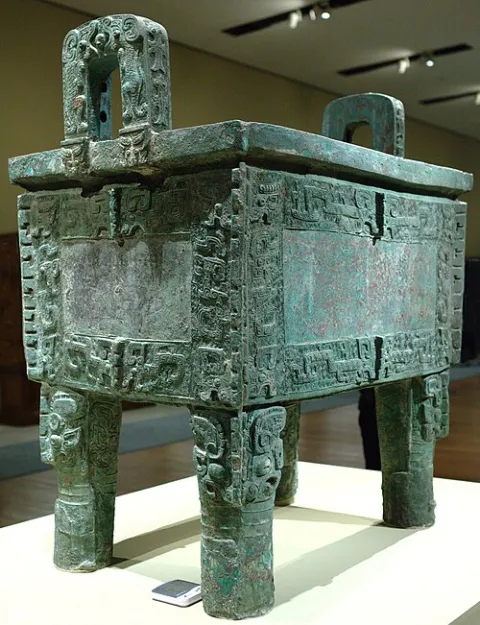
Legend credits Yu the Great, tamer of a great flood, with founding the Xia dynasty. Tradition says Tang overthrew Jie, the last Xia king, founding the Shang dynasty. Shang oracle bones, bone and turtle shell inscribed for divination, carry the earliest known Chinese writing. King Wu of Zhou then overthrew the last Shang ruler, ending Shang rule. The Zhou held kings kept the Mandate of Heaven only while ruling with virtue. To hold these conquests, they granted land to relatives and nobles, who ruled their own states while owing the king loyalty.
After the Zhou kings shifted their capital east to Luoyang, real power slipped from them to regional lords. Confucius taught that good government and order in society rested on a ruler's virtue, not on force or power. Then, in the Warring States period, seven major states fought for control of China. Qin's king Zheng took up the ideas of Han Fei, a Legalist philosopher. Qin's rulers concentrated power under strict laws, and these changes gave Qin the strength to conquer its rivals.
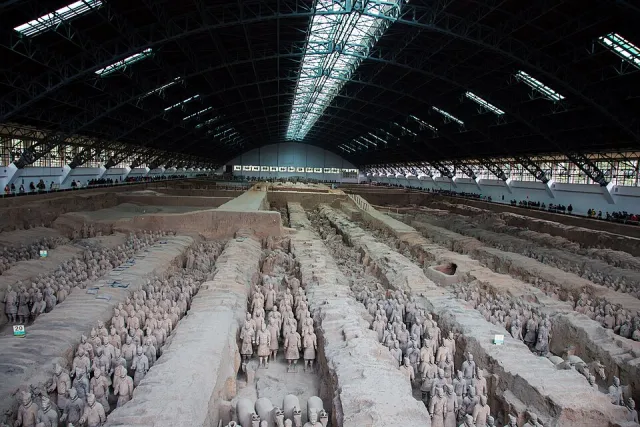
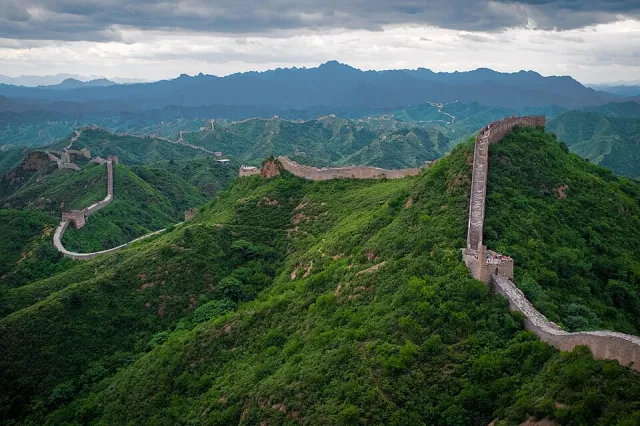
Ying Zheng of Qin brought China's states together, founded the Qin dynasty, and took the title Shi Huangdi, the First Emperor. To hold off the nomadic Xiongnu, he ordered a northern border wall made from older walls, an early Great Wall. Harsh rule bred unrest, and soon after he died the Qin dynasty fell. Liu Bang overcame his rival Xiang Yu and established the Han dynasty. Under Emperor Wu, Confucianism became the Han state's official doctrine. Zhang Qian's mission led Han China and the West into new contact and exchanges.
Wang Mang, a Han official, seized the throne and set up the Xin dynasty; his reforms failed. Emperor Guangwu then began the Eastern Han and set the capital at Luoyang. Tradition traces papermaking to Cai Lun, a court official, c. 105 CE. In 184 CE the Yellow Turban Rebellion badly weakened the dynasty; the generals who crushed it gained power. In 208 CE at Red Cliffs, the general Cao Cao suffered defeat, ending his attempt to unite China. The single empire then split into three separate kingdoms, ending the Han dynasty.
Three Kingdoms to the Northern and Southern dynasties
When the Han dynasty fell in 220 CE, China divided into three rival kingdoms, Wei, Shu and Wu. In 265 CE the Wei general Sima Yan seized power, established the Jin dynasty and reunited China by 280 CE. After his death the Jin empire came apart in a civil war between Sima princes, the War of the Eight Princes. As Jin crumbled, non-Chinese peoples, the Xiongnu among them, stepped into the power vacuum and founded their own states, the Sixteen Kingdoms. Jin survivors escaped south and set up the Eastern Jin at Jiankang, today's Nanjing.
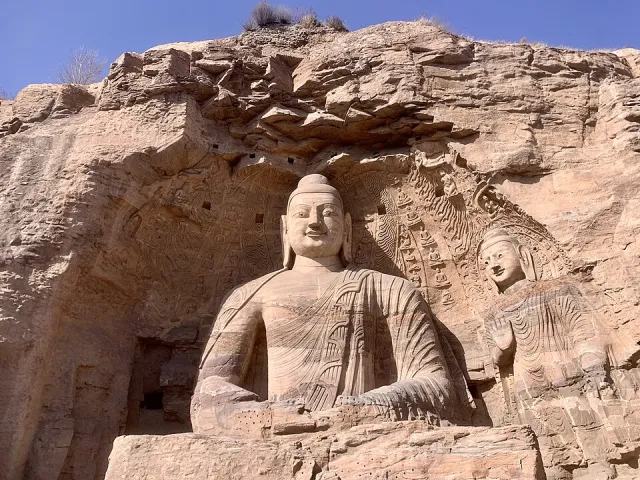
The turmoil of the age weakened Confucianism, and China opened to Daoism and to Buddhism coming from India. In the north, the Northern Wei, founded by the Tuoba people, brought all of northern China under one rule. The dynasty's rulers adopted Chinese culture and shifted their capital to Luoyang. They also gave their backing to Buddhism, funding the great cave temples at Yungang and afterward at Longmen. As a Northern Zhou commander, Yang Jian helped win the war that placed northern China under that dynasty.
In 589 CE the Sui defeated the last southern dynasty; China was one state again. The short-lived dynasty reformed government and created institutions the longer-lasting Tang built on. Masses of forced labourers built the Grand Canal, joining northern China to the Yangtze River. Its wars against Korea failed; widespread rebellion then broke out. After Emperor Yangdi died, Li Yuan founded the Tang, proclaiming himself emperor in 618 CE. In 690 CE Wu Zetian founded a new Zhou dynasty and declared herself emperor, the only woman who ruled China in her own right.
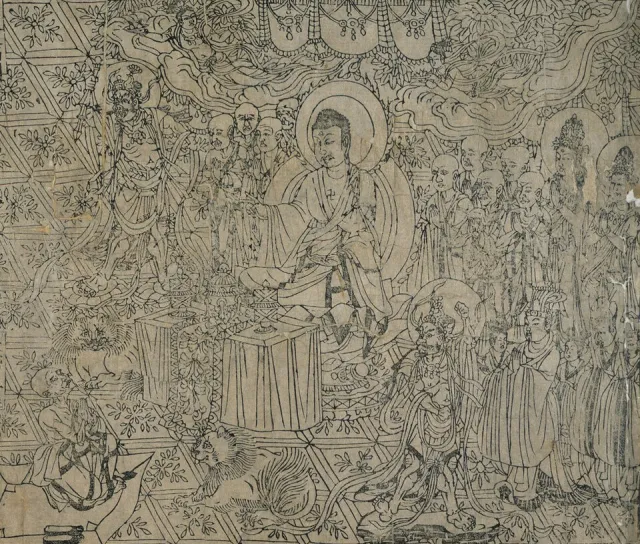
Tang rule then reached a golden age, with Chinese culture and the arts at a high point. In 755 CE the general An Lushan rose against Tang rule and declared himself emperor. After the rebellion was finally put down, generals and warlords governed many parts of a weakened empire. The Buddhist Diamond Sutra, produced by printing in China in 868 CE, is the oldest known printed book.
After the Tang fell, five brief dynasties rose one after another, while ten kingdoms held power alongside them. In Manchuria and Mongolia, the Khitan people formed the Liao dynasty and ruled those lands. The general Zhao Kuangyin, known as Taizu, took power and founded the Song dynasty. As a safeguard against military threats, he cut the power of his leading army commanders. When a border war ended, the Song promised the Liao annual payments in exchange for peace. In Song times, Bi Sheng produced movable type from baked clay.
The Jurchen established the Jin dynasty and, with Song help, brought down the Liao. The Jin then turned on the Song, struck the capital at Kaifeng, and took the Song emperor prisoner. The Song court then regrouped in the south as the Southern Song and made Hangzhou its capital. Zhu Xi, the philosopher, gathered Neo-Confucian thought into one synthesis. Under Ogedei Khan, the Mongols ended the Jin dynasty. The Mongol ruler Kublai Khan then sent his armies against the Song in southern China.
Kublai Khan named his Mongol dynasty the Yuan in 1271 CE and made his capital at Dadu, today's Beijing. Song loyalists resisted until 1279 CE; their final defeat finished the Mongol conquest of China. He ranked his subjects in four classes, Mongols on top, Chinese below. Infighting at court, corruption and natural disasters drove rebellions that toppled the Yuan. Zhu Yuanzhang, a poor orphaned peasant turned begging monk, joined a popular revolt against Mongol rule.
In 1368 CE, Zhu Yuanzhang founded the Ming dynasty and made himself emperor; his reign name was Hongwu. The Yongle Emperor shifted the capital to Beijing and started building the Forbidden City. Zheng He led seven voyages reaching India, the Persian Gulf and Africa's east coast. The Ming counted on the Great Wall against the Mongols, a constant threat. Late in the dynasty, famine caused great unrest: starving men formed marauding bands, while others joined the rebels. In Manchuria, Nurhaci founded a Manchu state that would rule China as the Qing dynasty.
The Ming general Wu Sangui went over to the Manchus, and their combined armies expelled the rebel Li Zicheng and seized Beijing for the Qing. Under Qianlong, military campaigns widened the empire to its greatest extent. Qianlong's court took Britain's Macartney mission as tribute, refusing its requests for wider trade. China's drive to end the foreign opium trade brought on the First Opium War. Losses in the two Opium Wars forced China to give foreign powers special legal rights, territory and trade privileges.
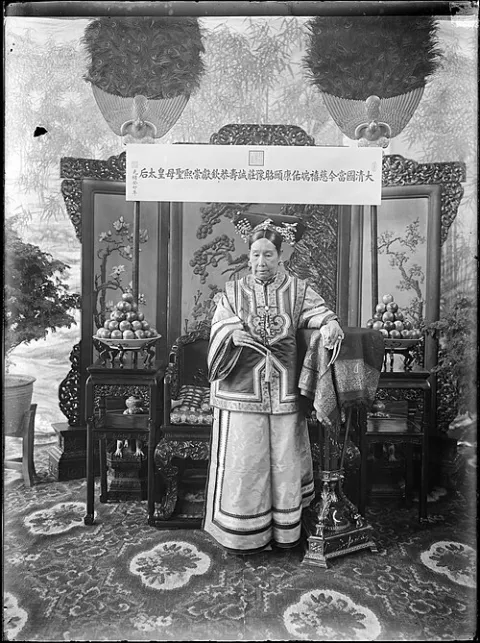
The Taiping Rebellion left the dynasty severely weakened. During the Boxer uprising, foreign troops captured Beijing, and the empress dowager Cixi fled the capital. The court abolished the civil service examination system in 1905 CE, a late attempt at reform. An uprising at Wuchang opened the revolution and became a nationalist revolt against the Qing. At Nanjing, Sun Yat-sen won election as provisional president of a new republican government. On 12 February 1912 CE Puyi was forced to abdicate; Qing rule ended after 267 years, imperial rule after 2,000 years.
c. approximate date · ? the sources give different dates · Scope the sources date different definitions of it · rows run by start date · how the dates are checked
Xia, Shang and Zhou
c. 2070 BCE – 222 BCE · 13 entries
Date
Event
Note
c. 2070 BCE?–c. 1600 BCE?
Xia dynasty (Dynasties and periods of division)#1, 2
Founder Yu the GreatSources differ: Wikipedia; World History Encyclopedia: start c. 2070 BCE, end c. 1600 BCE (Shang start: 1554 BCE (David Pankenier), 1766 BCE (Liu Xin)); Asia for Educators, Columbia University: ca. 2100 BCE.
c. 1600 BCE?–c. 1046 BCE?
Shang dynasty (Dynasties and periods of division)#3, 4
Earliest firmly attested dynastySources differ: Start: c. 1600 BCE (the Xia-Shang-Zhou Chronology Project, per Wikipedia), 1554 BCE (David Pankenier), 1766 BCE (Liu Xin); end: c. 1046 BCE (the Chronology Project), 1122 BCE (Liu Xin).
c. 1250 BCE–c. 1046 BCE?
Oracle bone inscriptions (Thought, science and culture)#5, 6
The oldest writing known from China, cut into bone and shell for Shang divination.Sources differ: World History Encyclopedia and Cambridge University Press c. 1250–1046 BCE, Wikipedia c. 1250–1050 BCE.
c. 1046 BCE?
Zhou conquest of Shang (Wars, rebellions and conquests)#4, 3
King Wu's defeat of the Shang at MuyeSources differ: World History Encyclopedia, Wikipedia and OpenStax all give c. 1046 BCE; older chronologies say 1122 BCE (Liu Xin) or 1027 BCE (Bamboo Annals).
c. 1046 BCE?–771 BCE
Western Zhou (Dynasties and periods of division)#7, 8
Zhou kings ruling from Hao, the dynasty that invoked the Mandate of Heaven.Sources differ: Wikipedia, Asia for Educators and Oxford University Press put the start at c. 1046 BCE; traditional chronologies say 1122 BCE or 1027 BCE.
770 BCE–c. 475 BCE
Spring and Autumn period (Dynasties and periods of division)#8, 9
Early Eastern Zhou: many states, with Zhou kings reduced to figureheads.Scope: Dates follow 770 to c. 475 BCE, the Warring States start used here. Others end at 481 BCE, when the Lu chronicle closes, or 453 BCE, the partition of Jin.
770 BCE–256 BCE
Eastern Zhou (Dynasties and periods of division)#10, 11
Court relocated to Luoyang while royal authority faded.
Warring States period (Dynasties and periods of division)#14, 15
Seven rival states at war until Qin finally unified China.Scope: This entry dates the period c. 475 to 221 BCE. Other dating starts at 481 BCE (where the Lu chronicle closes), 453 BCE (the partition of Jin), or 403 BCE.
The Han dynasty's founder, who ruled as Emperor Gaozu.Sources differ: EBSCO Research Starters and Smithsonian National Museum of Asian Art give 256–195 BCE; Wikipedia allows 247 BC.
230 BCE–221 BCE
Qin unification of China (Wars, rebellions and conquests)#22, 15
Six rival states fell to Qin; Zheng took the imperial title.
Qin and Han
221 BCE – 219 · 15 entries
Date
Event
Note
c. 221 BCE
Qin Great Wall construction begins (Thought, science and culture)#16, 23
Qin Shi Huang joined earlier walls for defense against the Xiongnu.
221 BCE–206 BCE?
Qin dynasty (Dynasties and periods of division)#24, 25
China's first imperial dynasty, created when Shi Huangdi unified the country.Sources differ: Wikipedia and Britannica give 207 BCE; World History Encyclopedia, Smithsonian National Museum of Asian Art and Asia for Educators give 206 BCE.
206 BCE?–202 BCE
Chu-Han Contention (Wars, rebellions and conquests)#26, 27
Liu Bang over Xiang YuSources differ: Wikipedia and World History Encyclopedia give 206–202 BCE, Cambridge University Press 207–202 BCE.
202 BCE–9 CE
Western Han (Dynasties and periods of division)#28, 27
Liu Bang took the imperial title; the capital was Chang'an.
Han emperor known for the Xiongnu wars, Confucian orthodoxy and sending Zhang Qian.
138 BCE–126 BCE
Zhang Qian's mission opens the Silk Road (Contact with the outside world)#31, 27
Mission to the Yuezhi.
133 BCE
Mayi ambush begins the Han-Xiongnu War (Wars, rebellions and conquests)#32, 33
The failed trap set for the Xiongnu brought decades of war.
c. 91 BCE?
Records of the Grand Historian completed (Thought, science and culture)#34, 35
Sima Qian's history of China, the model followed by later histories.Sources differ: Wikipedia and University of Chicago Press give about 91 BCE; World History Encyclopedia gives about 94 BCE.
Xin dynasty (Dynasties and periods of division)#37, 27
Wang Mang seized the throne, but his reforms failed.
25 CE–220 CE
Eastern Han (Dynasties and periods of division)#27, 8
Guangwu restored the Han; the capital was Luoyang.
c. 68 CE
White Horse Temple founded (Contact with the outside world)#38, 39
Its founding is tied to Emperor Ming, who dispatched envoys westward.
c. 105 CE
Invention of paper credited to Cai Lun (Thought, science and culture)#16, 40
Cai Lun of the Imperial Workshops at Luoyang is credited with improving papermaking.Scope: Dates follow the traditional date of 105 CE for Cai Lun's refined paper. Archaeology puts primitive hemp paper earlier, in the 2nd century BCE.
184 CE
Yellow Turban Rebellion breaks out (Wars, rebellions and conquests)#41, 42
A Daoist-led peasant revolt that weakened the Han.
208 CE
Battle of Red Cliffs (Wars, rebellions and conquests)#43, 44
Liu Bei and Sun Quan defeated Cao Cao in a Yangtze battle.
Three Kingdoms to the Northern and Southern dynasties
220 – 580 · 7 entries
Date
Event
Note
220 CE–280 CE
Three Kingdoms (Dynasties and periods of division)#45, 46
The era when Wei, Shu and Wu divided China.Scope: Dates follow 220 CE to 280, ending with Jin's conquest of Wu. Other dating ends at 265, when the Wei throne passed to the Jin.
265 CE–420 CE
Jin dynasty (265-420) (Dynasties and periods of division)#47, 48
The Sima family's rule briefly reunited China before the dynasty fled south in 317.
291 CE–306 CE
War of the Eight Princes (Wars, rebellions and conquests)#49, 50
Sima princes fought for control over the Jin court.
304 CE–439 CE
Sixteen Kingdoms (Dynasties and periods of division)#51, 52
Short-lived northern states until Northern Wei unified the north.
386 CE–534 CE?
Northern Wei (Dynasties and periods of division)#53, 54
A dynasty of the Tuoba Xianbei, which moved its capital to Luoyang in 493.Sources differ: Wikipedia 386–535; EBSCO Research Starters 386–534 CE; Cambridge University Press 386–534.
420 CE–589 CE
Northern and Southern dynasties (Dynasties and periods of division)#55, 56
A period when north and south were ruled separately and Buddhism spread.Scope: Dates follow 420 to 589, beginning with the founding of the Liu Song in the south. Other sources begin at 386, the Northern Wei founding, and end at 589.
Born Li Shimin, he became the Tang dynasty's second emperor and reigned from 626 to 649.
605 CE?–610 CE?
Grand Canal built under the Sui (Thought, science and culture)#64, 65
Ordered by emperors Wen and Yang to join the Yellow River to the Yangtze.Sources differ: Wikipedia gives 604–609; EBSCO Research Starters, 605–610; Columbia's Asia for Educators, about 605–610.
618 CE–907 CE
Tang dynasty (Dynasties and periods of division)#66, 67
Remembered as a golden age for poetry, commerce and the Buddhist faith.
Leader of the Khitan who founded the Liao dynasty.
Five Dynasties, Song, Liao and Jin
907 – 1270 · 13 entries
Date
Event
Note
907 CE–979 CE
Five Dynasties and Ten Kingdoms (Dynasties and periods of division)#81, 82
A divided age: five dynasties ruled the north in turn while ten kingdoms held much of the south.Scope: Dates run 907 to 979, ending when the Song took Northern Han, the last Ten Kingdoms holdout. Other sources close the period at 960, the Song founding.
916 CE–1125 CE
Liao dynasty (Dynasties and periods of division)#83, 79
A Khitan empire ruling the north until the Jurchens overthrew it.Scope: Dates run 916 to 1125, ending when Jurchen forces captured the last Liao emperor. Some sources start the dynasty at 907, with Abaoji's accession.
Yuan dynasty (Dynasties and periods of division)#102, 103
Proclaimed by Kublai Khan as the Mongol dynasty; its capital was Dadu (Beijing).
1275 CE?–1292 CE?
Marco Polo at Kublai Khan's court (Contact with the outside world)#16, 100
A traveller from Venice serves the Yuan and later writes his Travels.Sources differ: Smithsonian National Museum of Asian Art, Encyclopedia.com and University of Washington give 1275 to 1292; Britannica also lists 1274 and 1290 per Matsuo Otagi.
19 March 1279 CE
Battle of Yamen (Wars, rebellions and conquests)#103, 104
The Mongol Yuan fleet destroyed the last of the Song loyalists.
Zhu Yuanzhang, a peasant rebel who went on to found the Ming.
1351 CE–1368 CE?
Red Turban Rebellion (Wars, rebellions and conquests)#107, 108
A peasant revolt that brings down the Yuan and carries Zhu Yuanzhang to power.Sources differ: Wikipedia 1351–1368; EBSCO Research Starters 1351–1356; Eco-Vector, China: Society and Culture 1351–1368.
Xinhai Revolution (Wars, rebellions and conquests)#146, 147
Began with the Wuchang uprising, which brought down Qing rule and led to a republic.
1 January 1912 CE
Republic of China founded (Dynasties and periods of division)#148, 149
Sun Yat-sen becomes provisional president of the new republic at Nanjing.
12 February 1912 CE
Puyi abdicates (Dynasties and periods of division)#147, 149
The last emperor of the Qing dynasty steps down; imperial rule in China ends.
Project file
Get this timeline in Chronarium
The timeline is also a project file, chinese-dynasties.chronarium.json, a free download that opens in Chronarium on a Mac. The 4-week free trial includes every feature and starts with an email address, no card.