Roman Empire Timeline

This timeline spans c. 753 BCE to 1453 CE: the Roman Kingdom, the Republic, the Principate, the crisis of the late empire and the Eastern Roman Empire after 476. Its 89 entries sit in four lanes: politics and rulers, wars and frontiers, society, culture and religion, and Rome's neighbours. All four lanes share one time axis, so what happened at the same time in different places lines up side by side.

Period covered
c. 753 BCE – 1453 CE
Entries
89
Lanes
4
Context entries
1 (from 814 BCE)
Key dates
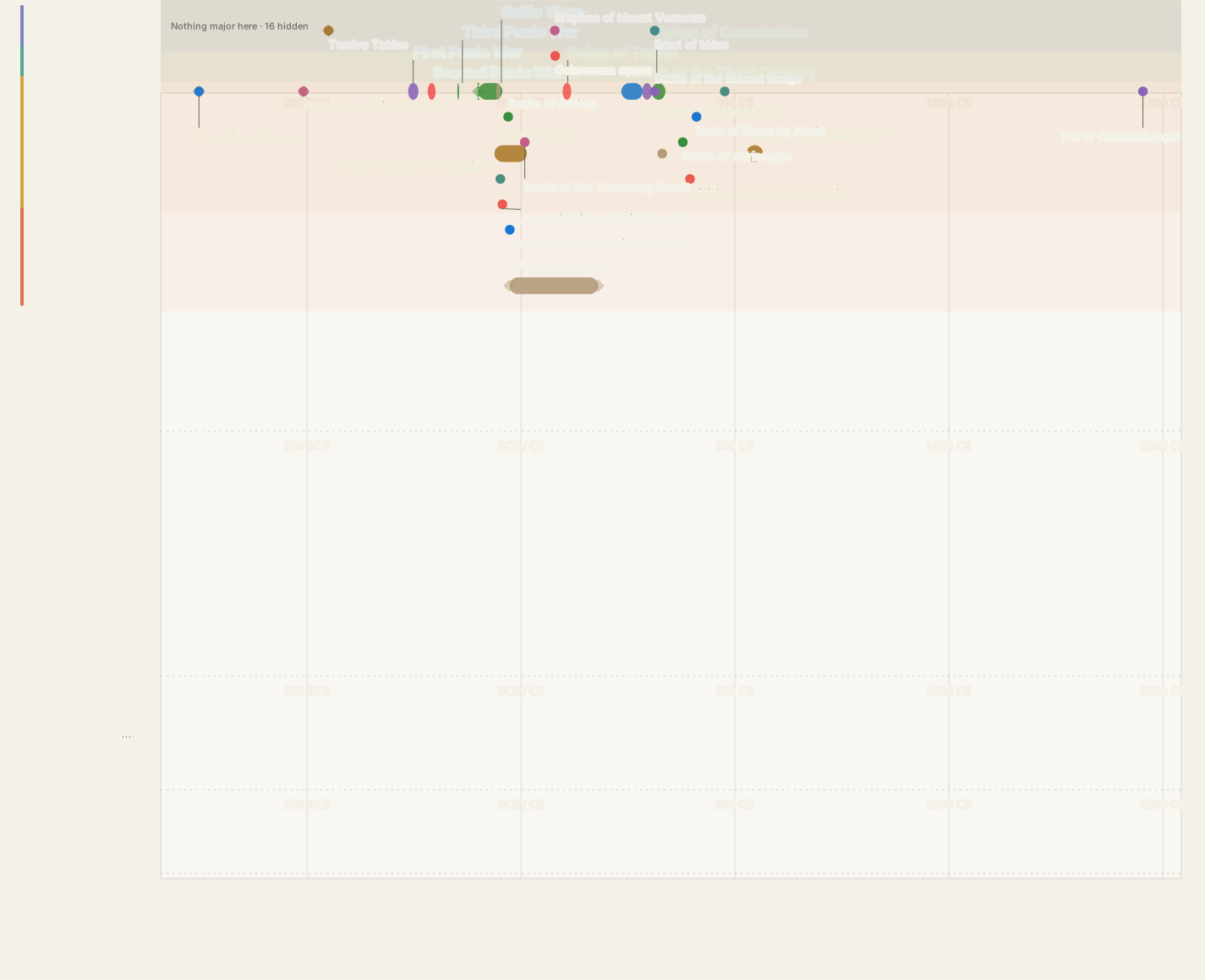
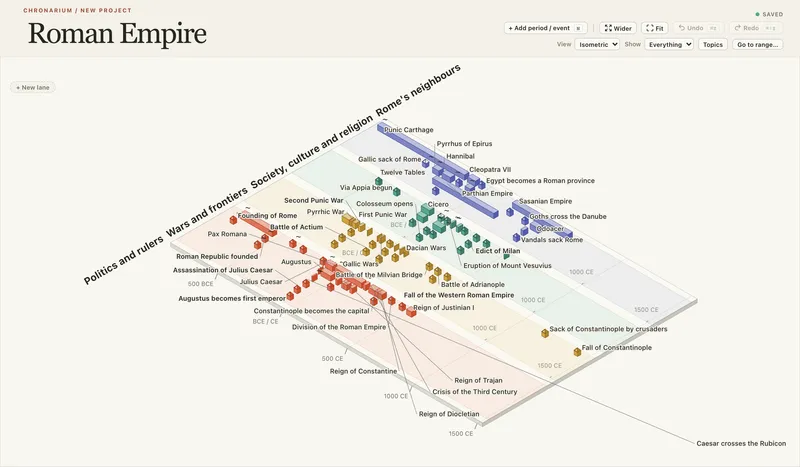
Chronarium’s picture of the Roman Empire timeline, major entries only, 842 BCE – 1542 CE. Lanes: Politics and rulers, Wars and frontiers, Society, culture and religion, Rome's neighbours.

Loading the live app…

Show the whole picture
· made by Chronarium’s Export → Picture, Major only · open the SVG (163 KB)
In the picture: 30 of 89 entries (major only) · all 89 in the table belowPicture range: 842 BCE – 1542 CE

In the table, 'c.' marks an approximate date, drawn on the timeline with a fading band, and '?' means published sources disagree on the date. The table below lists all 89 entries, grouped under 6 period headings.

Story

Story by period

The Roman Kingdom

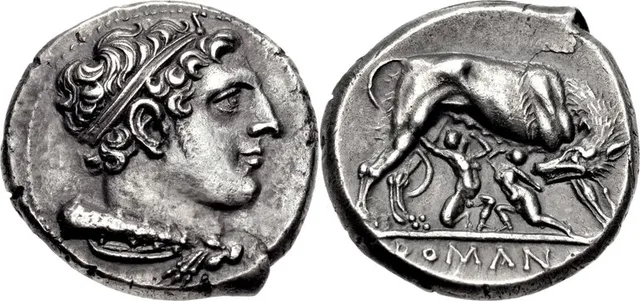
Didrachm with the she-wolf and twins
Didrachm with the she-wolf and twins, Classical Numismatic GroupImage: CNG · CC BY-SA 2.5 · Wikimedia CommonsIn the table: Founding of Rome

According to legend, Rome began with the twins Romulus and Remus, and Romulus killed his brother. Tradition placed Rome's founding at c. 753 BCE, a date Romans generally accepted by the Republic's end. Tradition named seven kings in turn, from Romulus down to Tarquin the Proud, who was Etruscan, from a family of Tarquinia. From the Etruscans the Romans took the military triumph, the toga, and other customs.

According to tradition, Tarquin ruled as a tyrant, and the Romans drove him out. Many modern historians think the monarchy fell to Porsenna, an Etruscan king who defeated Rome, rather than to a purely Roman uprising. Two consuls, elected each year, now replaced the king, and the Roman Republic began. Meanwhile, Carthage grew from a North African coastal city into a major Mediterranean power and became Rome's rival.

The early Republic

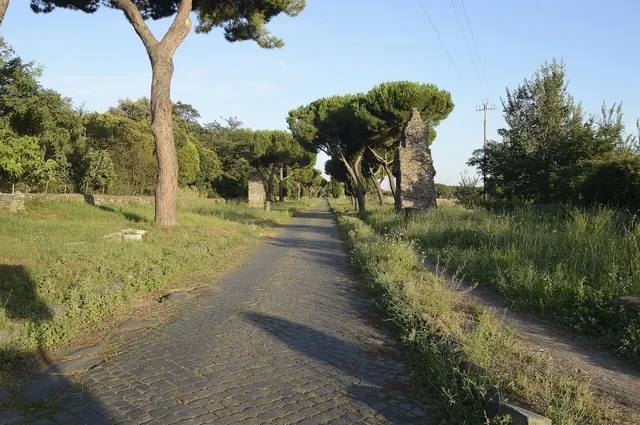
Appian Way (Via Appia Antica)
Appian Way (Via Appia Antica), RomeImage: Livioandronico2013 · CC BY-SA 4.0 · Wikimedia CommonsIn the table: Via Appia begun

According to tradition, the plebeians withdrew from the city in c. 494 BCE and secured protectors of their own, the tribunes of the plebs. A Gallic force overran and plundered Rome. A measure of c. 367 BCE, one of the Licinian–Sextian laws, admitted plebeians to the consulship. Three Samnite Wars (343 BCE–290 BCE) left Rome in control of much of Italy.

In 312 BCE work began on the Appian Way, the first and most famous of Rome's great roads, linking Rome with Capua. The Lex Hortensia of 287 BCE bound every citizen to plebeian assembly decisions and ended the Conflict of the Orders. Then Tarentum, a Greek city, called in King Pyrrhus of Epirus against Rome; he brought an army to Italy. Pyrrhus's costly victories over Rome produced the phrase "Pyrrhic victory". When the Pyrrhic War ended, Rome stood as the dominant power in Italy. Its expansion in Italy then brought Rome into conflict with Carthage.

The Punic Wars and the late Republic

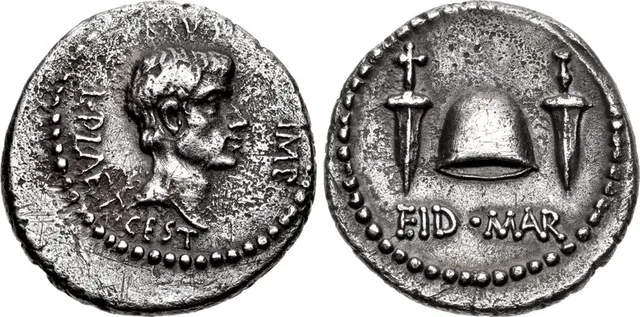
EID MAR denarius of Brutus
EID MAR denarius of Brutus, Classical Numismatic GroupImage: CNG · CC BY-SA 2.5 · Wikimedia CommonsIn the table: Assassination of Julius Caesar

When the First Punic War came to an end, Sicily passed from Carthage to Rome. In 218 BCE Hannibal crossed the Alps with a Carthaginian army and entered northern Italy. At Cannae his army encircled and crushed a Roman force, and historians call it a classic double envelopment. Scipio then invaded North Africa, which forced Hannibal to leave Italy and defend Carthage. After Hannibal lost to Scipio at Zama, Carthage accepted peace terms and surrendered its fleet. The Third Punic War ended with Rome's destruction of Carthage and the sale of the survivors into slavery.

In 133 BCE the tribune Tiberius Gracchus championed land reform on behalf of small farmers, and his opponents killed him during a riot. Later, Sulla won a civil war, made himself dictator, and reformed the Republic's government. Caesar's conquest of Gaul gave him wealth and power. Crassus's death in 53 BCE turned the rivalry between his partners Caesar and Pompey into civil war. It began in 49 BCE, when Caesar crossed the Rubicon with his army and entered Italy.

Caesar replaced Rome's old calendar with the Julian calendar. On 15 March 44 BCE, Julius Caesar was assassinated by a group of Roman nobles. The Republic came to an end with his dictatorship. His adopted heir Octavian defeated Antony and Cleopatra at Actium on 2 September 31 BCE. After Antony and Cleopatra killed themselves, Egypt came under Roman rule in 30 BCE, ending the Ptolemaic dynasty.

The Principate

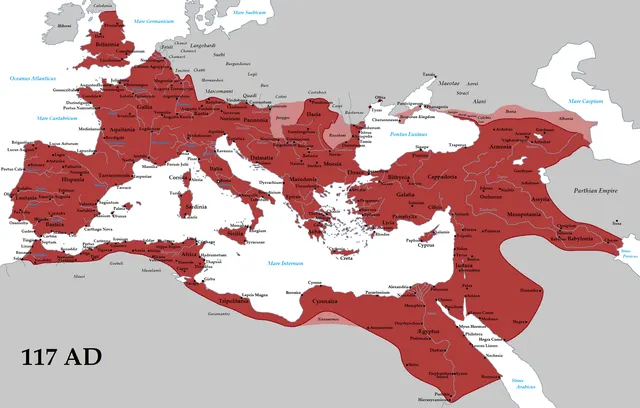
Map of the Roman Empire in 117 CE
Map of the Roman Empire in 117 CEImage: Tataryn · CC BY-SA 3.0 · Wikimedia CommonsIn the table: Dacian Wars

In 27 BCE Augustus became the first Roman emperor. He took the title princeps, meaning first citizen, and the system he created is known as the principate. Augustus laid the foundation of the Pax Romana (c. 27 BCE–c. 180 CE), a long period of relative peace. In 9 CE Arminius destroyed three Roman legions in Germany, which ended Rome's hopes of conquering Germania east of the Rhine. A great fire ravaged Rome in 64 CE, and according to ancient sources Nero blamed the Christians.

Nero died in 68 CE, and civil war followed. Vespasian founded the Flavian dynasty after winning the war in 69 CE. During the Jewish revolt, Titus besieged Jerusalem in 70 CE, and the Second Temple itself was destroyed. In 80 CE Titus opened the Colosseum with 100 days of games, an arena built over the drained lake of Nero's Golden House. Under Trajan (98 CE–117 CE), Rome conquered Dacia and made it part of the empire, then went on to annex Mesopotamia in the east. In 122 CE Hadrian began building a frontier wall that crossed northern Britain.

From 193 CE, Septimius Severus governed as a military monarch, paying the army well to hold its loyalty. In 212 CE, Caracalla gave Roman citizenship to all the free people of the empire. Then in 224 CE the Sasanians, led by Ardashir I, overthrew the Parthians, and their new Persian empire pushed into Roman Mesopotamia.

Crisis and the late empire

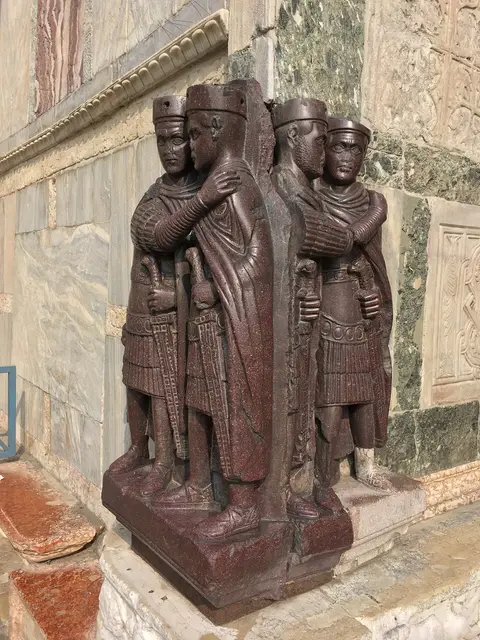
Portrait of the Four Tetrarchs
Portrait of the Four Tetrarchs, St Mark's Basilica, VeniceImage: Dimitris Kamaras · CC BY 2.0 · Wikimedia CommonsIn the table: Reign of Diocletian

In 235, soldiers killed Emperor Severus Alexander. Civil strife and short-lived emperors marked the next fifty years or so. The empire broke apart into breakaway Gallic and Palmyrene states until Aurelian defeated them both and reunited it. Diocletian, emperor from 284 CE to 305 CE, is credited with bringing the third-century crisis to an end and restoring orderly government. Judging the empire was too large for one ruler, he divided power among co-rulers in an arrangement called the tetrarchy. In 303 CE he ordered Christian scriptures burned and churches torn down, in what became the Great Persecution of Christians.

On 28 October 312 CE, Constantine's victory over Maxentius at the Milvian Bridge made him ruler of the West. In February 313 CE, Constantine and Licinius proclaimed the Edict of Milan; it gave Christians toleration throughout the empire. In 325 CE, Constantine summoned bishops to Nicaea to end the Arian controversy about Christ's nature. That gathering produced the Nicene Creed. Constantine dedicated Constantinople in 330 CE as his new imperial capital; it was a rebuilding of old Byzantium.

In 376 CE the Huns drove the Visigoths across the Danube into the empire; mistreated by Roman officials, they revolted. On 9 August 378 CE they defeated Valens's army at Adrianople; Valens was killed. In 380 CE Theodosius I declared Nicene Christianity the official faith; all Christians had to accept the Nicene creed. He died in 395 CE, leaving East and West to his two sons; no emperor after him ruled both halves. In August 410 CE Alaric's Visigoths plundered Rome for three days. In 476 CE Odoacer deposed the last western emperor, Romulus Augustulus, and became Italy's first king.

The Eastern Roman Empire after 476

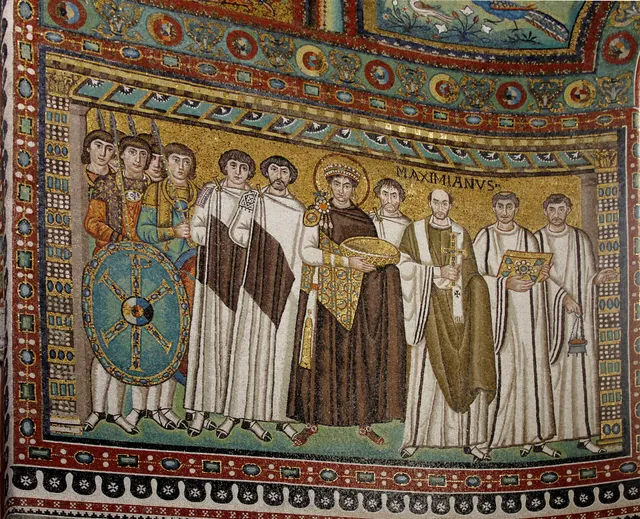
Mosaic of Justinian I
Mosaic of Justinian I, San Vitale, RavennaImage: José Luiz · CC BY-SA 4.0 · Wikimedia CommonsIn the table: Reign of Justinian I

Justinian I ruled the eastern Roman empire, known as the Byzantine Empire, from 527 to 565 CE. He had Roman law brought together as one text, the Code of Justinian, which took its revised form in 534 CE. The Nika riots of 532 CE destroyed Constantinople's earlier church; Justinian then had Hagia Sophia built in its place.

The Fourth Crusade set out for the Holy Land, but in April 1204 CE its army seized Constantinople. The sack broke the empire into separate states, and neither it nor its capital ever regained its former greatness. In 1261, forces from Nicaea, where the empire survived in exile, retook Constantinople, and Michael VIII re-established the Byzantine Empire. On 29 May 1453 CE, the Ottoman sultan Mehmed II conquered Constantinople. Its fall ended the Byzantine Empire, the Roman Empire's eastern half, and the old Roman Empire itself.

Roman Empire timeline in Chronarium, Isometric view
Chronarium, Isometric viewall 89 entries · roman-empire.chronarium.json

Entries

Entries by period

c. approximate date · ? the sources give different dates · Scope the sources date different definitions of it · rows run by start date · how the dates are checked

The Roman Kingdom

c. 753 BCE – 510 BCE · 3 entries
DateEventNote
c. 814 BCE–146 BCEPunic Carthage (Rome's neighbours)#1, 2Rome's Phoenician rival in Tunisia, later refounded as a Roman city.
c. 753 BCEFounding of Rome (Politics and rulers)#3, 4Legendary origin of the city, credited to Romulus; the traditional day is 21 April.
c. 753 BCE–c. 509 BCERoman Kingdom (Politics and rulers)#5, 4Centuries when kings governed Rome, ending when Tarquin, the final king, was driven out.

The early Republic

509 BCE – 265 BCE · 10 entries
DateEventNote
c. 509 BCERoman Republic founded (Politics and rulers)#5, 6Monarchy gives way to elected magistrates after Tarquin, the last king, is overthrown.
c. 494 BCEFirst secession of the plebs (Politics and rulers)#7, 8Plebeians walk out to the Sacred Mount; their protest wins them tribunes.
c. 451 BCE–c. 450 BCETwelve Tables (Society, culture and religion)#9, 10Rome's earliest written law code, published on bronze tablets set up in the Forum.
c. 390 BCE?Gallic sack of Rome (Rome's neighbours)#11, 12Brennus and his Gauls defeat the Romans at the Allia, then plunder the city.Sources differ: Encyclopaedia Britannica: c. 390 BCE; Wikipedia: 21 July 387 BCE; French Ministry of Education: 390 BCE.
c. 367 BCELicinian–Sextian laws (Politics and rulers)#13, 14Opened the consulship to plebeians and set limits on debt and land.
343 BCE–290 BCESamnite Wars (Wars and frontiers)#15, 16Three wars against the Samnites; Rome came to dominate central Italy.
c. 319 BCE–272 BCEPyrrhus of Epirus (Rome's neighbours)#17, 18Greek king of Epirus; his victories against Rome were costly.
312 BCEVia Appia begun (Society, culture and religion)#19, 20First great Roman road, built under the censor Appius Claudius Caecus; ran from Rome to southern Italy.
287 BCELex Hortensia (Politics and rulers)#21, 22Plebeian Council decisions now bind all citizens; ends the Conflict of the Orders.
281 BCE?–275 BCEPyrrhic War (Wars and frontiers)#23, 24Pyrrhus of Epirus leads campaigns against Rome in Sicily and southern Italy.Sources differ: Encyclopaedia Britannica: 280–275 BCE; Wikipedia: 281–275 BCE; World History Encyclopedia: 280–275 BCE.

The Punic Wars and the late Republic

264 BCE – 28 BCE · 28 entries
DateEventNote
264 BCE–241 BCEFirst Punic War (Wars and frontiers)#25, 26Rome fights Carthage over Sicily; Sicily becomes Rome's first province.
247 BCE–c. 183 BCEHannibal (Rome's neighbours)#27, 28Carthaginian general who crossed the Alps.
247 BCE–224 CEParthian Empire (Rome's neighbours)#29, 30Iranian empire to Rome's east; its forces defeated Crassus at Carrhae.
218 BCEHannibal crosses the Alps (Wars and frontiers)#28, 31Hannibal leads his army and elephants over the mountains into northern Italy.
218 BCE–201 BCESecond Punic War (Wars and frontiers)#32, 33Hannibal invades Italy; Scipio finally beats Carthage on African soil.
2 August 216 BCEBattle of Cannae (Wars and frontiers)#34, 35Hannibal encircles a larger Roman army.
202 BCEBattle of Zama (Wars and frontiers)#36, 37Scipio Africanus beats Hannibal in Tunisia, ending the war.
June 168 BCEBattle of Pydna (Rome's neighbours)#38, 39Aemilius Paullus beats King Perseus, and Macedon's monarchy ends.
149 BCE–146 BCEThird Punic War (Wars and frontiers)#40, 41Rome besieges Carthage, destroys the city and enslaves its population.
133 BCEAttalus III bequeaths Pergamon to Rome (Rome's neighbours)#42, 43The kingdom of Pergamon passes to Rome in its last king's will.
133 BCETribunate of Tiberius Gracchus (Politics and rulers)#44, 45A land-reform tribune, killed by senators in a riot.
120 BCE–63 BCEReign of Mithridates VI of Pontus (Rome's neighbours)#46, 47King of Pontus who fights three wars with Rome.
106 BCE–7 December 43 BCECicero (Society, culture and religion)#48, 49Orator, statesman and writer who defends the Republic; killed in 43 BCE.
c. 100 BCE?–15 March 44 BCEJulius Caesar (Politics and rulers)#50, 51Conquered Gaul, ruled as dictator, and was killed by senators.Sources differ: Encyclopaedia Britannica gives July 12/13, 100? BCE; World History Encyclopedia gives 12 July 100 BCE and notes 102 BCE; Encyclopedia.com gives 13 July 100 BCE.
82 BCE–79 BCE?Sulla's dictatorship (Politics and rulers)#52, 53Sulla seizes power after civil war.Sources differ: Encyclopaedia Britannica gives 82–79 BCE; World History Encyclopedia puts the end before 80 BCE, with retirement in 79 BCE; Harvard Law School gives 82–79 BCE.
73 BCE–71 BCEThird Servile War (Wars and frontiers)#54, 55The gladiator Spartacus leads a slave revolt; Crassus crushes it.
15 October 70 BCE–21 September 19 BCEVirgil (Society, culture and religion)#56, 57Author of the Aeneid, the Roman national epic.
c. 69 BCE–30 BCECleopatra VII (Rome's neighbours)#58, 59Last Ptolemaic ruler of Egypt.
23 September 63 BCE–19 August 14 CEAugustus (Politics and rulers)#60, 61Octavian, Caesar's heir, becomes the first Roman emperor.
c. 60 BCE–c. 53 BCEFirst Triumvirate (Politics and rulers)#62, 63Caesar, Pompey and Crassus form an informal alliance
58 BCE–50 BCEGallic Wars (Wars and frontiers)#64, 65Caesar conquers Gaul, with expeditions to the Rhine and Britain.
53 BCEBattle of Carrhae (Wars and frontiers)#66, 67Parthians crush the Roman army of Crassus in Mesopotamia.
49 BCECaesar crosses the Rubicon (Politics and rulers)#68, 69Caesar brings a legion into Italy, defying Senate orders.
49 BCE–45 BCECaesar's Civil War (Wars and frontiers)#50, 70Caesar beats Pompey and the forces of the Senate.
1 January 45 BCEJulian calendar takes effect (Society, culture and religion)#51, 71The 365-day solar calendar of Caesar replaces the older Roman calendar.
15 March 44 BCEAssassination of Julius Caesar (Politics and rulers)#50, 51Senators under Brutus and Cassius stab Caesar on the Ides of March.
2 September 31 BCEBattle of Actium (Wars and frontiers)#72, 73Octavian's fleet beats Antony and Cleopatra off the Greek coast.
30 BCEEgypt becomes a Roman province (Rome's neighbours)#74, 75Ptolemaic Egypt is annexed after Cleopatra's death.

The Principate

27 BCE – 234 · 25 entries
DateEventNote
c. 27 BCE–c. 180 CEPax Romana (Politics and rulers)#76, 77A long stretch of comparative calm, about 200 years
27 BCEAugustus becomes first emperor (Politics and rulers)#5, 78The Senate gives Octavian the name Augustus and the title princeps.
9 CEBattle of the Teutoburg Forest (Wars and frontiers)#79, 80Varus loses three legions to Arminius in Germany.
c. 30 CE?Crucifixion of Jesus (Society, culture and religion)#81, 82Jesus of Nazareth is executed in Jerusalem, with Roman authority over the city.Sources differ: Sources: Britannica 29–33 CE, World History Encyclopedia c. 30 CE, BYU Studies 30 CE.
43 CERoman invasion of Britain (Wars and frontiers)#83, 84Emperor Claudius starts the conquest of Britain.
54 CE–68 CEReign of Nero (Politics and rulers)#85, 86The last Julio-Claudian emperor; his reign sees the Great Fire and ends in suicide.
c. 56 CE–c. 120 CETacitus (Society, culture and religion)#87, 88Roman historian whose works include the Annals, the Histories and the Germania.
60 CE?–61 CE?Boudica's revolt in Britain (Wars and frontiers)#89, 90Boudica, queen of the Iceni, leads a rising; London and several towns are burned.Sources differ: Sources: Britannica 60 CE, World History Encyclopedia 60/61 CE, University of Warwick 60 or 61 CE.
64 CEGreat Fire of Rome (Society, culture and religion)#86, 91Much of Rome burns; blame falls on Nero; Christians are persecuted.
69 CEYear of the Four Emperors (Politics and rulers)#92, 93Galba, Otho, Vitellius, then Vespasian, rule in turn.
70 CEDestruction of the Second Temple (Wars and frontiers)#94, 95Titus captures Jerusalem during the Jewish revolt; its temple is burned.
79 CEEruption of Mount Vesuvius (Society, culture and religion)#96, 97Pompeii, Herculaneum and Stabiae are buried; Pliny the Elder perishes.
80 CEColosseum opens (Society, culture and religion)#98, 99Titus opens the Flavian Amphitheatre with games lasting 100 days.
98 CE–117 CEReign of Trajan (Politics and rulers)#100, 101Dacia is conquered and the empire grows to its largest extent.
101 CE–106 CEDacian Wars (Wars and frontiers)#102, 103Trajan conquers Dacia; its king Decebalus is defeated.
113 CETrajan's Column dedicated (Society, culture and religion)#104, 105Its spiral relief tells the story of the Dacian Wars.
117 CE–138 CEReign of Hadrian (Politics and rulers)#106, 107Consolidates the empire, builds Hadrian's Wall and rebuilds the Pantheon.
c. 118 CE–c. 128 CE?Pantheon rebuilt under Hadrian (Society, culture and religion)#108, 109Hadrian rebuilds the domed temple in Rome that Agrippa first constructed.Sources differ: Sources: Britannica 118–128 CE, World History Encyclopedia completed c. 125 CE, Getty 118/119–125/128 CE.
122 CEHadrian's Wall begun (Wars and frontiers)#110, 111Ordered by Hadrian; a frontier wall running across northern Britain.
132 CE–136 CE?Bar Kokhba revolt (Wars and frontiers)#112, 113A Jewish uprising against Hadrian in Judaea, crushed by Rome.Sources differ: Sources: Britannica 132–135 CE, Wikipedia and World History Encyclopedia 132–136 CE.
161 CE–180 CEReign of Marcus Aurelius (Politics and rulers)#114, 115The Stoic emperor; his reign faces the Marcomannic wars and the Antonine Plague.
165 CE–180 CEAntonine Plague (Society, culture and religion)#116, 117Epidemic spreading from the eastern campaigns kills millions.
193 CE–211 CEReign of Septimius Severus (Politics and rulers)#118, 119Founds the Severan dynasty and rules as a military monarchy.
212 CEConstitutio Antoniniana (Society, culture and religion)#120, 121Caracalla extends citizenship to every free inhabitant.
224 CE–651 CESasanian Empire (Rome's neighbours)#122, 123Persian empire that succeeded the Parthians; Rome's main rival in the east.

Crisis and the late empire

235 – 476 · 19 entries
DateEventNote
235 CE–284 CECrisis of the Third Century (Politics and rulers)#124, 125Decades of civil war and invasion break the empire apart before it is pulled back together.
260 CECapture of Emperor Valerian (Rome's neighbours)#126, 127Persian king Shapur I seizes Valerian; the emperor later dies as a captive.
284 CE–305 CEReign of Diocletian (Politics and rulers)#128, 129Order returns; the empire is shared under the Tetrarchy, and Christians face their final great persecution.
303 CEGreat Persecution of Christians begins (Society, culture and religion)#129, 130On Diocletian's command, churches are torn down and Christian scriptures go into the flames.
306 CE–337 CEReign of Constantine (Politics and rulers)#131, 132The first emperor to embrace Christianity; he brings the empire back together and establishes Constantinople.
28 October 312 CEBattle of the Milvian Bridge (Wars and frontiers)#133, 134Constantine overcomes Maxentius outside the city and wins control of Rome.
February 313 CEEdict of Milan (Society, culture and religion)#135, 136Constantine and Licinius give Christians freedom of worship across the empire.
325 CEFirst Council of Nicaea (Society, culture and religion)#137, 138Constantine gathers the bishops; the resulting Nicene Creed rejects Arianism.
330 CEConstantinople becomes the capital (Politics and rulers)#139, 140Constantine formally dedicates the new imperial seat on the Bosporus.
376 CEGoths cross the Danube (Rome's neighbours)#141, 142Fleeing the Huns, the Visigoths are let into Roman territory as refugees.
9 August 378 CEBattle of Adrianople (Wars and frontiers)#143, 144The Visigoths wipe out the eastern field army, and Emperor Valens is killed.
380 CEEdict of Thessalonica (Society, culture and religion)#145, 146Under Theodosius I, Nicene Christianity becomes the religion of the state.
395 CEDivision of the Roman Empire (Politics and rulers)#147, 148At the death of Theodosius I, the empire is divided between East and West.
August 410 CESack of Rome by Alaric (Wars and frontiers)#149, 150Alaric and his Visigoths loot Rome over three days.
c. 433 CE–493 CEOdoacer (Rome's neighbours)#151, 152A Germanic soldier who ended up as Italy's first king.
434 CE–453 CEReign of Attila the Hun (Rome's neighbours)#153, 154The Hunnic king strikes the Balkans, Gaul and Italy, then dies in 453.
451 CEBattle of the Catalaunian Plains (Wars and frontiers)#155, 156A Roman and Visigoth force halts Attila's Huns in Gaul.
455 CEVandals sack Rome (Rome's neighbours)#157, 158Gaiseric leads the Vandals in looting Rome.
476 CEFall of the Western Roman Empire (Politics and rulers)#151, 159Odoacer removes Romulus Augustulus, the last emperor of the West.

The Eastern Roman Empire after 476

477 – 1453 · 4 entries · selective coverage
DateEventNote
527 CE–565 CEReign of Justinian I (Politics and rulers)#160, 161From Constantinople he wins back lost lands, issues a famous law code and builds Hagia Sophia.
532 CE–537 CEHagia Sophia built (Society, culture and religion)#162, 163Justinian's great domed church rises in Constantinople.
April 1204 CESack of Constantinople by crusaders (Wars and frontiers)#164, 165The Fourth Crusade turns on the Byzantine capital and loots it.
29 May 1453 CEFall of Constantinople (Wars and frontiers)#166, 167Mehmed II and his Ottomans capture the city, and the Byzantine Empire comes to an end.

Project file

Get this timeline in Chronarium

Open this timeline in Chronarium, the Mac app for history timelines: the project file roman-empire.chronarium.json is a free download. Chronarium's 4-week free trial includes every feature and asks only for an email address, no card.

roman-empire.chronarium.jsonChronarium project file · JSON · 33 KB

CC BY 4.0: free to share and adapt, with credit to Chronarium

Download the free trial

4-week free trial. Full access, no card needed.macOS 13 or later.

Available for Mac

$39 per year · $79 lifetime

4-week free trial. Full access, no card needed.

Leave your email and we'll send the download link to open on your Mac.

Sources

Sources

Each entry rests on two published sources, with publisher and link listed below, and its date was verified against a third, independent reference.

Report a correction · email support@chronarium.app with the entry's name or its # link · how the dates are checked

  1. Encyclopaedia Britannica · britannica.com/place/Carthage-ancient-city-Tunisia
  2. World History Encyclopedia · worldhistory.org/Carthage
  3. Encyclopaedia Britannica · britannica.com/place/ancient-Rome
  4. World History Encyclopedia · worldhistory.org/Rome
  5. Encyclopaedia Britannica · britannica.com/topic/Roman-Republic
  6. World History Encyclopedia · worldhistory.org/Roman_Republic
  7. World History Encyclopedia · worldhistory.org/Secession_of_the_Plebs
  8. Wikipedia · en.wikipedia.org/wiki/Secessio_plebis
  9. Encyclopaedia Britannica · britannica.com/topic/Law-of-the-Twelve-Tables
  10. World History Encyclopedia · worldhistory.org/Twelve_Tables
  11. Encyclopaedia Britannica · britannica.com/biography/Marcus-Furius-Camillus
  12. Wikipedia · en.wikipedia.org/wiki/Sack_of_Rome_(390_BC)
  13. World History Encyclopedia · worldhistory.org/Roman_Constitution
  14. Wikipedia · en.wikipedia.org/wiki/Licinian_Rogations
  15. Encyclopaedia Britannica · britannica.com/topic/Samnite-people
  16. Wikipedia · en.wikipedia.org/wiki/Samnite_Wars
  17. Encyclopaedia Britannica · britannica.com/biography/Pyrrhus
  18. World History Encyclopedia · worldhistory.org/Pyrrhus
  19. Encyclopaedia Britannica · britannica.com/topic/Appian-Way
  20. Wikipedia · en.wikipedia.org/wiki/Appian_Way
  21. Encyclopaedia Britannica · britannica.com/topic/Lex-Hortensia
  22. Wikipedia · en.wikipedia.org/wiki/Lex_Hortensia
  23. Encyclopaedia Britannica · britannica.com/event/Pyrrhic-War
  24. Wikipedia · en.wikipedia.org/wiki/Pyrrhic_War
  25. Encyclopaedia Britannica · britannica.com/event/First-Punic-War
  26. World History Encyclopedia · worldhistory.org/First_Punic_War
  27. Encyclopaedia Britannica · britannica.com/biography/Hannibal-Carthaginian-general-247-183-BCE
  28. World History Encyclopedia · worldhistory.org/Hannibal
  29. Encyclopaedia Britannica · britannica.com/place/Parthia
  30. World History Encyclopedia · worldhistory.org/Parthian_Empire
  31. Wikipedia · en.wikipedia.org/wiki/Hannibal's_crossing_of_the_Alps
  32. Encyclopaedia Britannica · britannica.com/event/Second-Punic-War
  33. World History Encyclopedia · worldhistory.org/Second_Punic_War
  34. World History Encyclopedia · worldhistory.org/Battle_of_Cannae
  35. Wikipedia · en.wikipedia.org/wiki/Battle_of_Cannae
  36. Encyclopaedia Britannica · britannica.com/biography/Scipio-Africanus
  37. Wikipedia · en.wikipedia.org/wiki/Battle_of_Zama
  38. Encyclopaedia Britannica · britannica.com/event/Battle-of-Pydna
  39. World History Encyclopedia · worldhistory.org/Battle_of_Pydna
  40. Encyclopaedia Britannica · britannica.com/event/Third-Punic-War
  41. World History Encyclopedia · worldhistory.org/Third_Punic_War
  42. Encyclopaedia Britannica · britannica.com/biography/Attalus-III-Philometor-Euergetes
  43. World History Encyclopedia · worldhistory.org/timeline/Roman_Republic
  44. Encyclopaedia Britannica · britannica.com/biography/Tiberius-Sempronius-Gracchus
  45. World History Encyclopedia · worldhistory.org/Gracchi
  46. Encyclopaedia Britannica · britannica.com/topic/Mithradates-VI-Eupator
  47. World History Encyclopedia · worldhistory.org/Mithridates_VI
  48. Encyclopaedia Britannica · britannica.com/biography/Cicero
  49. Wikipedia · en.wikipedia.org/wiki/Cicero
  50. Encyclopaedia Britannica · britannica.com/biography/Julius-Caesar-Roman-ruler
  51. World History Encyclopedia · worldhistory.org/Julius_Caesar
  52. Encyclopaedia Britannica · britannica.com/biography/Sulla
  53. World History Encyclopedia · worldhistory.org/Sulla
  54. Encyclopaedia Britannica · britannica.com/biography/Spartacus-Roman-gladiator
  55. World History Encyclopedia · worldhistory.org/Spartacus
  56. Encyclopaedia Britannica · britannica.com/biography/Virgil
  57. World History Encyclopedia · worldhistory.org/Virgil
  58. Encyclopaedia Britannica · britannica.com/biography/Cleopatra-queen-of-Egypt
  59. World History Encyclopedia · worldhistory.org/Cleopatra_VII
  60. Encyclopaedia Britannica · britannica.com/biography/Augustus-Roman-emperor
  61. Wikipedia · en.wikipedia.org/wiki/Augustus
  62. World History Encyclopedia · worldhistory.org/First_Triumvirate
  63. Wikipedia · en.wikipedia.org/wiki/First_Triumvirate
  64. Encyclopaedia Britannica · britannica.com/event/Gallic-Wars
  65. Wikipedia · en.wikipedia.org/wiki/Gallic_Wars
  66. Encyclopaedia Britannica · britannica.com/event/Battle-of-Carrhae
  67. Wikipedia · en.wikipedia.org/wiki/Battle_of_Carrhae
  68. Encyclopaedia Britannica · britannica.com/place/Rubicon
  69. Wikipedia · en.wikipedia.org/wiki/Julius_Caesar
  70. Wikipedia · en.wikipedia.org/wiki/Caesar's_civil_war
  71. Wikipedia · en.wikipedia.org/wiki/Julian_calendar
  72. Encyclopaedia Britannica · britannica.com/event/Battle-of-Actium-ancient-Roman-history
  73. World History Encyclopedia · worldhistory.org/Battle_of_Actium
  74. Encyclopaedia Britannica · britannica.com/place/Egypt
  75. World History Encyclopedia · worldhistory.org/Roman_Egypt
  76. Encyclopaedia Britannica · britannica.com/event/Pax-Romana
  77. World History Encyclopedia · worldhistory.org/Pax_Romana
  78. World History Encyclopedia · worldhistory.org/Augustus
  79. Encyclopaedia Britannica · britannica.com/event/Battle-of-the-Teutoburg-Forest
  80. Wikipedia · en.wikipedia.org/wiki/Battle_of_the_Teutoburg_Forest
  81. Encyclopaedia Britannica · britannica.com/biography/Jesus
  82. World History Encyclopedia · worldhistory.org/Jesus_of_Nazareth
  83. Encyclopaedia Britannica · britannica.com/topic/Roman-Britain
  84. World History Encyclopedia · worldhistory.org/Roman_Britain
  85. Encyclopaedia Britannica · britannica.com/biography/Nero-Roman-emperor
  86. World History Encyclopedia · worldhistory.org/Nero
  87. Encyclopaedia Britannica · britannica.com/biography/Tacitus-Roman-historian
  88. World History Encyclopedia · worldhistory.org/Tacitus
  89. Encyclopaedia Britannica · britannica.com/biography/Boudicca
  90. World History Encyclopedia · worldhistory.org/Boudicca
  91. Wikipedia · en.wikipedia.org/wiki/Great_Fire_of_Rome
  92. Wikipedia · en.wikipedia.org/wiki/Year_of_the_Four_Emperors
  93. World History Encyclopedia · worldhistory.org/Vespasian
  94. Encyclopaedia Britannica · britannica.com/event/Siege-of-Jerusalem-70
  95. Wikipedia · en.wikipedia.org/wiki/Siege_of_Jerusalem_(70_CE)
  96. Encyclopaedia Britannica · britannica.com/topic/Vesuvius
  97. Wikipedia · en.wikipedia.org/wiki/Eruption_of_Mount_Vesuvius_in_79_CE
  98. Encyclopaedia Britannica · britannica.com/topic/Colosseum
  99. World History Encyclopedia · worldhistory.org/Colosseum
  100. Encyclopaedia Britannica · britannica.com/biography/Trajan
  101. World History Encyclopedia · worldhistory.org/Trajan
  102. World History Encyclopedia · worldhistory.org/Decebalus
  103. Wikipedia · en.wikipedia.org/wiki/Trajan's_Dacian_Wars
  104. Encyclopaedia Britannica · britannica.com/topic/Trajans-Column
  105. World History Encyclopedia · worldhistory.org/Trajans_Column
  106. Encyclopaedia Britannica · britannica.com/biography/Hadrian
  107. World History Encyclopedia · worldhistory.org/Hadrian
  108. Encyclopaedia Britannica · britannica.com/topic/Pantheon-building-Rome-Italy
  109. World History Encyclopedia · worldhistory.org/Pantheon
  110. World History Encyclopedia · worldhistory.org/Hadrians_Wall
  111. English Heritage · english-heritage.org.uk/faqs-hadrians-wall
  112. Encyclopaedia Britannica · britannica.com/event/Bar-Kokhba-Revolt
  113. Wikipedia · en.wikipedia.org/wiki/Bar_Kokhba_revolt
  114. Encyclopaedia Britannica · britannica.com/biography/Marcus-Aurelius-Roman-emperor
  115. World History Encyclopedia · worldhistory.org/Marcus_Aurelius
  116. Encyclopaedia Britannica · britannica.com/topic/10-Major-Epidemics
  117. Wikipedia · en.wikipedia.org/wiki/Antonine_Plague
  118. Encyclopaedia Britannica · britannica.com/biography/Septimius-Severus
  119. World History Encyclopedia · worldhistory.org/Septimius_Severus
  120. Encyclopaedia Britannica · britannica.com/biography/Caracalla
  121. Wikipedia · en.wikipedia.org/wiki/Constitutio_Antoniniana
  122. Encyclopaedia Britannica · britannica.com/topic/Sasanian-dynasty
  123. World History Encyclopedia · worldhistory.org/Sasanian_Empire
  124. World History Encyclopedia · worldhistory.org/Crisis_of_the_Third_Century
  125. Wikipedia · en.wikipedia.org/wiki/Crisis_of_the_Third_Century
  126. Encyclopaedia Britannica · britannica.com/biography/Valerian-Roman-emperor
  127. World History Encyclopedia · worldhistory.org/Valerian
  128. Encyclopaedia Britannica · britannica.com/biography/Diocletian
  129. World History Encyclopedia · worldhistory.org/Diocletian
  130. Wikipedia · en.wikipedia.org/wiki/Diocletianic_Persecution
  131. World History Encyclopedia · worldhistory.org/Constantine_I
  132. Wikipedia · en.wikipedia.org/wiki/Constantine_the_Great
  133. Encyclopaedia Britannica · britannica.com/event/Battle-of-the-Milvian-Bridge
  134. Wikipedia · en.wikipedia.org/wiki/Battle_of_the_Milvian_Bridge
  135. Encyclopaedia Britannica · britannica.com/event/Edict-of-Milan
  136. Wikipedia · en.wikipedia.org/wiki/Edict_of_Milan
  137. Encyclopaedia Britannica · britannica.com/event/First-Council-of-Nicaea-325
  138. Wikipedia · en.wikipedia.org/wiki/First_Council_of_Nicaea
  139. Encyclopaedia Britannica · britannica.com/biography/Constantine-I-Roman-emperor
  140. Wikipedia · en.wikipedia.org/wiki/Constantinople
  141. Encyclopaedia Britannica · britannica.com/topic/Visigoth
  142. World History Encyclopedia · worldhistory.org/Visigoths
  143. Encyclopaedia Britannica · britannica.com/event/Battle-of-Adrianople
  144. World History Encyclopedia · worldhistory.org/Battle_of_Adrianople
  145. Encyclopaedia Britannica · britannica.com/question/When-did-Christianity-become-the-official-religion-of-the-Roman-Empire
  146. Wikipedia · en.wikipedia.org/wiki/Edict_of_Thessalonica
  147. Wikipedia · en.wikipedia.org/wiki/Western_Roman_Empire
  148. Encyclopaedia Britannica · britannica.com/biography/Theodosius-I
  149. Encyclopaedia Britannica · britannica.com/biography/Alaric
  150. Wikipedia · en.wikipedia.org/wiki/Sack_of_Rome_(410)
  151. Encyclopaedia Britannica · britannica.com/biography/Odoacer
  152. World History Encyclopedia · worldhistory.org/Odoacer
  153. Encyclopaedia Britannica · britannica.com/topic/Attila-king-of-the-Huns
  154. World History Encyclopedia · worldhistory.org/Attila_the_Hun
  155. Encyclopaedia Britannica · britannica.com/event/Battle-of-the-Catalaunian-Plains
  156. Wikipedia · en.wikipedia.org/wiki/Battle_of_the_Catalaunian_Fields
  157. Encyclopaedia Britannica · britannica.com/biography/Gaiseric
  158. World History Encyclopedia · worldhistory.org/Vandals
  159. Wikipedia · en.wikipedia.org/wiki/Fall_of_the_Western_Roman_Empire
  160. Encyclopaedia Britannica · britannica.com/biography/Justinian-I
  161. World History Encyclopedia · worldhistory.org/Justinian_I
  162. Encyclopaedia Britannica · britannica.com/topic/Hagia-Sophia
  163. World History Encyclopedia · worldhistory.org/Hagia_Sophia
  164. World History Encyclopedia · worldhistory.org/Fourth_Crusade
  165. Wikipedia · en.wikipedia.org/wiki/Fourth_Crusade
  166. Encyclopaedia Britannica · britannica.com/event/Fall-of-Constantinople-1453
  167. Wikipedia · en.wikipedia.org/wiki/Fall_of_Constantinople