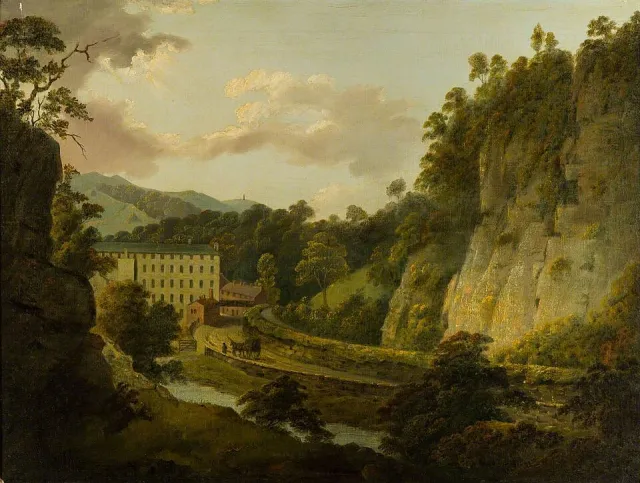
| 1800 CE | Owen takes charge of New Lanark mills (Workers, protest, factory laws and public health)#31, 49 | Cotton mills beside the Clyde in Scotland, run as a model community. |
| 1802 CE | Health and Morals of Apprentices Act (Workers, protest, factory laws and public health)#50, 51 | Britain's first factory law, brought in by Sir Robert Peel. |
| 1804 CE | Jacquard introduces his punched-card loom (Textiles and the factory system)#52, 53 | Lyon silk-weaving loom; punched cards set the warp threads. |
| 21 February 1804 CE | Trevithick's locomotive makes first railway journey (Canals, railways, ships and telecommunications)#54, 55 | Ran from Penydarren to Abercynon in south Wales carrying 10 tons of iron. |
| 9 April 1806 CE–15 September 1859 CE | Isambard Kingdom Brunel (People)#56, 57 | English engineer behind the Great Western Railway and the SS Great Britain. |
| 17 August 1807 CE | Fulton's Clermont makes maiden Hudson voyage (Canals, railways, ships and telecommunications)#58, 59 | Robert Fulton's steamboat travelled between New York City and Albany. |
| 1811 CE–1816 CE? | Luddite uprising (Workers, protest, factory laws and public health)#60, 24 | Textile workers smashed machinery across Nottinghamshire, Yorkshire and Lancashire. |
| 1813 CE | Boston Manufacturing Company is incorporated (Textiles and the factory system)#61, 62 | Cotton textiles company at Waltham, Massachusetts, founded by Francis Cabot Lowell with Boston Associates. |
| 19 January 1813 CE–15 March 1898 CE | Henry Bessemer (People)#63, 64 | English engineer known for his steel converter. |
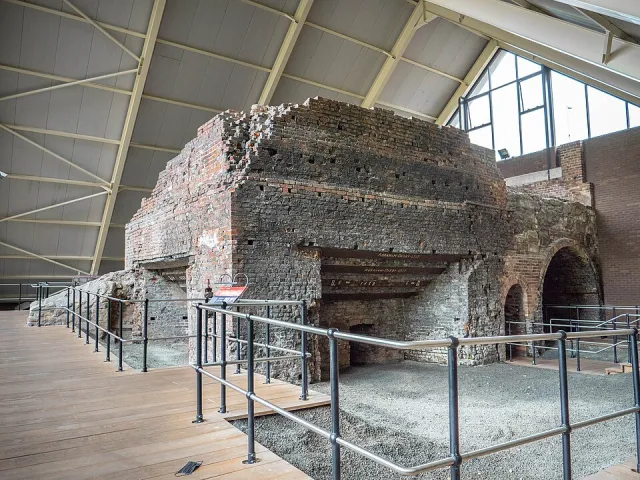
| 1817 CE | Cockerill founds Seraing ironworks (Industrialisation abroad, trade, cotton and slavery, economic writing)#65, 66 | Iron and machine works under one roof at Seraing, Belgium. |
| 5 May 1818 CE–14 March 1883 CE | Karl Marx (People)#67, 68 | German philosopher and economist who lived in London exile. |
| 16 August 1819 CE | Peterloo Massacre (Workers, protest, factory laws and public health)#69, 70 | Yeomanry charged a crowd at Manchester's St Peter's Field. |
| 28 November 1820 CE–5 August 1895 CE | Friedrich Engels (People)#71, 72 | German socialist and Manchester mill manager who collaborated with Marx. |
| 1824 CE | Combination Acts repealed (Workers, protest, factory laws and public health)#73, 74 | Trade unions made legal, though the 1825 Act restricts them. |
| 1825 CE | Roberts patents the self-acting mule (Textiles and the factory system)#35, 24 | Richard Roberts' first patent, for a self-acting spinning mule. |
| 27 September 1825 CE | Stockton and Darlington Railway opens (Canals, railways, ships and telecommunications)#75, 76 | Locomotion No. 1 hauled the first steam railway passengers. |
| 26 October 1825 CE | Erie Canal opens (Canals, railways, ships and telecommunications)#77, 78 | New York canal connecting Lake Erie with the Hudson River. |
| October 1829 CE | Rainhill Trials (Canals, railways, ships and telecommunications)#79, 80 | Stephenson's Rocket won this locomotive contest. |
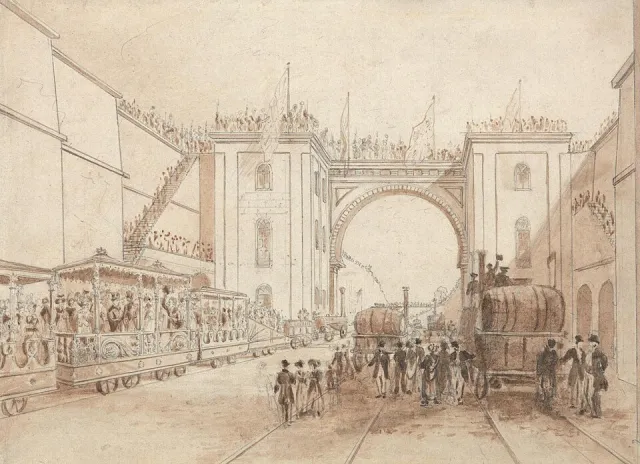
| 15 September 1830 CE | Liverpool and Manchester Railway opens (Canals, railways, ships and telecommunications)#81, 82 | First inter-city railway, running from Liverpool to Manchester. |
| 1831 CE | Faraday discovers electromagnetic induction (Power, iron, steel, chemicals and engines)#83, 84 | Changing magnetic field shown to induce a current, at the Royal Institution. |
| 1832 CE | Great Reform Act (Workers, protest, factory laws and public health)#85, 86 | Seats redistributed and electorate enlarged under the Earl Grey government. |
| 1833 CE | Factory Act limits child labour (Workers, protest, factory laws and public health)#74, 87 | Barred children under nine from textile mills. |
| 28 August 1833 CE | Slavery Abolition Act receives royal assent (Industrialisation abroad, trade, cotton and slavery, economic writing)#88, 89 | Abolished slavery across the British colonies; owners were compensated. |
| 1834 CE | Tolpuddle Martyrs sentenced to transportation (Workers, protest, factory laws and public health)#90, 91 | Six Dorset labourers transported for starting a union. |
| 1 January 1834 CE | Zollverein customs union takes effect (Industrialisation abroad, trade, cotton and slavery, economic writing)#92, 93 | A German customs union under Prussian leadership. |
| February 1834 CE | Lowell mill women strike over wage cut (Workers, protest, factory laws and public health)#94, 95 | Massachusetts women mill workers walked out over a wage cut. |
| 25 November 1835 CE–11 August 1919 CE | Andrew Carnegie (People)#96, 97 | Steel maker and philanthropist, born in Scotland, later American. |
| 7 December 1835 CE | Nuremberg-Fürth Ludwig Railway opens (Industrialisation abroad, trade, cotton and slavery, economic writing)#98, 99 | Germany's first steam railway; the locomotive Adler covered six kilometres. |
| 1836 CE | Schneider brothers buy Le Creusot ironworks (Industrialisation abroad, trade, cotton and slavery, economic writing)#100, 101 | Adolphe and Eugène Schneider acquired forges and iron mines in Burgundy. |
| 1838 CE–1848 CE | Chartism (Workers, protest, factory laws and public health)#102, 103 | Movement behind the People's Charter, pressed through mass petitions in 1839, 1842 and 1848. |