| 30 November 1874 CE–24 January 1965 CE | Winston Churchill (People)#1, 2 | Britain's prime minister in two spells, 1940 to 1945 and 1951 to 1955; gave the Iron Curtain speech. |
| 18 December 1878 CE–5 March 1953 CE | Joseph Stalin (People)#3, 4 | Head of the Soviet state until he died in 1953. |
| 8 May 1884 CE–26 December 1972 CE | Harry S. Truman (People)#5, 6 | US president from 1945 to 1953; his term brought the Truman Doctrine and the Korean War. |
| 14 November 1889 CE–27 May 1964 CE | Jawaharlal Nehru (People)#7, 8 | The first prime minister of India, he led the country on a non-aligned path. |
| 19 May 1890 CE–2 September 1969 CE | Ho Chi Minh (People)#9, 10 | Vietnam's communist leader, serving as president of North Vietnam. |
| 14 October 1890 CE–28 March 1969 CE | Dwight D. Eisenhower (People)#11, 12 | US president from 1953 to 1961; brought the Korean War to a close. |
| 7 May 1892 CE–4 May 1980 CE | Josip Broz Tito (People)#13, 14 | Yugoslavia's leader, he split with Stalin and followed a non-aligned course. |
| 26 December 1893 CE–9 September 1976 CE | Mao Zedong (People)#15, 16 | Led Communist China from 1949 to 1976. |
| April 1894 CE–11 September 1971 CE | Nikita Khrushchev (People)#17, 18 | Soviet leader from 1953 to 1964, in office during the Cuban Missile Crisis. |
| 5 March 1898 CE–8 January 1976 CE | Zhou Enlai (People)#19, 20 | China's premier from 1949 to 1976; welcomed Nixon on the 1972 visit. |
| 22 August 1904 CE–19 February 1997 CE | Deng Xiaoping (People)#21, 22 | Rose to lead China after Mao and brought in market reforms. |
| 19 December 1906 CE–10 November 1982 CE | Leonid Brezhnev (People)#23, 24 | Soviet leader from 1964 to 1982; détente and Afghanistan marked his years in power. |
| September 1909 CE–27 April 1972 CE | Kwame Nkrumah (People)#25, 26 | Ghana's first leader, a pan-African voice who kept to a non-aligned line. |
| 6 February 1911 CE–5 June 2004 CE | Ronald Reagan (People)#27, 28 | US president from 1981 to 1989; built up arms, then signed the INF Treaty. |
| 9 January 1913 CE–22 April 1994 CE | Richard Nixon (People)#29, 30 | US president from 1969 to 1974; visited China and pursued détente. |
| 29 May 1917 CE–22 November 1963 CE | John F. Kennedy (People)#31, 32 | US president from 1961 to 1963, in office for the Cuban Missile Crisis. |
| 15 January 1918 CE–28 September 1970 CE | Gamal Abdel Nasser (People)#33, 34 | Egypt's president from 1956 to 1970, tied to Suez and the non-aligned movement. |
| 18 May 1920 CE–2 April 2005 CE | Pope John Paul II (People)#35, 36 | Polish pontiff from 1978 to 2005 who supported the Solidarity movement. |
| 13 October 1925 CE–8 April 2013 CE | Margaret Thatcher (People)#37, 38 | Prime minister of Britain from 1979 to 1990, allied with Reagan. |
| 13 August 1926 CE–25 November 2016 CE | Fidel Castro (People)#39, 40 | Revolutionary who led Cuba from 1959 to 2008. |
| 2 March 1931 CE–30 August 2022 CE | Mikhail Gorbachev (People)#41, 42 | Final Soviet leader, 1985 to 1991, known for glasnost and perestroika. |
| 1945 CE–1991 CE | Cold War (Doctrines, alliances, diplomacy and decolonization)#43, 44 | US-Soviet rivalry waged through arms buildup and proxy wars rather than open war. |
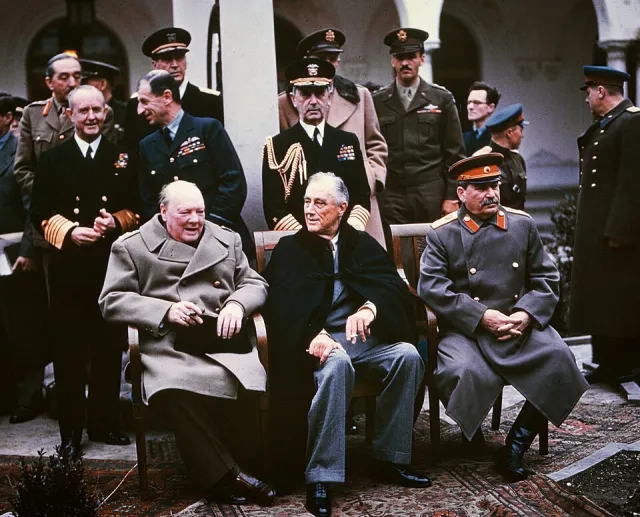
| 4 February 1945 CE–11 February 1945 CE | Yalta Conference (Doctrines, alliances, diplomacy and decolonization)#45, 46 | Big Three leaders met in Crimea to shape postwar Europe. |
| 16 July 1945 CE | Trinity nuclear test (Nuclear arms race, arms control and the space race)#47, 48 | The first nuclear explosion: a plutonium device tested in New Mexico. |
| 17 July 1945 CE–2 August 1945 CE | Potsdam Conference (Doctrines, alliances, diplomacy and decolonization)#49, 50 | Truman, Stalin, and Churchill (later Attlee) settled terms for Germany. |
| 6 August 1945 CE–9 August 1945 CE | Atomic bombings of Hiroshima and Nagasaki (Nuclear arms race, arms control and the space race)#51, 52 | American atomic bombs leveled two cities in Japan. |
| 2 September 1945 CE | Vietnam declares independence (China and the rest of Asia)#53, 54 | Ho Chi Minh announces the new Democratic Republic of Vietnam. |
| 1946 CE–1949 CE | Greek Civil War (Europe: Germany, the Eastern bloc, revolts and the end of communism)#55, 56 | Communist insurgency that helped prompt the Truman Doctrine. |
| 1946 CE–1954 CE | First Indochina War (China and the rest of Asia)#57, 58 | France fought the Viet Minh over control of Vietnam. |
| 22 February 1946 CE | Kennan's Long Telegram (Doctrines, alliances, diplomacy and decolonization)#59, 60 | Moscow-based US diplomat urged a firm policy of containing the USSR. |
| 5 March 1946 CE | Churchill's Iron Curtain speech (Doctrines, alliances, diplomacy and decolonization)#61, 62 | Speech at Fulton, Missouri warning of a Soviet-dominated Europe. |
| 14 June 1946 CE | Baruch Plan proposed (Nuclear arms race, arms control and the space race)#63, 64 | US proposal to put atomic energy under international control. |
| 12 March 1947 CE | Truman Doctrine (Doctrines, alliances, diplomacy and decolonization)#65, 66 | Truman requests congressional funding to support Greece and Turkey. |
| 5 June 1947 CE | Marshall Plan announced (Doctrines, alliances, diplomacy and decolonization)#67, 68 | Marshall outlines American assistance for rebuilding Europe in a Harvard address. |
| 14 August 1947 CE–15 August 1947 CE | India and Pakistan become independent (China and the rest of Asia)#69, 70 | British India is split in two, with Nehru as prime minister. |
| February 1948 CE | Czechoslovak coup of 1948 (Europe: Germany, the Eastern bloc, revolts and the end of communism)#71, 72 | Prague government falls to a communist takeover supported by Moscow. |
| 14 May 1948 CE | Israel declares independence (Crises and proxy wars outside Europe)#73, 74 | Ben-Gurion proclaims the new state; Washington and Moscow quickly grant recognition. |
| June 1948 CE | Yugoslavia expelled from Cominform (Europe: Germany, the Eastern bloc, revolts and the end of communism)#75, 76 | The Tito-Stalin rupture pushes Yugoslavia out of the Soviet bloc. |
| 16 June 1948 CE–July 1960 CE | Malayan Emergency (China and the rest of Asia)#77, 78 | A communist insurgency battles British-led forces after planters are killed in Perak. |
| 24 June 1948 CE–12 May 1949 CE | Berlin Blockade (Europe: Germany, the Eastern bloc, revolts and the end of communism)#79, 80 | Soviet forces seal off West Berlin; a Western airlift keeps the city supplied. |
| 4 April 1949 CE | North Atlantic Treaty signed (Doctrines, alliances, diplomacy and decolonization)#81, 82 | 12 founding members sign in Washington and form NATO. |
| 23 May 1949 CE | West Germany founded (Europe: Germany, the Eastern bloc, revolts and the end of communism)#83, 84 | The Basic Law takes effect in Bonn, establishing the Federal Republic of Germany. |
| 29 August 1949 CE | First Soviet atomic bomb test (Nuclear arms race, arms control and the space race)#85, 86 | The RDS-1 device detonates at Semipalatinsk, ending the American atomic monopoly. |
| 1 October 1949 CE | People's Republic of China proclaimed (China and the rest of Asia)#87, 88 | Mao announces communist rule while the Nationalists retreat to Taiwan. |
| 7 October 1949 CE | East Germany founded (Europe: Germany, the Eastern bloc, revolts and the end of communism)#89, 90 | The Soviet occupation zone is remade as the German Democratic Republic. |