French Revolution Timeline

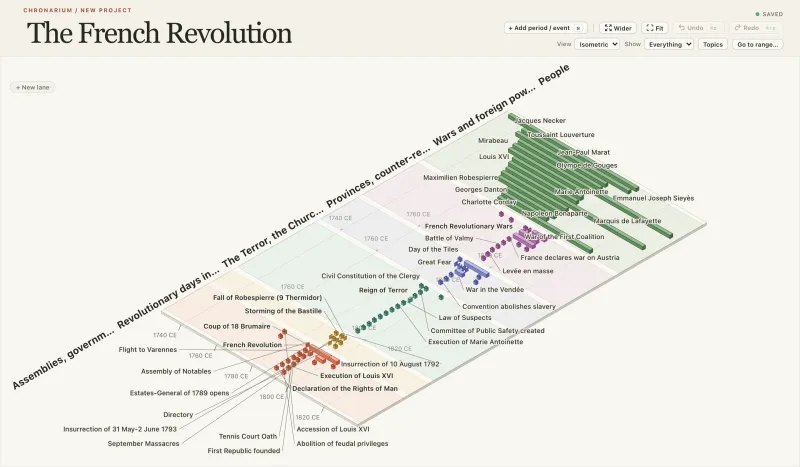
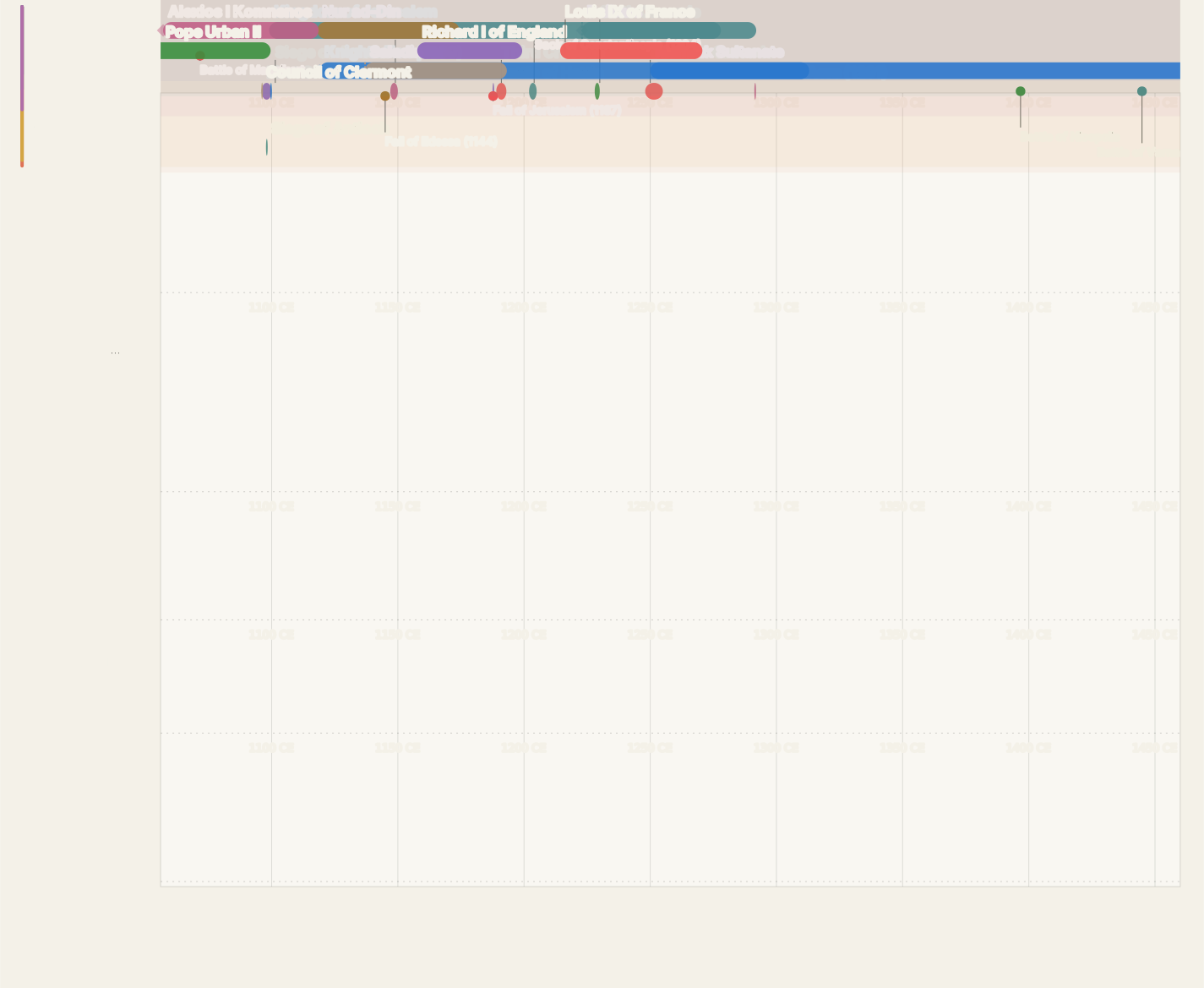
This timeline covers 1774 to 1804, from the old regime in crisis through the Consulate. Six lanes run side by side: assemblies and laws, revolutionary days in Paris, the Terror, the provinces and colonies, wars with foreign powers, and people. Sharing one time axis, they show which events at home and abroad fell in the same years.

Period covered
1774 – 1804
Entries
90
Lanes
6
Context entries
14 (1732 – 1836)

Usual dates French Revolution: 1789 CE–1799 CE

Key dates
Chronarium’s picture of the French Revolution timeline, major entries only, 1772 CE – 1806 CE. Lanes: Assemblies, governments and laws, Revolutionary days in Paris, The Terror, the Church and the calendar, Provinces, counter-revolution and colonies, Wars and foreign powers, People.

Loading the live app…

Show the whole picture
· made by Chronarium’s Export → Picture, Major only · open the SVG (200 KB)
In the picture: 33 of 90 entries (major only) · all 90 in the table belowPicture range: 1772 CE – 1806 CE

A "?" after a date in the table means the date is uncertain: published sources disagree on it. The table below lists all 90 entries, grouped under 6 period headings.

Story

Story by period

The old regime in crisis

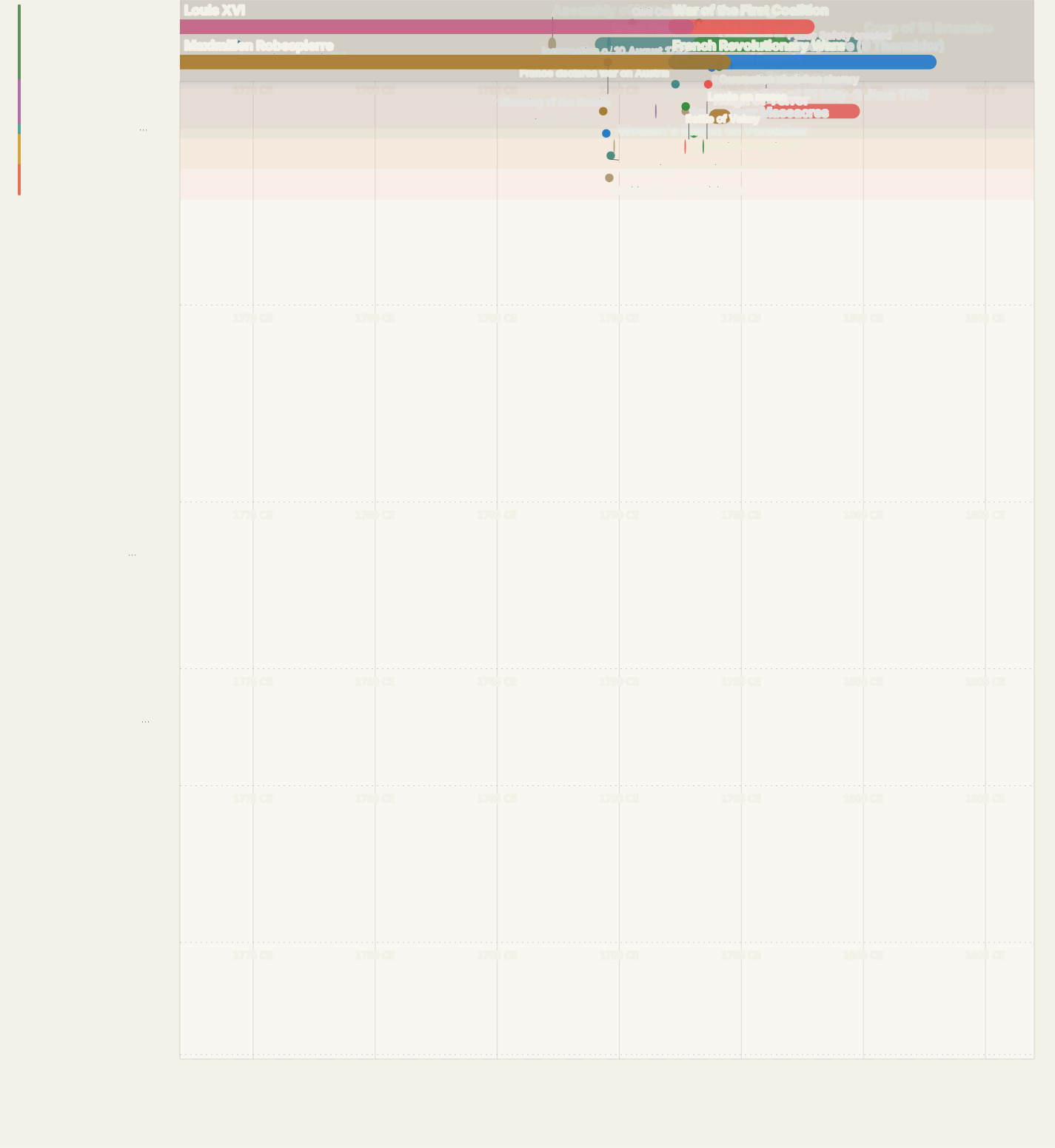
Gold louis d'or of Louis XVI, 1786
Gold louis d'or of Louis XVI, 1786, Musée Carnavalet, ParisImage: Pierre Simon Benjamin Duvivier · CC0 · Wikimedia CommonsIn the table: Louis XVI

Louis XV died on 10 May 1774, and his grandson succeeded him as Louis XVI. French society had three orders, or estates: clergy, nobility, and the Third Estate of commoners. Early in his reign, Louis XVI restored the parlements' powers, the high courts that Maupeou, chancellor to Louis XV, had cut back. After Britain beat France in the Seven Years' War, the American rebellion offered a chance to strike back. On 6 February 1778, France and the United States signed a treaty of alliance.

Finance minister Jacques Necker funded France's share of the war with loans, not new taxes. Treaties on 3 September 1783 ended the American war: Britain acknowledged U.S. independence and made peace as well with France and Spain. The cost of that war pushed the French government close to bankruptcy. Another finance minister, Calonne, offered sweeping reforms built around a new land tax reaching even the privileged clergy and nobility. In 1787 the Assembly of Notables, a body drawn mostly from privileged elites, refused to approve his plans and called instead for the Estates-General.

The parlements resisted the reforms too. Royal efforts to force them through drove the parlements into revolt. Grenoble rose in the Day of the Tiles on 7 June 1788, against a royal decree that curbed its parlement. A bad harvest deepened unrest across France as the Estates-General approached. Forced to yield, Louis XVI brought Necker back as finance minister and promised an Estates-General. The crown doubled Third Estate deputy numbers, but the orders would still act separately, not as one body.

Revolution and constitutional monarchy

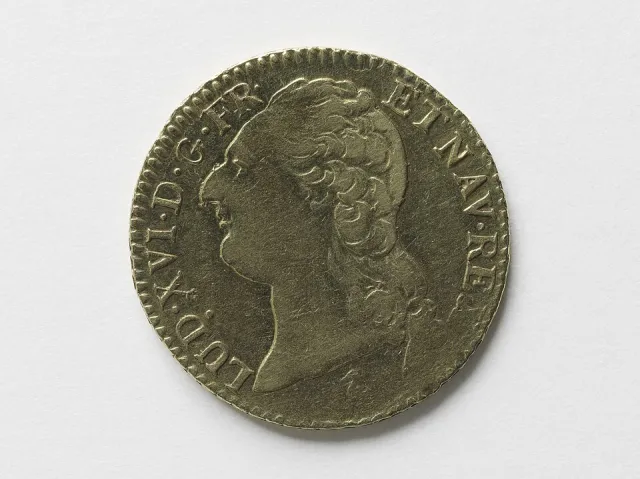
Siege and storming of the Bastille, gouache, 1789
Siege and storming of the Bastille, gouache, 1789, Musée Carnavalet, ParisImage: Jean-Pierre Houël · Public domain · Wikimedia CommonsIn the table: Storming of the Bastille

The Estates-General convened at Versailles on 5 May 1789, and votes by estate, not by head, risked leaving the Third Estate outvoted. On 17 June 1789 its deputies and allies declared themselves a National Assembly. Barred from their hall on 20 June 1789, they swore in a tennis court that they would not disband before France had a constitution. Unrest in Paris after Necker's dismissal led to the storming of the Bastille on 14 July 1789. Rumors of an aristocratic plot then drove peasant riots in the Great Fear of 1789, and the Assembly, to check them, abolished the feudal regime. The Declaration of the Rights of Man and of the Citizen stated that men are born and remain free and equal in rights.

Crowds of women from Paris marched on Versailles and made the king move to Paris. The Civil Constitution of the Clergy reorganized France's Catholic Church, and many Catholics turned against the Revolution. The king tried to escape Paris but was caught at Varennes, and he lost standing as a constitutional monarch. On 17 July 1791 the National Guard under Lafayette opened fire on a crowd at the Champ de Mars demanding abdication of the king, killing and wounding demonstrators. The Constitution of 1791 kept the monarchy weak, and a new Legislative Assembly convened under it.

War and the fall of the monarchy

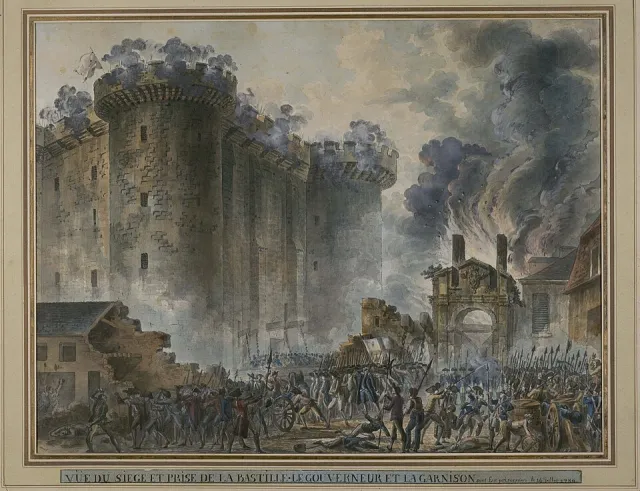
Battle of Valmy, engraving, 1833
Battle of Valmy, engraving, 1833, Musée Carnavalet, ParisImage: Joliot · CC0 · Wikimedia CommonsIn the table: Battle of Valmy

Wanting to spread the Revolution, revolutionaries drove France to declare war on Austria on 20 April 1792. Defeats came first, and many French people blamed the king. The Duke of Brunswick's manifesto threatened Paris, aiming to protect the royal family; it stiffened resistance instead. That threat helped push Parisians to storm the Tuileries, the king's palace, on 10 August 1792. They killed the king's Swiss Guards, and the rising effectively ended the monarchy.

Fear that jailed prisoners would rise up drove Paris's September Massacres. The French victory at Valmy on 20 September 1792, little more than a skirmish, stopped the Prussian-led invasion, saving the Revolution. The next day the National Convention abolished the monarchy and declared France a republic. The Republic's war aims widened, and more European powers soon entered the war against France. His secret papers discovered, former king Louis XVI was tried for treason.

The Terror

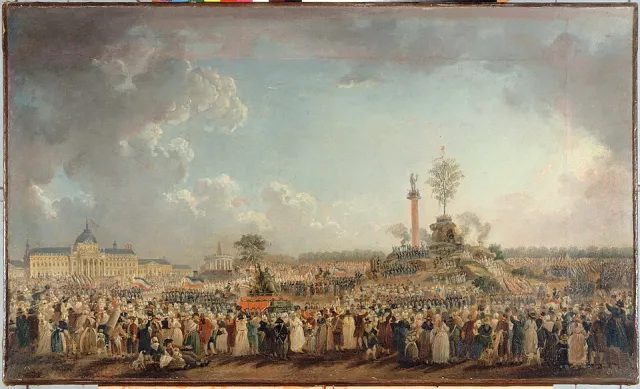
Festival of the Supreme Being, painting, about 1794
Festival of the Supreme Being, painting, about 1794, Musée Carnavalet, ParisImage: Pierre-Antoine Demachy · Public domain · Wikimedia CommonsIn the table: Festival of the Supreme Being

Louis XVI was tried and condemned to death, then executed on 21 January 1793. In the Vendée, the Republic's conscription drive sparked an uprising that grew into open revolt. On 6 April 1793 the government created a Committee of Public Safety to oversee its work. From 31 May 1793–2 June 1793, an insurrection in Paris drove the Girondin deputies from the Convention. After their fall, 'federalist' risings erupted in several parts of France.

The levée en masse, a general call-up to fight the war, required unmarried men between 18 and 25 to enlist. With internal strife and foreign armies threatening, the revolutionary government declared terror 'the order of the day' against suspected enemies. During the Terror, the Committee of Public Safety, with Robespierre as its leading figure, exercised near-dictatorial control over France. The Law of Suspects permitted the arrest of anyone whose words, contacts or conduct cast them as supporters of tyranny or as enemies of liberty. Marie Antoinette, the former queen, was tried and executed on 16 October 1793. The Convention also adopted a new republican calendar, numbering years from the Republic's founding rather than from the birth of Christ.

The Convention voted on 4 February 1794 to end slavery in the French colonies. For turning to moderation and opposing the Terror, Georges Danton was executed on 5 April 1794. After the Law of 22 Prairial of 10 June 1794, the 'Great Terror' followed, with about 1,400 people executed. The French victory at Fleurus opened the way into Belgium and made the Terror seem pointless. On 27 July 1794 (9 Thermidor) Robespierre was arrested; the next day he was guillotined with allies, Saint-Just among them. The revolt of 9 Thermidor closed the Reign of Terror and opened the Thermidorian Reaction.

The Thermidorian Convention and the Directory

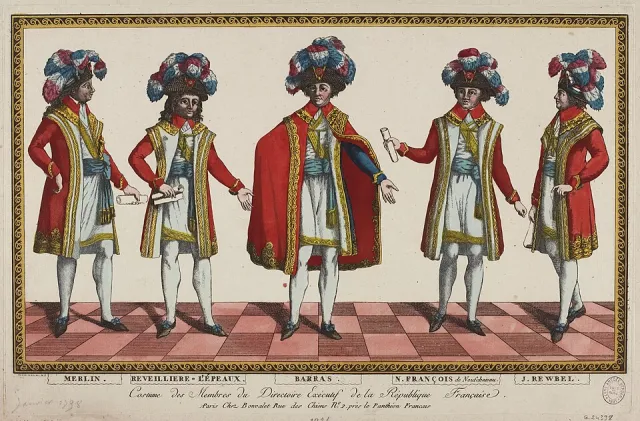
The five Directors in official costume, etching
The five Directors in official costume, etching, Musée Carnavalet, ParisImage: Unknown author · Public domain · Wikimedia CommonsIn the table: Directory

The Thermidorians ended controls on prices for bread and other necessities, causing a new economic crisis; on 20 May 1795, hungry Parisians rose in the Revolution's last popular uprising, demanding bread and the Constitution of 1793. The Constitution of Year III created a two-house legislature and the Directory, a five-man executive; keeping two-thirds of the Convention's deputies there provoked a royalist revolt in Paris. On 5 October 1795, General Napoleon Bonaparte's troops fired on royalist rebels, breaking the revolt.

Bonaparte's Italian campaign drove Austria from northern Italy and forced it to make peace. On 4 September 1797, the coup of 18 Fructidor purged royalists from the government; many were sent to Guiana. Britain still fought; Bonaparte proposed occupying Egypt to pressure British power in India. Once Bonaparte held Egypt, Nelson destroyed France's fleet at the Battle of the Nile, encouraging France's enemies toward a Second Coalition. The Fructidor coup confirmed the army's new political weight, setting a precedent for military seizure of power.

Brumaire and the Consulate

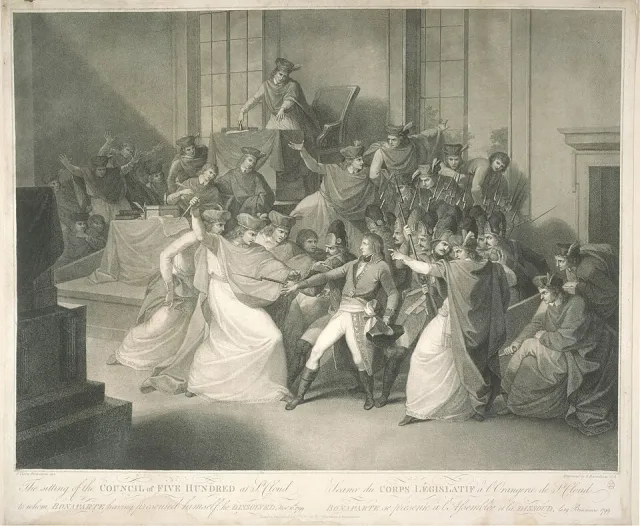
Bonaparte at the Council of Five Hundred, engraving, 1800
Bonaparte at the Council of Five Hundred, engraving, 1800, Musée Carnavalet, ParisImage: Francesco Bartolozzi · CC0 · Wikimedia CommonsIn the table: Coup of 18 Brumaire

In 1799 the Coup of 18 Brumaire saw Sieyès and Napoleon topple the Directory and establish the Consulate. Many historians regard the Brumaire coup as the Revolution's end. As First Consul, Napoleon wielded real power; the other two consuls played only a minor part. In 1801 his Concordat with the papacy reconciled France and the Catholic Church, mending the Revolution's break. After Austria made peace, Britain settled with France in the Treaty of Amiens. That peace brought Napoleon the title of First Consul for life.

In 1802 Napoleon restored slavery in some French colonies. Guadeloupe made slavery's return a fear, and Saint-Domingue's Black soldiers and farm workers rose against the French. After the French were expelled, Dessalines declared Haiti independent on 1 January 1804. On 2 December 1804, with Pope Pius VII present in Notre-Dame, Napoleon was crowned emperor and set the crown upon his own head. The First French Republic gave way to the First French Empire.

French Revolution timeline in Chronarium, Isometric view
Chronarium, Isometric viewall 90 entries · french-revolution.chronarium.json

Entries

Entries by period

c. approximate date · ? the sources give different dates · Scope the sources date different definitions of it · rows run by start date · how the dates are checked

The old regime in crisis

1774 – 1788 · 20 entries
DateEventNote
30 September 1732 CE–9 April 1804 CEJacques Necker (People)#1, 2Banker from Geneva who ran France's finances under Louis XVI.
20 May 1743 CE?–7 April 1803 CEToussaint Louverture (People)#3, 4Born enslaved, he became the general who led the revolution in Saint-Domingue.Sources differ: Wikipedia and Liverpool University Press give 20 May 1743; Encyclopedia.com has 20 May 1746? Death 7 April 1803.
24 May 1743 CE–13 July 1793 CEJean-Paul Marat (People)#5, 6Radical journalist who ran the paper 'Friend of the People'; stabbed in his bath.
1748 CE–3 November 1793 CEOlympe de Gouges (People)#7, 8Playwright who also wrote on women's rights; sent to the guillotine.
3 May 1748 CE–20 June 1836 CEEmmanuel Joseph Sieyès (People)#9, 10Author of a pamphlet on the Third Estate; later a Brumaire plotter.
9 March 1749 CE–2 April 1791 CEMirabeau (People)#11, 12Noble who became a leading orator in the National Assembly; favoured a constitutional monarchy.
23 August 1754 CE–21 January 1793 CELouis XVI (People)#13, 14King of France from 1774 to 1792; died by the guillotine.
2 November 1755 CE–16 October 1793 CEMarie Antoinette (People)#15, 16Queen of France, born in Austria; executed by guillotine.
6 September 1757 CE–20 May 1834 CEMarquis de Lafayette (People)#17, 18Commanded the National Guard and drafted the Declaration.
6 May 1758 CE–28 July 1794 CEMaximilien Robespierre (People)#19, 20Committee of Public Safety head and leading Jacobin; guillotined.
26 October 1759 CE–5 April 1794 CEGeorges Danton (People)#21, 22Orator who led the Committee early on; guillotined in 1794.
25 August 1767 CE–28 July 1794 CELouis Antoine de Saint-Just (People)#23, 24Robespierre's ally; Committee of Public Safety member.
27 July 1768 CE–17 July 1793 CECharlotte Corday (People)#25, 26Girondin sympathiser; killed Marat and went to the guillotine.
15 August 1769 CE–5 May 1821 CENapoleon Bonaparte (People)#27, 28Corsican-born general who became First Consul and then Emperor.
10 May 1774 CEAccession of Louis XVI (Assemblies, governments and laws)#13, 29Louis XV dies; his grandson takes the throne at 19.
11 June 1775 CECoronation of Louis XVI (Assemblies, governments and laws)#13, 30Crowned at Reims; the final coronation before the Revolution.
6 February 1778 CEFranco-American alliance (Wars and foreign powers)#31, 32France signs an alliance with the United States; war with Britain follows.
3 September 1783 CETreaty of Paris (1783) (Wars and foreign powers)#33, 34Britain ends the American war and signs peace with France too.
1787 CEAssembly of Notables (Assemblies, governments and laws)#35, 36Calonne gathered the notables at Versailles to approve his reforms; they refused.
7 June 1788 CEDay of the Tiles (Provinces, counter-revolution and colonies)#37, 38A Grenoble crowd blocks troops sent to shut the Parlement.

Revolution and constitutional monarchy

1789 – 1791 · 19 entries
DateEventNote
1789 CE–1799 CEFrench Revolution (Assemblies, governments and laws)#39, 38Runs from the Estates-General until Napoleon's coup; a republic replaces the monarchy.
5 May 1789 CEEstates-General of 1789 opens (Assemblies, governments and laws)#40, 30The first Estates-General since 1614 gathers at Versailles.
17 June 1789 CEThird Estate declares National Assembly (Assemblies, governments and laws)#40, 41The commons break away, claiming to speak for the nation.
20 June 1789 CETennis Court Oath (Assemblies, governments and laws)#42, 30Deputies vow to stay assembled until France gains a constitution.
1789 CEGreat Fear (Provinces, counter-revolution and colonies)#43, 44Panic sweeps the countryside as peasants attack manor houses.
11 July 1789 CENecker dismissed (Assemblies, governments and laws)#45, 30The king sacks a popular finance minister and Paris riots.
14 July 1789 CEStorming of the Bastille (Revolutionary days in Paris)#46, 47A Paris crowd takes the royal fortress and kills its governor.
4 August 1789 CEAbolition of feudal privileges (Assemblies, governments and laws)#48, 30A night session ends the feudal system, with the August Decrees following.
26 August 1789 CEDeclaration of the Rights of Man (Assemblies, governments and laws)#49, 50The assembly adopts 17 articles, later the preamble of the 1791 constitution.
5 October 1789 CE–6 October 1789 CEWomen's March on Versailles (Revolutionary days in Paris)#51, 30Market women march to Versailles and the royal family is brought to Paris.
12 July 1790 CECivil Constitution of the Clergy (The Terror, the Church and the calendar)#52, 53The assembly turns French clergy into state employees, splitting the Church.
20 June 1791 CE–21 June 1791 CEFlight to Varennes (Assemblies, governments and laws)#54, 55The royal family flees Paris but is stopped at Varennes.
17 July 1791 CEChamp de Mars massacre (Revolutionary days in Paris)#56, 30Guardsmen shoot into a crowd of people demanding a republic.
August 1791 CE–1 January 1804 CEHaitian Revolution (Provinces, counter-revolution and colonies)#57, 58Enslaved people rise up in Saint-Domingue; the colony wins independence as Haiti.
22 August 1791 CE?Saint-Domingue slave uprising (Provinces, counter-revolution and colonies)#57, 59Boukman leads a revolt of enslaved people in the colony's north.Sources differ: Wikipedia says night of 21 August; Office of the Historian and Liberty, Equality, Fraternity say 22 August 1791.
27 August 1791 CEDeclaration of Pillnitz (Wars and foreign powers)#60, 30Austria and Prussia vow to defend the French royal family.
September 1791 CEDeclaration of the Rights of Woman (Assemblies, governments and laws)#61, 62Olympe de Gouges extends the 1789 Declaration to women.
3 September 1791 CEConstitution of 1791 (Assemblies, governments and laws)#63, 30The first written constitution keeps a king with limited powers.
October 1791 CE–20 September 1792 CELegislative Assembly (Assemblies, governments and laws)#64, 41Elected under the new constitution, it sits until the monarchy falls.

War and the fall of the monarchy

1792 · 9 entries
DateEventNote
1792 CE–1797 CEWar of the First Coalition (Wars and foreign powers)#65, 66France fights Austria, Prussia, Britain and their allies.
1792 CE–1802 CEFrench Revolutionary Wars (Wars and foreign powers)#67, 68Revolutionary France fights Europe's monarchies until the peace of Amiens.
20 April 1792 CEFrance declares war on Austria (Wars and foreign powers)#67, 69The Legislative Assembly's vote opens war with the First Coalition.
25 July 1792 CEBrunswick Manifesto (Wars and foreign powers)#70, 71An allied general warns Paris of reprisals if the royal family is harmed.
10 August 1792 CEInsurrection of 10 August 1792 (Revolutionary days in Paris)#72, 30The Tuileries palace is stormed; the Swiss Guards die and the king is jailed.
2 September 1792 CE–6 September 1792 CESeptember Massacres (Revolutionary days in Paris)#73, 74Mobs murder over 1,000 prisoners held in Paris.
20 September 1792 CEBattle of Valmy (Wars and foreign powers)#75, 69French cannon fire stops the Prussian army marching on Paris.
21 September 1792 CEFirst Republic founded (Assemblies, governments and laws)#76, 30The Convention ends the monarchy and proclaims a republic.
6 November 1792 CEBattle of Jemappes (Wars and foreign powers)#77, 69A French victory over Austria leads to the occupation of Belgium.

The Terror

1793 – 1794 · 26 entries
DateEventNote
1793 CE–1796 CEWar in the Vendée (Provinces, counter-revolution and colonies)#78, 79A peasant revolt in the west, fought in the name of Church and king.
21 January 1793 CEExecution of Louis XVI (Assemblies, governments and laws)#80, 30The deposed king met the guillotine in the Place de la Révolution.
10 March 1793 CERevolutionary Tribunal established (The Terror, the Church and the calendar)#81, 71A Paris court set up to judge political crimes.
6 April 1793 CECommittee of Public Safety created (The Terror, the Church and the calendar)#82, 71The Convention formed an executive committee; Robespierre became a member later.
31 May 1793 CE–2 June 1793 CEInsurrection of 31 May-2 June 1793 (Revolutionary days in Paris)#83, 30The sans-culottes forced a purge of Girondin deputies.
2 June 1793 CEFederalist revolts begin (Provinces, counter-revolution and colonies)#84, 85Provincial cities turned on Paris once the Girondins fell.
13 July 1793 CEAssassination of Marat (The Terror, the Church and the calendar)#5, 86Charlotte Corday stabbed him in his bath.
9 August 1793 CE–9 October 1793 CESiege of Lyon (Provinces, counter-revolution and colonies)#87, 88The republican army besieged rebel Lyon until the city gave in.
23 August 1793 CELevée en masse (Wars and foreign powers)#89, 90The Convention decreed mass mobilisation of the entire population for the army.
29 August 1793 CE–19 December 1793 CESiege of Toulon (Wars and foreign powers)#91, 92Republicans recovered the royalist, British-held port; Bonaparte made his name.
5 September 1793 CE–28 July 1794 CEReign of Terror (The Terror, the Church and the calendar)#81, 71The revolutionary government turns to mass executions and political repression.Scope: Runs from terror's declaration as policy to Robespierre's execution. Other accounts open on 10 March 1793 or 17 September 1793, or close on 27 July 1794 with Robespierre's fall.
17 September 1793 CELaw of Suspects (The Terror, the Church and the calendar)#93, 71Made it possible to arrest anyone suspected of counter-revolution.
16 October 1793 CEExecution of Marie Antoinette (The Terror, the Church and the calendar)#15, 94The widowed queen was guillotined following a Revolutionary Tribunal trial.
24 October 1793 CERepublican calendar adopted (The Terror, the Church and the calendar)#95, 96New names for months and days, ten-day weeks; abolished in 1806.
30 October 1793 CEWomen's political clubs banned (Assemblies, governments and laws)#62, 97The Convention outlawed women's political clubs after Amar's report.
31 October 1793 CEExecution of the Girondins (The Terror, the Church and the calendar)#98, 7121 Girondin leaders, Brissot among them, died by the guillotine.
1793 CE–1794 CEDrownings at Nantes (Provinces, counter-revolution and colonies)#99, 100On Carrier's orders, prisoners are drowned in the Loire in large numbers.
3 November 1793 CEExecution of Olympe de Gouges (The Terror, the Church and the calendar)#7, 62A writer on women's rights, sent to the guillotine as a counter-revolutionary.
10 November 1793 CEFestival of Reason (The Terror, the Church and the calendar)#101, 71Notre-Dame cathedral is rededicated and renamed a Temple of Reason.
23 December 1793 CEBattle of Savenay (Provinces, counter-revolution and colonies)#102, 103Republican forces wipe out the Vendéens' main army.
4 February 1794 CEConvention abolishes slavery (Provinces, counter-revolution and colonies)#39, 58The decree ends slavery throughout the French colonies.
5 April 1794 CEExecution of Danton and Dantonists (The Terror, the Church and the calendar)#104, 22Danton, Desmoulins and other moderate Jacobin leaders go to the guillotine.
8 June 1794 CEFestival of the Supreme Being (The Terror, the Church and the calendar)#105, 106Robespierre establishes a state cult honouring the Supreme Being.
10 June 1794 CELaw of 22 Prairial (The Terror, the Church and the calendar)#107, 108Trials are sped up, death becomes the only sentence, and the Great Terror begins.
26 June 1794 CEBattle of Fleurus (Wars and foreign powers)#109, 110Jourdan's victory over Coburg leaves Belgium in French hands.
27 July 1794 CE–28 July 1794 CEFall of Robespierre (9 Thermidor) (Revolutionary days in Paris)#111, 20The Convention arrests Robespierre, who is guillotined the following day.

The Thermidorian Convention and the Directory

1795 – 1798 · 9 entries
DateEventNote
20 May 1795 CERevolt of 1 Prairial Year III (Revolutionary days in Paris)#112, 113The final sans-culotte rising, with a crowd invading the Convention.
27 June 1795 CE–21 July 1795 CEQuiberon expedition (Provinces, counter-revolution and colonies)#114, 115British-supported émigrés land in Brittany and are defeated by republican forces.Scope: Runs from the Carnac landing on 27 June 1795 to the royalists' surrender on 21 July 1795. Others date it from the sea battle off Groix on 23 June 1795.
5 October 1795 CERevolt of 13 Vendémiaire (Revolutionary days in Paris)#116, 117Bonaparte's cannon put down a royalist rising aimed at the Convention.
2 November 1795 CE–9 November 1799 CEDirectory (Assemblies, governments and laws)#118, 119Five directors take power on 2 November; Napoleon's coup later overthrows them.
1796 CE–1797 CENapoleon's Italian campaign (Wars and foreign powers)#120, 121Bonaparte beats the Austrians across northern Italy.
4 September 1797 CECoup of 18 Fructidor (Assemblies, governments and laws)#122, 119With army backing, the directors purge the royalist majority.
17 October 1797 CETreaty of Campo Formio (Wars and foreign powers)#123, 120Austria makes peace, ending the First Coalition's war.
1798 CE–1802 CEWar of the Second Coalition (Wars and foreign powers)#124, 125Britain, Austria and Russia fight France; the war closes at Amiens.
1798 CE–1801 CEFrench campaign in Egypt and Syria (Wars and foreign powers)#126, 120The fleet leaves Toulon; Bonaparte invades Ottoman Egypt, but French forces withdraw in 1801.

Brumaire and the Consulate

1799 – 1804 · 7 entries
DateEventNote
9 November 1799 CE–10 November 1799 CECoup of 18 Brumaire (Assemblies, governments and laws)#127, 128Napoleon and Sieyès topple the Directory; the Consulate starts.
10 November 1799 CE–18 May 1804 CEFrench Consulate (Assemblies, governments and laws)#129, 130Three consuls are appointed on 10 November, Napoleon first among them; the Empire follows.
15 July 1801 CEConcordat of 1801 (The Terror, the Church and the calendar)#131, 41Napoleon settles with Pope Pius VII over the Church's status.
25 March 1802 CETreaty of Amiens (Wars and foreign powers)#132, 120Peace between Britain and France; the Revolutionary Wars end.
20 May 1802 CELaw of 20 May 1802 on slavery (Provinces, counter-revolution and colonies)#133, 134Napoleon's law maintains slavery in the colonies handed back to France.
1 January 1804 CEHaitian declaration of independence (Provinces, counter-revolution and colonies)#135, 58Dessalines declares independence at Gonaïves; the new state takes the name Haiti.
2 December 1804 CENapoleon crowned Emperor (Assemblies, governments and laws)#136, 137The coronation is held at Notre-Dame before Pope Pius VII.

Project file

Get this timeline in Chronarium

The project file, french-revolution.chronarium.json, is a free download and opens in Chronarium, the timeline app for Mac. The 4-week free trial includes every feature and needs only an email address, no card.

french-revolution.chronarium.jsonChronarium project file · JSON · 39 KB

CC BY 4.0: free to share and adapt, with credit to Chronarium

Download the free trial

4-week free trial. Full access, no card needed.macOS 13 or later.

Available for Mac

$39 per year · $79 lifetime

4-week free trial. Full access, no card needed.

Leave your email and we'll send the download link to open on your Mac.

Sources

Sources

Every entry cites two published sources, with publisher and link on this page, and every date was verified in an independent third source.

Report a correction · email support@chronarium.app with the entry's name or its # link · how the dates are checked

  1. Wikipedia · en.wikipedia.org/wiki/Jacques_Necker
  2. World History Encyclopedia · worldhistory.org/Jacques_Necker
  3. Wikipedia · en.wikipedia.org/wiki/Toussaint_Louverture
  4. Encyclopedia.com · encyclopedia.com/humanities/encyclopedias-almanacs-transcripts-and-maps/louverture-toussaint-1746-1803
  5. Wikipedia · en.wikipedia.org/wiki/Jean-Paul_Marat
  6. Encyclopedia.com · encyclopedia.com/people/history/french-history-biographies/jean-paul-marat
  7. Wikipedia · en.wikipedia.org/wiki/Olympe_de_Gouges
  8. Encyclopedia.com · encyclopedia.com/women/encyclopedias-almanacs-transcripts-and-maps/gouges-olympe-de-1748-1793
  9. Wikipedia · en.wikipedia.org/wiki/Emmanuel_Joseph_Sieyès
  10. World History Encyclopedia · worldhistory.org/Emmanuel-Joseph_Sieyes
  11. Wikipedia · en.wikipedia.org/wiki/Honoré_Gabriel_Riqueti,_comte_de_Mirabeau
  12. Encyclopedia.com · encyclopedia.com/history/encyclopedias-almanacs-transcripts-and-maps/comte-de-mirabeau
  13. Wikipedia · en.wikipedia.org/wiki/Louis_XVI
  14. World History Encyclopedia · worldhistory.org/timeline/Louis_XVI_of_France
  15. Wikipedia · en.wikipedia.org/wiki/Marie_Antoinette
  16. Encyclopedia.com · encyclopedia.com/people/history/french-history-biographies/marie-antoinette
  17. Wikipedia · en.wikipedia.org/wiki/Gilbert_du_Motier,_Marquis_de_Lafayette
  18. World History Encyclopedia · worldhistory.org/timeline/Gilbert_du_Motier_Marquis_de_Lafayette
  19. Wikipedia · en.wikipedia.org/wiki/Maximilien_Robespierre
  20. World History Encyclopedia · worldhistory.org/timeline/Maximilien_Robespierre
  21. Wikipedia · en.wikipedia.org/wiki/Georges_Danton
  22. Encyclopedia.com · encyclopedia.com/international/encyclopedias-almanacs-transcripts-and-maps/danton-georges-jacques-1759-1794
  23. Wikipedia · en.wikipedia.org/wiki/Louis_Antoine_de_Saint-Just
  24. World History Encyclopedia · worldhistory.org/Louis_Antoine_de_Saint-Just
  25. Wikipedia · en.wikipedia.org/wiki/Charlotte_Corday
  26. Encyclopedia.com · encyclopedia.com/women/encyclopedias-almanacs-transcripts-and-maps/corday-charlotte-1768-1793
  27. Wikipedia · en.wikipedia.org/wiki/Napoleon
  28. History.com · history.com/topics/european-history/napoleon
  29. World History Encyclopedia · worldhistory.org/Louis_XVI_of_France
  30. World History Encyclopedia · worldhistory.org/timeline/French_Revolution
  31. U.S. Department of State, Office of the Historian · history.state.gov/milestones/1776-1783/french-alliance
  32. Wikipedia · en.wikipedia.org/wiki/France_in_the_American_Revolutionary_War
  33. U.S. National Archives · archives.gov/milestone-documents/treaty-of-paris
  34. Wikipedia · en.wikipedia.org/wiki/Treaty_of_Paris_(1783)
  35. Wikipedia · en.wikipedia.org/wiki/Assembly_of_Notables
  36. World History Encyclopedia · worldhistory.org/Assembly_of_Notables_of_1787
  37. Wikipedia · en.wikipedia.org/wiki/Day_of_the_Tiles
  38. World History Encyclopedia · worldhistory.org/French_Revolution
  39. Wikipedia · en.wikipedia.org/wiki/French_Revolution
  40. Wikipedia · en.wikipedia.org/wiki/Estates_General_of_1789
  41. Encyclopedia.com · encyclopedia.com/history/modern-europe/french-history/french-revolution
  42. Wikipedia · en.wikipedia.org/wiki/Tennis_Court_Oath
  43. Wikipedia · en.wikipedia.org/wiki/Great_Fear
  44. World History Encyclopedia · worldhistory.org/Great_Fear
  45. Encyclopedia.com · encyclopedia.com/people/history/french-history-biographies/jacques-necker
  46. Wikipedia · en.wikipedia.org/wiki/Storming_of_the_Bastille
  47. World History Encyclopedia · worldhistory.org/Storming_of_the_Bastille
  48. Wikipedia · en.wikipedia.org/wiki/August_Decrees
  49. Wikipedia · en.wikipedia.org/wiki/Declaration_of_the_Rights_of_Man_and_of_the_Citizen
  50. World History Encyclopedia · worldhistory.org/article/2012/declaration-of-the-rights-of-man-and-of-the-citize
  51. Wikipedia · en.wikipedia.org/wiki/Women's_March_on_Versailles
  52. Wikipedia · en.wikipedia.org/wiki/Civil_Constitution_of_the_Clergy
  53. World History Encyclopedia · worldhistory.org/Civil_Constitution_of_the_Clergy
  54. Wikipedia · en.wikipedia.org/wiki/Flight_to_Varennes
  55. World History Encyclopedia · worldhistory.org/Flight_to_Varennes
  56. Wikipedia · en.wikipedia.org/wiki/Champ_de_Mars_massacre
  57. Wikipedia · en.wikipedia.org/wiki/Haitian_Revolution
  58. Encyclopedia.com · encyclopedia.com/history/encyclopedias-almanacs-transcripts-and-maps/haitian-revolution-overview
  59. U.S. Department of State, Office of the Historian · history.state.gov/milestones/1784-1800/haitian-rev
  60. Wikipedia · en.wikipedia.org/wiki/Declaration_of_Pillnitz
  61. Wikipedia · en.wikipedia.org/wiki/Declaration_of_the_Rights_of_Woman_and_of_the_Female_Citizen
  62. Liberty, Equality, Fraternity: Exploring the French Revolution · revolution.chnm.org/exhibits/show/liberty--equality--fraternity/women-and-the-revolution
  63. Wikipedia · en.wikipedia.org/wiki/French_Constitution_of_1791
  64. Wikipedia · en.wikipedia.org/wiki/Legislative_Assembly_(France)
  65. Wikipedia · en.wikipedia.org/wiki/War_of_the_First_Coalition
  66. World History Encyclopedia · worldhistory.org/timeline/War_of_the_First_Coalition
  67. Wikipedia · en.wikipedia.org/wiki/French_Revolutionary_Wars
  68. World History Encyclopedia · worldhistory.org/French_Revolutionary_Wars
  69. Encyclopedia.com · encyclopedia.com/history/encyclopedias-almanacs-transcripts-and-maps/french-revolutionary-wars-and-napoleonic-wars
  70. Wikipedia · en.wikipedia.org/wiki/Brunswick_Manifesto
  71. World History Encyclopedia · worldhistory.org/timeline/Reign_of_Terror
  72. Wikipedia · en.wikipedia.org/wiki/10_August_(French_Revolution)
  73. Wikipedia · en.wikipedia.org/wiki/September_Massacres
  74. World History Encyclopedia · worldhistory.org/September_Massacres
  75. Wikipedia · en.wikipedia.org/wiki/Battle_of_Valmy
  76. Wikipedia · en.wikipedia.org/wiki/French_First_Republic
  77. Wikipedia · en.wikipedia.org/wiki/Battle_of_Jemappes
  78. Wikipedia · en.wikipedia.org/wiki/War_in_the_Vendée
  79. World History Encyclopedia · worldhistory.org/War_in_the_Vendee
  80. Wikipedia · en.wikipedia.org/wiki/Execution_of_Louis_XVI
  81. Wikipedia · en.wikipedia.org/wiki/Reign_of_Terror
  82. Wikipedia · en.wikipedia.org/wiki/Committee_of_Public_Safety
  83. Wikipedia · en.wikipedia.org/wiki/Insurrection_of_31_May_–_2_June_1793
  84. Wikipedia · en.wikipedia.org/wiki/Federalist_revolts
  85. World History Encyclopedia · worldhistory.org/timeline/Federalist_Revolts
  86. World History Encyclopedia · worldhistory.org/Charlotte_Corday
  87. Wikipedia · en.wikipedia.org/wiki/Siege_of_Lyon
  88. World History Encyclopedia · worldhistory.org/timeline/Revolt_of_Lyon
  89. Wikipedia · en.wikipedia.org/wiki/Levée_en_masse
  90. Encyclopedia.com · encyclopedia.com/history/encyclopedias-almanacs-transcripts-and-maps/levee-en-masse
  91. Wikipedia · en.wikipedia.org/wiki/Siege_of_Toulon
  92. World History Encyclopedia · worldhistory.org/timeline/Napoleon_Bonaparte
  93. Wikipedia · en.wikipedia.org/wiki/Law_of_Suspects
  94. World History Encyclopedia · worldhistory.org/timeline/Marie_Antoinette
  95. Wikipedia · en.wikipedia.org/wiki/French_Republican_calendar
  96. World History Encyclopedia · worldhistory.org/French_Republican_Calendar
  97. Library of Congress · blogs.loc.gov/international-collections/2020/07/women-in-the-french-revolution-from-the-salons-to-the-streets
  98. Encyclopedia.com · encyclopedia.com/history/encyclopedias-almanacs-transcripts-and-maps/girondins
  99. Wikipedia · en.wikipedia.org/wiki/Drownings_at_Nantes
  100. World History Encyclopedia · worldhistory.org/Drownings_at_Nantes
  101. Wikipedia · en.wikipedia.org/wiki/Cult_of_Reason
  102. Wikipedia · en.wikipedia.org/wiki/Battle_of_Savenay
  103. World History Encyclopedia · worldhistory.org/timeline/War_in_the_Vendee
  104. World History Encyclopedia · worldhistory.org/timeline/Georges_Danton
  105. Wikipedia · en.wikipedia.org/wiki/Festival_of_the_Supreme_Being
  106. World History Encyclopedia · worldhistory.org/Cult_of_the_Supreme_Being
  107. Wikipedia · en.wikipedia.org/wiki/Law_of_22_Prairial
  108. Liberty, Equality, Fraternity: Exploring the French Revolution · revolution.chnm.org/d/439
  109. Wikipedia · en.wikipedia.org/wiki/Battle_of_Fleurus_(1794)
  110. World History Encyclopedia · worldhistory.org/article/2213/battle-of-fleurus
  111. Wikipedia · en.wikipedia.org/wiki/Coup_of_9_Thermidor
  112. Wikipedia · en.wikipedia.org/wiki/Revolt_of_1_Prairial_Year_III
  113. World History Encyclopedia · worldhistory.org/Prairial_Uprising
  114. Wikipedia · en.wikipedia.org/wiki/Quiberon_expedition
  115. L'Histoire par l'image · histoire-image.org/etudes/combats-quiberon
  116. Wikipedia · en.wikipedia.org/wiki/13_Vendémiaire
  117. World History Encyclopedia · worldhistory.org/13_Vendemiaire
  118. Wikipedia · en.wikipedia.org/wiki/Directory_(France)
  119. World History Encyclopedia · worldhistory.org/French_Directory
  120. World History Encyclopedia · worldhistory.org/timeline/French_Revolutionary_Wars
  121. EBSCO Research Starters · ebsco.com/research-starters/history/napoleon-rises-power-france
  122. Wikipedia · en.wikipedia.org/wiki/Coup_of_18_Fructidor
  123. Wikipedia · en.wikipedia.org/wiki/Treaty_of_Campo_Formio
  124. Wikipedia · en.wikipedia.org/wiki/War_of_the_Second_Coalition
  125. World History Encyclopedia · worldhistory.org/War_of_the_Second_Coalition
  126. Wikipedia · en.wikipedia.org/wiki/French_invasion_of_Egypt
  127. Wikipedia · en.wikipedia.org/wiki/Coup_of_18_Brumaire
  128. World History Encyclopedia · worldhistory.org/Coup_of_18_Brumaire
  129. Wikipedia · en.wikipedia.org/wiki/French_Consulate
  130. World History Encyclopedia · worldhistory.org/French_Consulate
  131. Wikipedia · en.wikipedia.org/wiki/Concordat_of_1801
  132. Wikipedia · en.wikipedia.org/wiki/Treaty_of_Amiens
  133. Wikipedia · en.wikipedia.org/wiki/Law_of_20_May_1802
  134. Bibliothèque nationale de France · heritage.bnf.fr/france-ameriques/en/1802-expedition-saint-domingue-haiti-and-louisiana-purchase
  135. Wikipedia · en.wikipedia.org/wiki/Haitian_Declaration_of_Independence
  136. Wikipedia · en.wikipedia.org/wiki/Coronation_of_Napoleon_I
  137. World History Encyclopedia · worldhistory.org/article/2251/coronation-of-napoleon-i